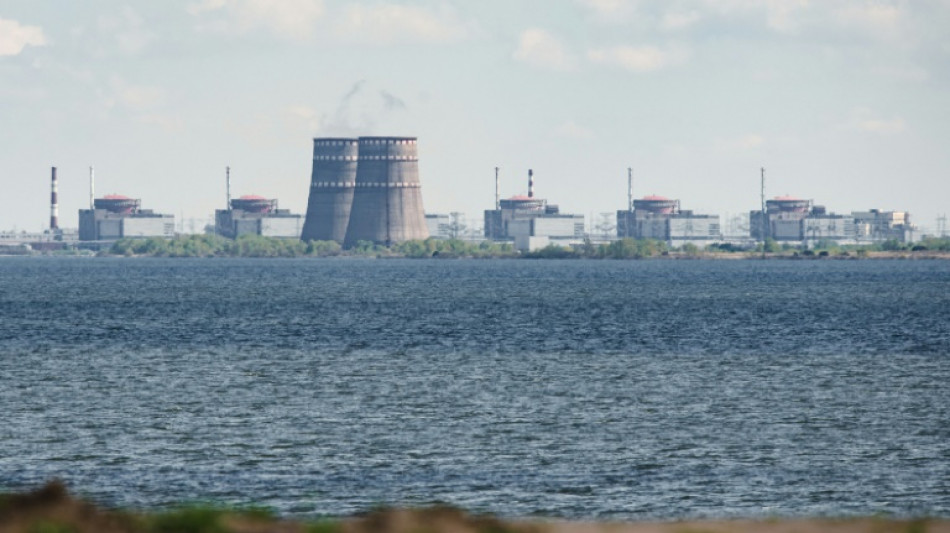
Standoff at strategic Ukraine river eyed by Russian troops / Photo: Ed JONES - AFP

 Martin wins Austrian MotoGP sprint after Acosta crash

 Japan edge Fiji to win Pacific Nations Cup
 Black smoke, flames rising near Riyadh airport: residents to AFP

 UK actor Naomi Watts honoured at Spain film festival
 Japan emperor declares Asian Games open after turbulent build-up

 Asian Games open with unity message after troubled build-up
 Denmark hails 'binding' Greenland deal with Trump
 We don't want Games host Japan losing money, says Asian Olympic official
 Ed Sheeran returns to stage after Palestinian controversy

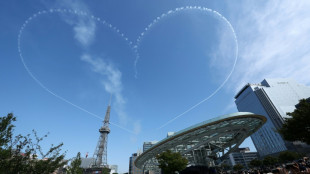 Asian Games to open in Japan after troubled build-up
 Drone owners rush to offload devices ahead of Beijing ban

 Trump's beef policies irk Texas ranchers, testing their loyalty

 Kennedy Center: future unclear for iconic Washington arts hub

 Trump claims 'infinite' Greenland security deal with Denmark

 Helicopters battle wildfire threatening Ecuador's capital

 Brentford batter Chelsea to undo Alonso's promising start

 Kane hits Bundesliga century as Bayern rout Union

 Trump says CNN, MS NOW, Politico banned from White House
 Hushing and hedging: US companies retreat on climate

 Springboks to face Fiji before 2027 Rugby World Cup
 Nigeria miners struggled to breathe in cell before 37 died: survivors

 McIlroy on the charge at PGA Championship as Reed withdraws

 McIlroy on the charge at PGA Championship

 Crisis-wracked Volkswagen warns of 10-bn-euro hit to profits

 Costa Rica's Grynspan tops third informal poll for UN chief: diplomat

On the municipal beach at Nikopol in southern Ukraine, barbed wire, sand bags and other defences have replaced children playing on the sand.
Bang opposite, the Russians control the other bank of the Dnipro, the river that divides Ukraine between east and west.
Planted in the sand is a slightly rusty sign asking people to pay attention -- a polite warning requesting not to disturb a neighbour relaxing on a towel, to keep a ball under control.
It is a reminder of carefree days before February 24 when Russia invaded Ukraine.
Then at the beginning of March, Russian troops captured Energodar, the largest nuclear power plant in Europe, located just opposite Nikopol.
Clashes at the plant raised the spectre of a catastrophe similar to that of Chernobyl in 1986.
But apart from a burned out administrative building, the six reactors seemed intact when Russian troops took journalists on a tour.
For Nikopol's residents, the broad expanse of the Dnipro has become a natural border with the Russians.
"It's forbidden to enter the water. It's too dangerous," a soldier told AFP.
On the beach, everything appears ready to take on enemy soldiers if they decide to cross the river, with barbed wire and sand bags stacked high.
- Repeated setbacks -
At a nearby sports club, the owner Alexander Zagrydny, has set up a telescope that allows members to survey the other bank.
"We no longer see Russian armoured vehicles. We're a bit relieved," he said.
But he's frustrated that he can no longer sail.
"I cannot imagine my life without the Dnipro. I have been navigating it since I was a child," sighed the athletic 50-something whose wife left Nikopol with other residents to avoid the risk of war.
Control of the Dnipro was seen as a major Kremlin objective in the first days of the war.
Some 2,300-kilometres long, the river, which rises in Russia before meandering past Belarus, travels more than 1,000 kilometres (600 miles) through Ukraine to the Black Sea.
"Once you control the points of passage along the Dnipro, that gives you real freedom of action between the east and west of Ukraine," said a Western military expert at the end of February when the Russian army seemed poised to conquer Kyiv.
But Russian troops met with repeated setbacks on the northern front and withdrew to concentrate on Donbas, the eastern territory where Russian-backed separatists have been at war with Kyiv since 2014, and on the south.
- 'Defensive boundary' -
"While before there was perhaps talk about how Russia would move up to the Dnipro trying to lock that down and proceed westward, now it looks more like a defensive boundary that can help Russia fortify what it already has," said Andrew Lohsen, an analyst for the the Center for Strategic and International Studies in Washington.
To take the Dnipro river cities of Zaporizhzhia and Dnipro, whose pre-war populations numbered 800,000 people and one million respectively, "would be very difficult combat considering how poorly they failed in other attempts to take cities," he said.
Unless of course, the Russians destroy these cities like the southern port of Mariupol, Lohsen said, pointing out that Zaporizhzhia has one of the six hydroelectric dams on the river, whose destruction would trigger catastrophic consequences as the Energodar nuclear power plant lies dozens of kilometres downstream.
Anatoliy Kovalyov, the rector of the Odessa National University of Economy, said the Dnipro is a lifeline for Ukraine and accounts for 10 percent of total electrical output.
Thirty bridges link the east, rich in mining resources, with western Ukraine, where they are processed and transformed.
"Ukraine's entire economy depends on transport" between the two banks, Kovalyov said.
"The most important task" for the Ukrainian forces now is to "protect the bridges", which will guarantee the preservation of a "solid and united state."
E.Hall--AT



