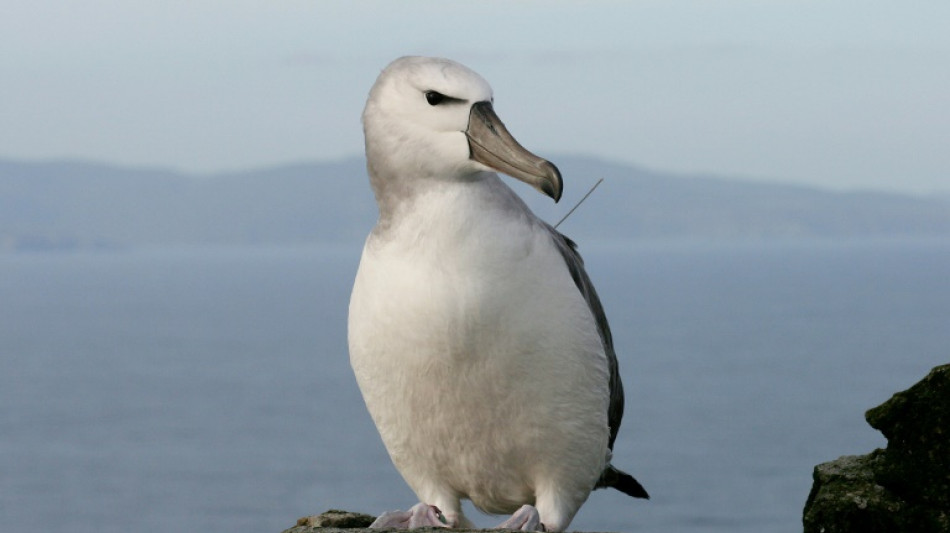
S.Africa plan to 'bomb' mice that eat alabatrosses alive / Photo: STR - AFP

 South African election results renew debate over identity-based voting

 South African voters report smoother local election but declining IEC trust

 Dolly Parton museum and Nashville hotel open after singer’s death

 George and Amal Clooney attend New York political-comedy reading
 British buyers pay substantial premiums for period-home appearance

 Thomas Markle released to house arrest after child-abuse-image charge

 Dawn of War 4 developers chose Adeptus Mechanicus for tactical variety

 Italy face unbeaten South Africa in Turin Nations Championship match

 ChatGPT interactive interface feature tested across six custom tools

 Freshways milk-price cut deepens pressure on UK dairy farms

 Labour and National remain virtually tied as New Zealand vote count advances

 The Good Daughter adapts Karin Slaughter thriller with Rose Byrne and Meghann Fahy

 Heavy-lift drone evacuates wounded Ukrainian soldier from frontline kill zone

 Morrison says West Brom recovered after pressure from successive derby losses

 Britain considers 2027 state visit for Ukraine’s Zelensky

 Survey Finds Majority of Brits Use Polite Language with AI Assistants

Conservationists said Saturday that they plan to bomb a remote South African island with tonnes of pesticide-laced pellets to kill mice that are eating albatrosses and other seabirds alive.
Hordes of mice are devouring the eggs of some of the world's most important seabirds that nest on Marion Island, about 2,000 kilometres (1,240 miles) southeast of Cape Town, and have started eating live birds, leading conservationist Mark Anderson said.
This includes the iconic Wandering Albatross, with a quarter of the world's population nesting on the Indian Ocean island.
"The mice have now, for the first time last year, been found to be feeding on adult Wandering Albatrosses," Anderson told a meeting of BirdLife South Africa, the country's leading bird conservation organisation.
Gruesome images presented at the meeting showed bloodied birds, some with flesh chewed off their heads.
Of the 29 species of seabirds that breed on the island, 19 are threatened with local extinction, the Mouse-Free Marion Project said.
Mouse attacks have escalated in recent years but the birds do not know how to respond because they evolved without terrestrial predators, said Anderson, a leader of the project and CEO of BirdLife South Africa.
"Mice just climb onto them and just slowly eat them until they succumb," he told AFP. It can take days for a bird to die. "We are losing hundreds of thousands of seabirds every year through the mice."
- Extreme conditions -
Billed as one of the world's most important bird conservation efforts, the Mouse-Free Marion Project has raised about a quarter of the $29 million it needs to send a squad of helicopters to drop 600 tonnes of rodenticide-laced pellets onto the rugged island.
It wants to strike in 2027 in winter, when the mice are most hungry and the summer-breeding birds are largely absent.
The pilots will have to fly in extreme conditions and reach every part of the island, which is about 25 kilometres long and 17 kilometres wide.
"We have to get rid of every last mouse," Anderson said. "If there was a male and female remaining, they could breed and eventually get back to where we are now."
The mice are proliferating because warmer temperatures due to climate change means they are breeding more frequently over a longer period, Anderson said. After eating through plants and invertebrates, the mice turned to the birds.
House mice were introduced to the island in the early 1800s. Five cats were brought in around 1948 to control their numbers. But the cat numbers grew to about 2,000 and they were killing about 450,000 birds a year. An eradication project removed the last cat in 1991.
H.Romero--AT