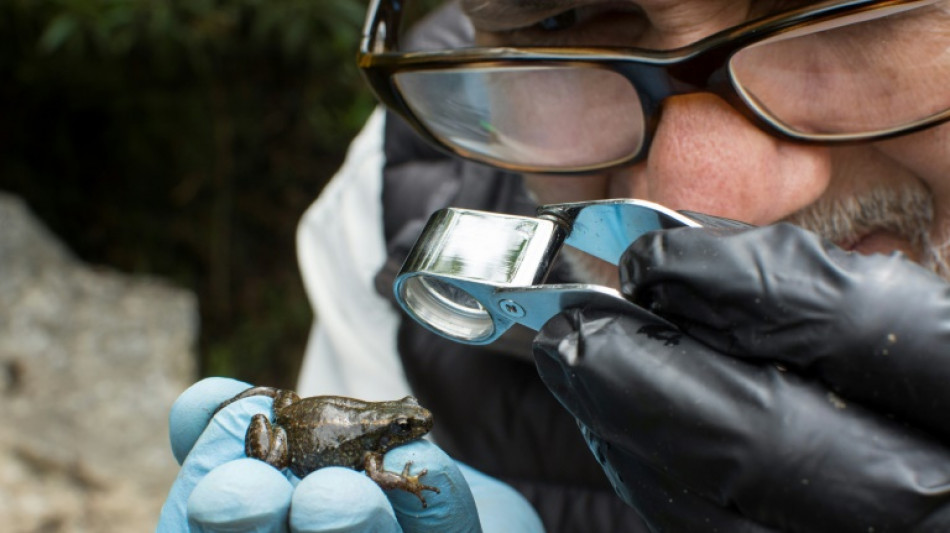
Please don't croak: Setting the mood to save Venezuelan frog / Photo: Miguel ZAMBRANO - AFP

 Martin wins Austrian MotoGP sprint after Acosta crash

 Japan edge Fiji to win Pacific Nations Cup

 Black smoke, flames rising near Riyadh airport: residents to AFP
 UK actor Naomi Watts honoured at Spain film festival

 Japan emperor declares Asian Games open after turbulent build-up

 Asian Games open with unity message after troubled build-up

 Denmark hails 'binding' Greenland deal with Trump

 We don't want Games host Japan losing money, says Asian Olympic official

 Ed Sheeran returns to stage after Palestinian controversy

 Asian Games to open in Japan after troubled build-up

 Drone owners rush to offload devices ahead of Beijing ban

 Trump's beef policies irk Texas ranchers, testing their loyalty

 Kennedy Center: future unclear for iconic Washington arts hub

 Trump claims 'infinite' Greenland security deal with Denmark

 Helicopters battle wildfire threatening Ecuador's capital

 Brentford batter Chelsea to undo Alonso's promising start

 Kane hits Bundesliga century as Bayern rout Union

 Trump says CNN, MS NOW, Politico banned from White House

 Hushing and hedging: US companies retreat on climate

 Springboks to face Fiji before 2027 Rugby World Cup

 Nigeria miners struggled to breathe in cell before 37 died: survivors

 McIlroy on the charge at PGA Championship as Reed withdraws

 McIlroy on the charge at PGA Championship

 Crisis-wracked Volkswagen warns of 10-bn-euro hit to profits

 Costa Rica's Grynspan tops third informal poll for UN chief: diplomat

Enormous expectations rest on the tiny endangered amphibian perched on a rock in a plastic box: the Mucuchies' Frog needs to produce offspring if its species is to survive.
The dark, spotted creature is categorized as "critically endangered" on the Red List of threatened species of the International Union for Conservation of Nature (IUCN) -- the last step before an animal is declared "extinct in the wild."
But there is cause for hope.
Driven by a "passion" to save the unassuming two-centimeter (0.8-inch) critter, biologist Enrique La Marca and a team launched a breeding project at the REVA amphibian conservation center in Merida in Venezuela's northwest.
To date, some two dozen captured adults have created about 100 tiny jumpers released into nature, said La Marca -- more or less doubling the previously known number of Mucuchies' Frogs in the wild.
That should help the species, which according to the Red List, has seen 98 percent of its habitat in the forests of the Venezuelan Andes lost to deforestation.
Today, its entire population is limited to an area smaller than 10 square kilometers (3.9 square miles.)
- Streams dried up -
"Most of the population disappeared... between 15 and 25 years ago" from areas around the region of Mucuchies where it was once abundant, said La Marca.
The main reasons, according to the IUCN: crops and aquaculture encroaching on nature and polluting water sources, as well as the abstraction of surface water for irrigation.
"There are streams that have dried up and springs that have decreased significantly... All this has a negative impact on organisms that are directly associated with water," La Marca told AFP.
The Mucuchies' Frog is a species that breeds during the wet season, laying eggs onto leaf litter.
The male protects the eggs until they hatch, then carries the tadpoles on his back and releases them into small pools where they complete their development.
- Frog song, 'greatest joy' -
But before the REVA project started in 2018, "we didn’t know what it (the frog) fed on, what reproduction was like, we were improvising and learning on the fly," said La Marca.
They have since ascertained that for an amorous mood, the frog requires a sprinkling of plants such as bromelias, rocks and leaves for frolicking, the sexy sounds of a simulated stream, and a steady diet of insects and larvae.
The resultant offspring are reared in the lab for about a year after making the transition from tadpole to four-legged frog before they are released.
Then comes the "maximum challenge," according to La Marca: "to survive in the new natural conditions they will face."
On frequent field visits, the team searches for the slippery frogs between stones or on river banks, but it is hard to keep track of all of the bashful brood.
"The greatest joy comes when... we notice that there are more songs in the place, an indication that they are procreating," said La Marca.
Ch.Campbell--AT



