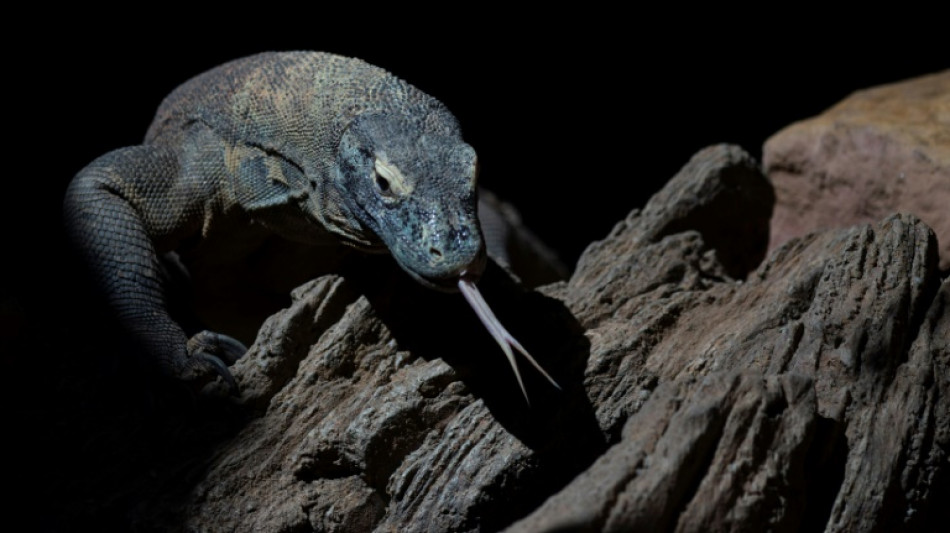
Komodo dragons have teeth coated in iron to kill prey: study / Photo: JORGE GUERRERO - AFP/File

 Freshways milk-price cut deepens pressure on UK dairy farms

 Labour and National remain virtually tied as New Zealand vote count advances

 The Good Daughter adapts Karin Slaughter thriller with Rose Byrne and Meghann Fahy

 Heavy-lift drone evacuates wounded Ukrainian soldier from frontline kill zone

 Morrison says West Brom recovered after pressure from successive derby losses

 Britain considers 2027 state visit for Ukraine’s Zelensky

 Survey Finds Majority of Brits Use Polite Language with AI Assistants

 Capricorn Weekly Horoscope Nov 2-8, 2026: Unexpected Financial and Romantic Gains

 Jimenez Extends Lead Over Anderson in Richmond Mayoral Race

 DEA Marijuana Rescheduling Hearing Closes With Government Not Meeting Its Burden Of Proof?

 LeftLion Reviews New Music from Panchiko, Keane Baldwin, CATHEDRA., and Emily Ashberry

The fearsome Komodo dragon, native to Indonesia and the world's largest living lizard, has a coat of iron on its razor-like teeth to help it kill its prey, scientists found in a study published Wednesday.
A study led by researchers from King's College London, who carried out their work with advanced chemical and structural imaging, revealed protective iron coats in orange pigment found in the tips and serrations of Komodo dragon teeth.
"This feature has never been reported before in a carnivorous reptile," said the study published in the journal Nature Ecology & Evolution.
The researchers found iron-rich coatings most prominently on Komodo dragon teeth, although similar coverings were also found on the teeth of other living reptiles, including monitor lizards, crocodiles and alligators.
The study said concentrated iron played "a crucial role in supporting serrated teeth" in the huge lizards, who use them to kill their prey.
They prey on a range of animals from rodents to water buffalo and kill using a one-two punch of sharp teeth and a venomous bite.
The researchers believe the iron coatings may have existed in carnivorous dinosaurs but were lost over time because they could not find evidence of them on the fossilised teeth of reptiles and dinosaurs closely related to Komodo dragons.
Komodo dragons are found only in the national park of the same name and neighbouring Flores island. Only 3,458 adult and baby Komodo dragons are left in the wild, according to the International Union for the Conservation of Nature.
Thousands of tourists descend annually on the cluster of islands in the eastern part of Indonesia, the only place in the world where Komodo dragons can be seen in their natural habitat.
The reptiles, which can grow to three metres (10 feet) in length and weigh up to 90 kilograms (200 pounds), are threatened by human activity and climate change destroying their habitat.
R.Chavez--AT