First radioactive rhino horns to curb poaching in S.Africa / Photo: EMMANUEL CROSET - AFP

 New Zealanders pick endangered black robin as Bird of the Year

 Asia stocks rise on AI, US-China trade talks optimism

 Malaysia's 'elephant whisperer' fights to save Borneo's endangered giants

 'I live in fear': 1.5 million Pakistani children sexually exploited online

 Cowboys beat Commanders, Vikings down Bears as star QBs injured

 4 Hacks for Yearlong Savings on Your Kids' Wardrobes

 Forest fire threatens tourist town in Colombian Andes

 Torres on target again as PSG beat 10-man Marseille in Ligue 1

 Germany's Merz vows to stay course despite new election defeats

 Carrick demands Man Utd response after 'pathetic' jibes

 Liverpool boss Iraola urges Isak to raise his level

 Evenepoel wins record 4th straight world time-trial title

 France's Macron, Canada's Carney announce closer ties

 Carrick defends troubled Man Utd after Fulham escape

 Horror movie 'Resident Evil' tops N. American box office

 Germany's Merz vows to stay course despite new vote losses

 Man City outgun Sunderland despite Brobbey hat-trick, Man Utd rescue Fulham draw

 Mourinho blames ref committee for Real Madrid derby defeat

 Maresca craves a 1-0 win after eight-goal Man City thriller

 Atletico Madrid beat Real Madrid in tense derby clash

 Reusser retains world time-trial title

 Man City outgun Sunderland despite Brobbey hat-trick, Liverpool win at Bournemouth

 Top US, Chinese economic officials meet ahead of Trump-Xi summit

 Erdogan's LGBTQ crackdown 'first step of election campaign': activist

 Mass drone barrage on Moscow kills two

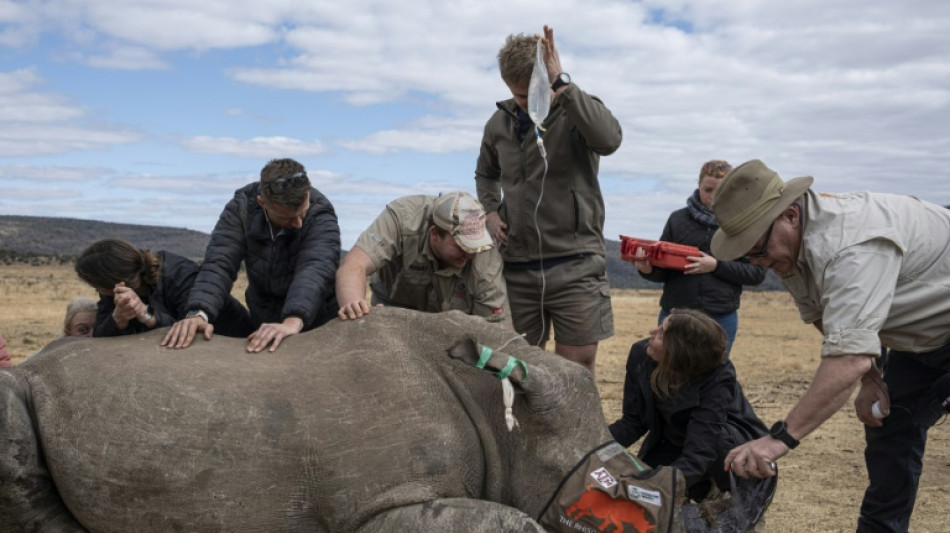
South African scientists on Tuesday injected radioactive material into live rhino horns to make them easier to detect at border posts in a pioneering project aimed at curbing poaching.
The country is home to a large majority of the world's rhinos and as such is a hotspot for poaching driven by demand from Asia, where horns are used in traditional medicine for their supposed therapeutic effect.
At the Limpopo rhino orphanage in the Waterberg area, in the country's northeast, a few of the thick-skinned herbivores grazed in the low savannah.
James Larkin, director of the University of the Witwatersrand's radiation and health physics unit who spearheaded the initiative, told AFP he had put "two tiny little radioactive chips in the horn" as he administered the radioisotopes on one of the large animals' horns.
The radioactive material would "render the horn useless... essentially poisonous for human consumption" added Nithaya Chetty, professor and dean of science at the same university.
The dusty rhino, put to sleep and crouched on the ground, did not feel any pain, Larkin said.
The radioactive material's dose was so low it would not impact the animal's health or the environment in any way, he said.
In February the environment ministry said that, despite government efforts to tackle the illicit trade, 499 of the giant mammals were killed in 2023, mostly in state-run parks. This represents an 11 percent increase over the 2022 figures.
Twenty live rhinos in total would be part of the pilot Rhisotope project whereby they would be administered a dose "strong enough to set off detectors that are installed globally" at international border posts originally installed "to prevent nuclear terrorism", a pleased Larkin said, sporting a green hat and a khaki shirt.
Border agents often have handheld radiation detectors which can detect contraband in addition to thousands of radiation detectors installed at ports and airports, the scientists said.
-'Best idea'-
Rhino horns are highly sought after on black markets, where the price by weight rivals that of gold and cocaine.
According to Arrie Van Deventer, the orphanage's founder, dehorning the rhino and poisoning the horns have failed to deter poachers.
"Maybe this is the thing that will stop poaching", the tall, slim-built conservationist said. "This is the best idea I've ever heard".
Wildebeest, warthogs and giraffe roamed the vast conservation area as more than a dozen team members performed the delicate process on another rhino.
Larkin meticulously drilled a small hole into the horn, hammered in the radioisotope, then finished off by spraying 11,000 microdots all over the horn.
About 15,000 rhinos live in the southern African nation, according to an estimate by the international Rhino foundation.
The last phase of the project would be the animal's aftercare following "proper scientific protocol and ethical protocol", said the project's COO, a bubbly Jessica Babich.
The team would then take follow-up blood samples to ensure the rhinos were effectively protected.
The material would last five years on the horn, which was cheaper than dehorning every 18 months, Larkin said.
A.Taylor--AT

