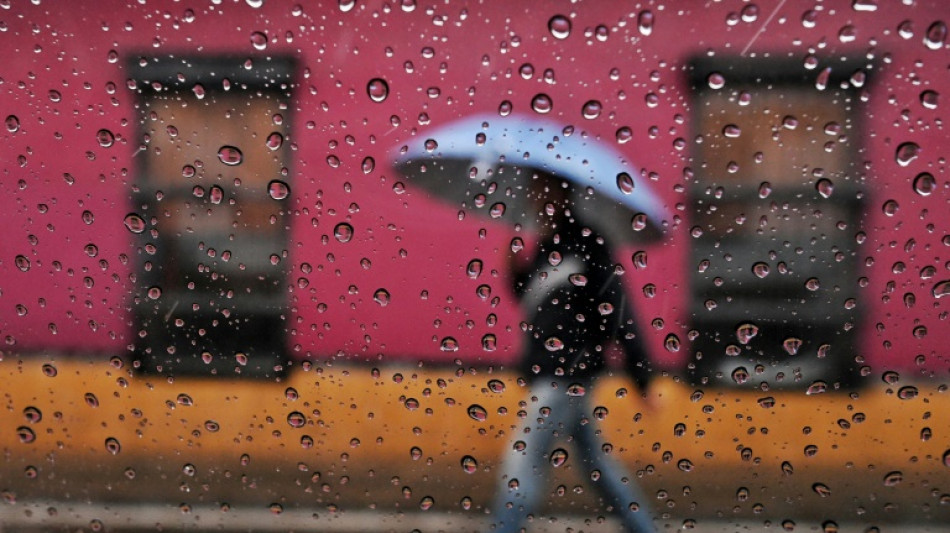
What looming La Nina means for global temperatures / Photo: Luis ROBAYO - AFP/File

 New Zealanders pick endangered black robin as Bird of the Year

 Asia stocks rise on AI, US-China trade talks optimism

 Malaysia's 'elephant whisperer' fights to save Borneo's endangered giants

 'I live in fear': 1.5 million Pakistani children sexually exploited online

 Cowboys beat Commanders, Vikings down Bears as star QBs injured

 4 Hacks for Yearlong Savings on Your Kids' Wardrobes

 Forest fire threatens tourist town in Colombian Andes

 Torres on target again as PSG beat 10-man Marseille in Ligue 1

 Germany's Merz vows to stay course despite new election defeats

 Carrick demands Man Utd response after 'pathetic' jibes

 Liverpool boss Iraola urges Isak to raise his level

 Evenepoel wins record 4th straight world time-trial title

 France's Macron, Canada's Carney announce closer ties

 Carrick defends troubled Man Utd after Fulham escape

 Horror movie 'Resident Evil' tops N. American box office

 Germany's Merz vows to stay course despite new vote losses

 Man City outgun Sunderland despite Brobbey hat-trick, Man Utd rescue Fulham draw

 Mourinho blames ref committee for Real Madrid derby defeat

 Maresca craves a 1-0 win after eight-goal Man City thriller

 Atletico Madrid beat Real Madrid in tense derby clash
 Reusser retains world time-trial title

 Man City outgun Sunderland despite Brobbey hat-trick, Liverpool win at Bournemouth

 Top US, Chinese economic officials meet ahead of Trump-Xi summit

 Erdogan's LGBTQ crackdown 'first step of election campaign': activist

 Mass drone barrage on Moscow kills two

El Nino, the natural weather phenomenon that contributed to 2023 being the hottest year on record, has recently subsided, paving the way for its opposing, cooling La Nina phase to begin.
But in the context of a warming planet due to human-caused climate change, scientists say that cooling effect may be miniscule.
Here is how the cycle called El Nino-Southern Oscillation (ENSO) works to affect global weather:
- El Nino -
El Nino can weaken consistent trade winds that blow east to west across the tropical Pacific, influencing weather by affecting the movement of warm water across this vast ocean.
This weakening warms the usually cooler central and eastern sides of the ocean, altering rainfall over the equatorial Pacific and wind patterns that change temperature and rain around the world.
The extra heat at the surface of the Pacific releases energy into the atmosphere that can temporarily drive up global temperatures, which is why El Nino years are often among the warmest on record.
It occurs every two to seven years, and lasts nine to 12 months.
The latest El Nino, which began in June 2023, peaked among the five strongest such events on record, according to the World Meteorological Organization (WMO).
It typically results in drier conditions across southeast Asia, Australia, southern Africa, and northern South America, and conversely much wetter conditions in the Horn of Africa and the southern United States.
While it is unclear what impact climate change may be having on ENSO, it is affecting how these events play out, said Michelle L'Heureux, lead ENSO forecaster for the US NOAA weather agency.
Climate change is making extreme events more frequent and intense, and when colliding with ENSO can cause its associated drier or wetter conditions to "become more amplified", she added.
The elevated global temperatures ENSO causes also served as a "portal" into the future of climate change, L'Heureux said.
"It gives you... a bit of a preview of what a warmer world looks like because it is giving you a temporary boost. So we're now at a new level we haven't seen before," she said.
- Neutral period -
Although El Nino has been dissipating, the first four months of 2024 have continued to break heat records -- unsurprisingly as the cycle typically drives up temperatures the year after it develops.
ENSO is "not an on-off switch", L'Heureux explained. "It takes a while for the global atmospheric circulation to adjust."
Scientists anticipate that the neutral period between the two cycles will begin between May and July.
Above-normal temperatures are forecast to persist through July across the northern and southern hemispheres, with just equatorial regions anticipated to see near-to-below normal temperatures, according to WMO.
The neutral period is not likely to last long, L'Heureux explained.
Typically, after a strong El Nino as the world just experienced, La Nina soon follows.
- La Nina -
La Nina sees the eastern Pacific Ocean cool for a period of about one to three years, generating the opposite effects to El Nino on global weather.
It leads to wetter conditions in parts of Australia, southeast Asia, India, southeast Africa and northern Brazil, while causing drier conditions in parts of South America.
It can also contribute to more severe Atlantic hurricanes, and NOAA has forecast an "extraordinary" storm season ahead this year.
La Nina tends to bring down global temperatures, although L'Heureux warned against hopes of relief in areas like southeast Asia that have recently be battered by scorching heatwaves.
"The world is warming and ENSO is acting secondary to that," she said.
"Even this year with La Nina potentially developing, we're still expecting basically a top-five global mean temperature record," she said.
NOAA says there is a 69 percent chance of La Nina beginning sometime between July and September.
E.Rodriguez--AT

