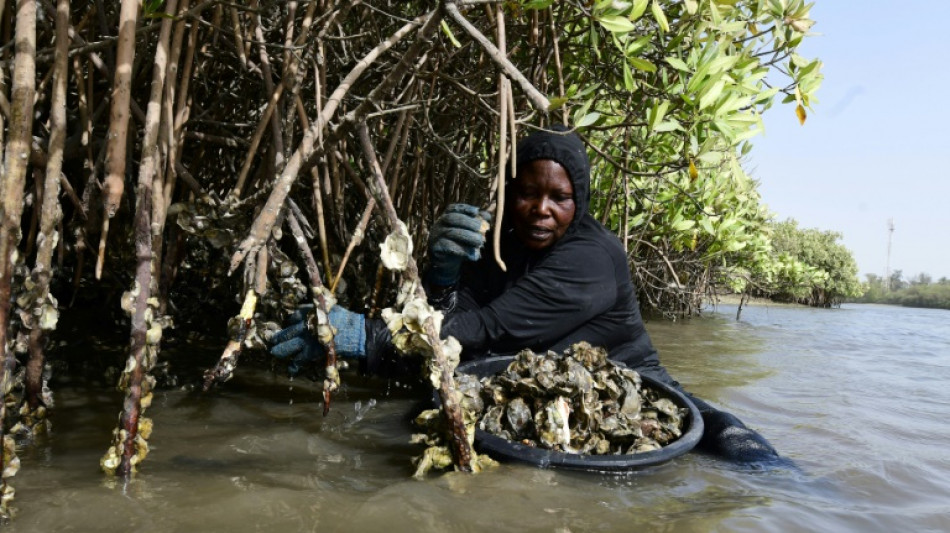
Senegal eyes economic boom in oyster farming / Photo: SEYLLOU - AFP

 Martin wins Austrian MotoGP sprint after Acosta crash

 Japan edge Fiji to win Pacific Nations Cup

 Black smoke, flames rising near Riyadh airport: residents to AFP

 UK actor Naomi Watts honoured at Spain film festival

 Japan emperor declares Asian Games open after turbulent build-up

 Asian Games open with unity message after troubled build-up
 Denmark hails 'binding' Greenland deal with Trump

 We don't want Games host Japan losing money, says Asian Olympic official

 Ed Sheeran returns to stage after Palestinian controversy

 Asian Games to open in Japan after troubled build-up

 Drone owners rush to offload devices ahead of Beijing ban

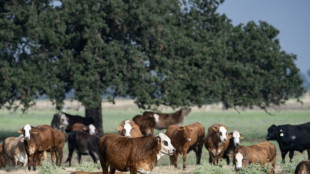 Trump's beef policies irk Texas ranchers, testing their loyalty

 Kennedy Center: future unclear for iconic Washington arts hub

 Trump claims 'infinite' Greenland security deal with Denmark

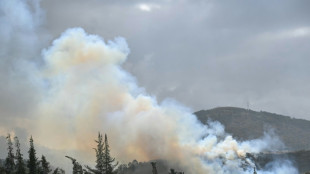 Helicopters battle wildfire threatening Ecuador's capital

 Brentford batter Chelsea to undo Alonso's promising start

 Kane hits Bundesliga century as Bayern rout Union

 Trump says CNN, MS NOW, Politico banned from White House

 Hushing and hedging: US companies retreat on climate

 Springboks to face Fiji before 2027 Rugby World Cup

 Nigeria miners struggled to breathe in cell before 37 died: survivors

 McIlroy on the charge at PGA Championship as Reed withdraws

 McIlroy on the charge at PGA Championship

 Crisis-wracked Volkswagen warns of 10-bn-euro hit to profits

 Costa Rica's Grynspan tops third informal poll for UN chief: diplomat

The mangrove swamp near Joal-Fadiouth, a fishing village in southern Senegal, teems with oysters.
But hunting for shellfish treasure among gnarly tree roots in brackish water is a lot of work.
Thousands of people -- the vast majority of them women -- make a living from oysters in Senegal, usually at a small and informal level.
But experts say the tropical West African state has huge prospects for ramping up oyster output to far greater levels.
"Oyster production is falling short of its potential," said Boubacar Banda Diop, in charge of the oyster sector at Senegal's fisheries ministry.
The possible harvest, in terms of protein and money, could be high, say champions of the oyster.
About 40 percent of Senegal's population of 17 million people live below the poverty line, according to a World Bank metric. In a nation where fish is a traditional staple, the country also suffers from overfishing and food insecurity.
In 2017, farmers plucked about 15,600 tonnes of oysters from Senegal's mangroves, according to the United Nations Food and Agriculture Organization (FAO). They also gathered about 400 tonnes from oyster beds.
By comparison, the world's largest oyster producer China harvests about 3.5 million tonnes per year, according to the French research institute Ifremer.
- 'Enormous' prospects -
Senegal's government has a development plan for the oyster industry, while the FAO and the European Union are putting forward ideas for techniques and breeding programmes to enhance production.
A small business in the Somone lagoon south of Dakar has already begun to apply some of the project's recommendations.
"We have doubled our production capacity compared to last year, going from three to six tonnes per year," the head of the business, Khadim Tine, told AFP.
But such successes are rare -- and the hurdles for those who want to make the jump from artisanal to industrial-scale farming are daunting.
Mamadou Bakhoum, the head of an association of villages in southern Senegal, said high water salinity caused by climate change meant there were fewer oysters than before.
But, he said, "if people get serious about it, the potential for developing oyster farming is enormous."
- Environmental factors -
Increasing the productivity of oyster farming while protecting Senegal's mangroves poses another environmental challenge.
The habitat features plants and shrubs growing in shallow semi-salty water, protecting against coastal erosion and nurturing a complex and invaluable ecosystem. Mangroves are already under increasing threat in Senegal, as elsewhere.
Abdou Karim Sall, president of the Joal-Fadiouth Marine Protected Area, aims to help farmers cultivate oysters without spoiling the mangroves.
Wooden trestles are placed in the swamp with wires hanging between supports just above the waterline.
Spats -- strings of oyster larvae that grow into the shellfish -- then begin to develop on the wires.
Sall said the method protects the mangrove but also allows the women farmers to produce more oysters and earn more money.
Local NGOs in Joal-Fadiouth have helped several women oyster farmers to start using the technique.
Selling oysters fresh -- as opposed to cooked, as is usual in Senegal -- could also boost returns for farmers.
Industry figures say that a dozen fresh Senegalese oysters sell for the equivalent of between seven and nine euros ($7.70-8.20).
That's a price that puts fresh oysters way of out of reach for many in the country --- wealthy tourists would be the target market for an expanded industry.
To meet it would problems are cold storage, transport infrastructure and sanitation standards.
Expanding the oyster business to an industrial scale requires systems to monitor water quality, as oyster farms are prone to contamination.
For water quality alone, a budget of about 305,000 euros ($335,000) would be needed for the first decade, according to Diop's ministry -- a big ask in a developing country.
H.Gonzales--AT