India under fresh scrutiny as UN panel calls for shunning coal

 Martin wins Austrian MotoGP sprint after Acosta crash

 Japan edge Fiji to win Pacific Nations Cup

 Black smoke, flames rising near Riyadh airport: residents to AFP

 UK actor Naomi Watts honoured at Spain film festival

 Japan emperor declares Asian Games open after turbulent build-up

 Asian Games open with unity message after troubled build-up

 Denmark hails 'binding' Greenland deal with Trump

 We don't want Games host Japan losing money, says Asian Olympic official

 Ed Sheeran returns to stage after Palestinian controversy

 Asian Games to open in Japan after troubled build-up

 Drone owners rush to offload devices ahead of Beijing ban

 Trump's beef policies irk Texas ranchers, testing their loyalty

 Kennedy Center: future unclear for iconic Washington arts hub

 Trump claims 'infinite' Greenland security deal with Denmark

 Helicopters battle wildfire threatening Ecuador's capital

 Brentford batter Chelsea to undo Alonso's promising start

 Kane hits Bundesliga century as Bayern rout Union

 Trump says CNN, MS NOW, Politico banned from White House

 Hushing and hedging: US companies retreat on climate

 Springboks to face Fiji before 2027 Rugby World Cup

 Nigeria miners struggled to breathe in cell before 37 died: survivors

 McIlroy on the charge at PGA Championship as Reed withdraws

 McIlroy on the charge at PGA Championship

 Crisis-wracked Volkswagen warns of 10-bn-euro hit to profits

 Costa Rica's Grynspan tops third informal poll for UN chief: diplomat

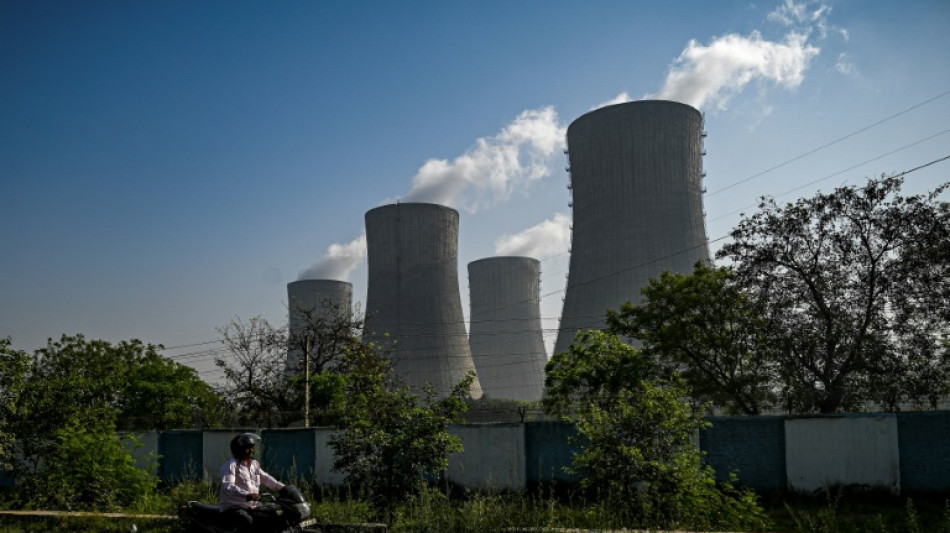
The mounds of jet-black coal shimmering under the afternoon sun at the Dadri power plant are a raw illustration of India's coal dependence -- a habit that despite increasing pressure, the country is finding hard to kick.
Coal is vital for providing electricity to India's 1.4 billion citizens, making up 70 percent of the country's energy needs.
That reliance is in the spotlight after a warning by UN experts this week that to ensure a "liveable future", countries must move to greener energy sources much faster to reduce emissions.
Coal-based plants like the sprawling Dadri facility are attempting to make themselves cleaner, but their efforts are mostly in their infancy, and pale in comparison to their overall emission rate.
Prime Minister Narendra Modi has set ambitious goals for renewable energy development, aiming to increase non-fossil energy capacity to over double the current coal capacity by 2030.
But Harjeet Singh of the Fossil Fuel Non-proliferation Treaty Initiative said that while the cost of renewable energy has come down by up to 90 percent in the last decade, India still requires hundreds of billions of dollars upfront to make the transition.
"That kind of international support in terms of investments or concessional loans or grants is not coming through," he said.
Experts say coal will remain the dominant fuel in India for a long time to come, with its energy needs over the next 20 years set to rise faster than any other country in the world.
- Crossroads -
The UN report, released Monday, said current policies are leading the planet towards catastrophic temperature rises and that the world was at a "crossroads".
If the world's current oil, gas and coal infrastructure operate for their designed lifetime -- without technology to capture and store carbon -- capping global warming at the target of 1.5 degrees Celsius will be impossible, it said.
India, which with China reportedly led opposition to a commitment to "phase out" coal at the COP26 summit last year, currently has about 211 gigawatts of operational coal capacity, according to the Central Electricity Authority, with another 55GW under various phases of construction.
None of India's power stations yet has the technology the UN report mentions as a mitigation option.
"Carbon-trapping technology is being used on an experimental basis at one of our plants," said B. Srinivasa Rao, chief general manager of the Dadri plant. "If it is successful it will be done at all the plants."
With six coal-fired units supplying megacity Delhi and elsewhere, the plant -- run by India's biggest power producer, the National Thermal Power Corporation (NTPC) -- is spread across some 3,000 acres (1,200 hectares) in the northern state of Uttar Pradesh.
It has taken some steps to reduce emissions, including burning pellets made from agricultural waste along with coal.
Like several other NTPC units, it has installed a solar thermal power plant with and output of 5 megawatts -- though the plant as a whole generates 2500 MW.
Rao said the plant has also achieved 100 percent recycling of fly ash, a main byproduct of burning coal, and implemented a zero liquid discharge system.
But locals living in the vicinity complained about coal dust spilling from trucks and affecting their health.
"It burns our eyes and hurts our lungs," said Rinku Rana, who runs a confectionery shop close by.
"But if the plant closes down we will be robbed of our livelihoods. So in a way it's a necessary evil that we have to live with," 29-year-old Rana said, wiping off a thick layer of ash-grey dust that had settled on biscuit and sweet packets at his shop.
- Climate equity -
Singh, the environmental campaigner, said India cannot continue to rely on fossil fuels, especially in view of severe air pollution.
At the same time, it needs cheap fuel to power its economy and help millions out of poverty.
Levies on coal are an important source of employment and government revenue, especially for states like Jharkhand and Odisha, among the poorest in the country.
Modi has said India will cut its emissions to net-zero only by 2070 -- missing a key goal of the COP26 summit for countries to commit to doing so by 2050.
The government argues that although the country is the world's third-largest emitter in total, its per capita emissions are far lower than the American average.
Singh said New Delhi was "well within its right" to talk about equity and climate justice.
"The current climate crisis is not because of India's industrialisation. It's because of the Western industrialisation that has happened over the last 150 years," he told AFP.
"Rich countries need to reduce their emissions far more earlier than what they have planned right now... and at the same time provide support to developing countries to move away from fossil fuels."
P.Smith--AT