
Will big biodiversity ambitions be enough to save nature?

 Martin wins Austrian MotoGP sprint after Acosta crash

 Japan edge Fiji to win Pacific Nations Cup

 Black smoke, flames rising near Riyadh airport: residents to AFP

 UK actor Naomi Watts honoured at Spain film festival

 Japan emperor declares Asian Games open after turbulent build-up

 Asian Games open with unity message after troubled build-up

 Denmark hails 'binding' Greenland deal with Trump

 We don't want Games host Japan losing money, says Asian Olympic official

 Ed Sheeran returns to stage after Palestinian controversy

 Asian Games to open in Japan after troubled build-up

 Drone owners rush to offload devices ahead of Beijing ban

 Trump's beef policies irk Texas ranchers, testing their loyalty

 Kennedy Center: future unclear for iconic Washington arts hub

 Trump claims 'infinite' Greenland security deal with Denmark

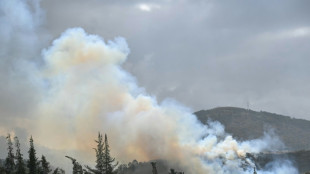 Helicopters battle wildfire threatening Ecuador's capital

 Brentford batter Chelsea to undo Alonso's promising start

 Kane hits Bundesliga century as Bayern rout Union

 Trump says CNN, MS NOW, Politico banned from White House

 Hushing and hedging: US companies retreat on climate

 Springboks to face Fiji before 2027 Rugby World Cup

 Nigeria miners struggled to breathe in cell before 37 died: survivors

 McIlroy on the charge at PGA Championship as Reed withdraws

 McIlroy on the charge at PGA Championship

 Crisis-wracked Volkswagen warns of 10-bn-euro hit to profits

 Costa Rica's Grynspan tops third informal poll for UN chief: diplomat

After the world missed almost all of its targets to protect fast-dwindling nature for the last decade, observers following a new round of negotiations are focusing as much on how goals will be put in place as the headline targets.
Nearly 200 nations are taking part in talks until Tuesday, aimed at fine-tuning a draft text to preserve biodiversity by 2050, with key milestones at 2030, which will be adopted at the United Nations COP15 conference later this year.
Countries are striving to increase their ambitions in the face of stark warnings that humanity is driving devastating declines in the biodiversity that supports all life on the planet.
But the world failed almost entirely to reach a similar set of 10-year objectives set a decade ago at UN talks in Aichi, Japan.
"The Aichi targets were largely missed because of lack of political will and parties not prioritising them enough," said AFP Anna Heslop, of the NGO ClientEarth, which is following the Geneva talks.
"There was just a lack of implementation. We can't afford to be in that position again in 10 years."
The text under negotiation includes a series of proposals to avoid repeating the same mistakes.
"What we need is a better system for encouraging parties to plan and report, and then the global community needs to do something. It is keeping these three elements is the challenge," said a delegate from a Global North country, who asked not to be named.
- Progress reports -
Member countries should develop stronger action plans to use natural resources sustainably, said the IDDRI think tank said to be more effective.
There should also be a more robust reporting system, with countries periodically measuring progress and passing on data that feeds into a global assessment, it added.
Currently, each country draws up its national biodiversity plan on a different basis, making comparisons difficult.
To address this, the delegations in Geneva are trying to develop common indicators to measure progress.
"Let's put in place mechanisms for collective and individual review, which will increase the pressure and this affects ambitions and implementation at the national level," said Juliette Landry, researcher at IDDRI.
Experts and conservation groups want national action plans to be updated regularly after COP15 with progress reports and a global stocktake before 2030.
That way, nations and the international community can see if they are going off track and increase their efforts.
But more reporting and administration requires more funding, and biodiversity-rich developing countries stress they will need both financial and technological support to meet these obligations.
"You cannot ask people to do spatial planning if they don't have the means," said a delegate from the Global South.
Another IDDRI proposal is the creation of a compliance mechanism, although Landry stressed that this would not be an exercise in finger-pointing.
Instead she said it would show the "gaps between what the countries had planned and what they implemented" and enable problems to be addressed and for countries to share their experiences, she said. So far, there has been little appetite for such a mechanism.
But without one "all of this process is meaningless" said Oscar Soria, of the advocacy group Avaaz.
"Because nobody will take responsibility and nobody will take the convention seriously from the outside," he said.
Ch.P.Lewis--AT



