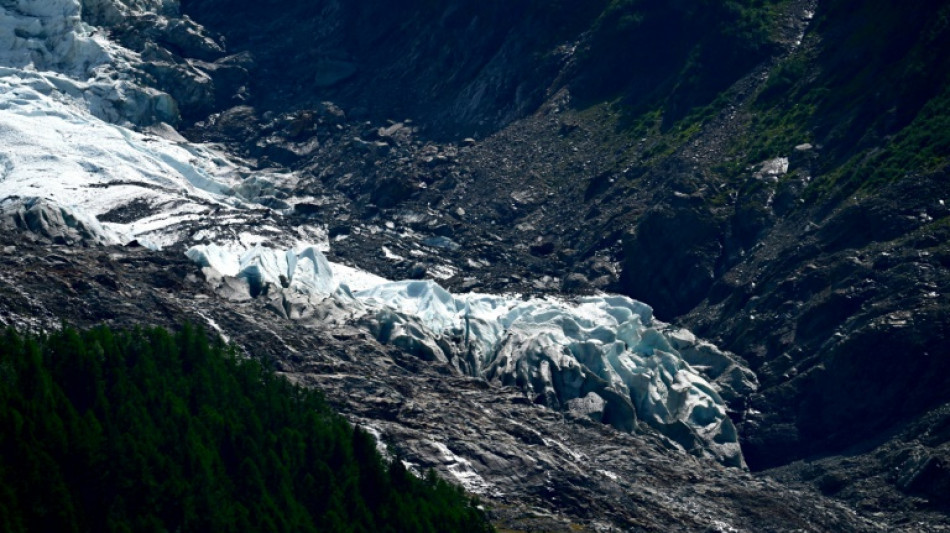
Retreating glaciers reveal new pastures for conservationists / Photo: Emmanuel DUNAND - AFP/File

 Germany's Merz vows to stay course despite new vote losses

 Man City outgun Sunderland despite Brobbey hat-trick, Man Utd rescue Fulham draw

 Mourinho blames ref committee for Real Madrid derby defeat

 Maresca craves a 1-0 win after eight-goal Man City thriller

 Atletico Madrid beat Real Madrid in tense derby clash

 Reusser retains world time-trial title

 Man City outgun Sunderland despite Brobbey hat-trick, Liverpool win at Bournemouth

 Top US, Chinese economic officials meet ahead of Trump-Xi summit

 Erdogan's LGBTQ crackdown 'first step of election campaign': activist

 Mass drone barrage on Moscow kills two

 82-year-old dies after beach fight in Greece over sun lounger

 US warns of rapid escalation in Mideast war

 Iran 'put hearts on the court' to win Asian Games basketball bronze

 School girl Yu helps China dominate in Asian Games swimming openers

 Myanmar win first Asian Games teqball gold as Spain great Puyol watches

 China's 13-year-old Yu scorches to first major gold at Asian Games

 Russians vote on last day of parliamentary elections

 Hong Kong pays final respects to former city leader Tung

 Typhoon put people off Asian Games opening ceremony, official says

 China's 13-year-old Yu cruises as Asian Games swimming begins

 AI 'warning shots' focus Beijing on national security risks

 Philippine tribe in limbo over US-led tech hub

 Leo XIV, first US pope transcends his restrained style
 Singer Ed Sheeran says Gaza situation 'unjustifiable' following controversy

 In 'Tenzing', a Sherpa mountaineer gets his due

Water surged through a desolate canyon of grey rock into a blue-grey lake, an ancient landscape only revealed to humanity in recent decades because France's glaciers have retreated so far.
The rocks bore the markings of the ice and, on an unseasonably hot day in October high above the ski resort of Chamonix, experts from the Ice and Life research project were clear that their task was no longer to try to protect the glaciers.
Human-induced global heating has led to reduced winter snowfall and to summer heatwaves, which is having devastating, and mostly irreversible, effects on glaciers.
"We've melted the glaciers. We haven't managed to preserve them. But maybe we have a second chance," Jean-Baptiste Bosson, glaciologist and coordinator of Ice and Life, told AFP.
"It's now all about how we preserve the nature that emerges after the retreat. Can we create a sanctuary for this new life, a Garden of Eden?"
Even at an altitude of some 2,000 metres (6,600 feet), the glacial retreat had already made way for a lake and small pools surrounded by wild rushes.
Small, colourful flowers were gradually colonising the lake's edges.
For Bosson and his team, these landscapes could play a huge role in mitigating climate change, either by filtering water, storing carbon or promoting biodiversity.
But the team said post-glacial landscapes were largely unprotected and could soon fall prey to commercial interests like companies and tourist resorts looking to exploit mineral deposits or the available water.
- 'Nature decides' -
Since the end of the so-called Little Ice Age, a very cold period in Europe and North America from the 14th century to the 1850s, an area four times the size of Paris has emerged from under the ice in the French Alps.
And the phenomenon is global.
The Earth is home to about 210,000 glaciers and experts predict ice-free areas the size of Nepal or Finland could emerge by 2100.
Part of the uniqueness of these ecosystems is that they are completely untouched by human development.
"Here, it's nature that decides, and it makes the best decisions," said Bosson.
His colleague, geographer Kenzo Heas, explains that the plants that emerged would also die, forming organic matter and fertile ground for grasslands or moors.
Primary forest had already emerged lower down the mountain.
- 'Extraordinary allies' -
The experts highlighted that wetlands and lakes were the next best thing to glaciers to preserve a well-functioning water cycle.
But Bosson worried that the new landscapes that emerge will have mineral companies and tour operators licking their lips in anticipation.
Bosson said such areas could be protected by giving them a special status, perhaps enshrined in an international treaty.
"There is a real coup to be made here -- a low economic and political cost for a huge benefit," he said, pointing out that the affected land is largely in the public domain and not subject to private ownership.
Ice and Life intend to take its proposals to the One Planet Summit in France next month, which is billed as the first international summit for glaciers and the poles.
They also hope to make headway in the coming years after the United Nations designated 2025 as the "International Year for the Preservation of Glaciers".
For Bosson, the power of glaciers to raise awareness and galvanise the public cannot be overstated.
"Glaciers amaze people," he said, calling them "extraordinary allies".
E.Rodriguez--AT



