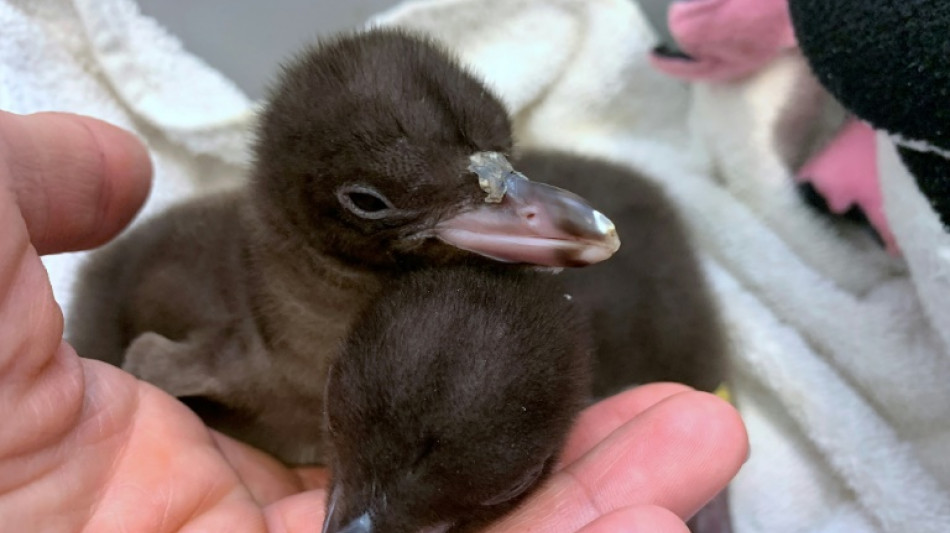
New Zealand probes mystery illness killing rare penguins / Photo: Handout - DUNEDIN WILDLIFE HOSPITAL/AFP

 Germany's Merz vows to stay course despite new vote losses

 Man City outgun Sunderland despite Brobbey hat-trick, Man Utd rescue Fulham draw

 Mourinho blames ref committee for Real Madrid derby defeat

 Maresca craves a 1-0 win after eight-goal Man City thriller

 Atletico Madrid beat Real Madrid in tense derby clash

 Reusser retains world time-trial title

 Man City outgun Sunderland despite Brobbey hat-trick, Liverpool win at Bournemouth

 Top US, Chinese economic officials meet ahead of Trump-Xi summit

 Erdogan's LGBTQ crackdown 'first step of election campaign': activist

 Mass drone barrage on Moscow kills two

 82-year-old dies after beach fight in Greece over sun lounger

 US warns of rapid escalation in Mideast war

 Iran 'put hearts on the court' to win Asian Games basketball bronze

 School girl Yu helps China dominate in Asian Games swimming openers

 Myanmar win first Asian Games teqball gold as Spain great Puyol watches

 China's 13-year-old Yu scorches to first major gold at Asian Games

 Russians vote on last day of parliamentary elections

 Hong Kong pays final respects to former city leader Tung

 Typhoon put people off Asian Games opening ceremony, official says

 China's 13-year-old Yu cruises as Asian Games swimming begins

 AI 'warning shots' focus Beijing on national security risks

 Philippine tribe in limbo over US-led tech hub

 Leo XIV, first US pope transcends his restrained style

 Singer Ed Sheeran says Gaza situation 'unjustifiable' following controversy

 In 'Tenzing', a Sherpa mountaineer gets his due

A mystery illness is decimating the chicks of New Zealand's endangered yellow-eyed penguins, and scientists say they may have found the cause.
The flightless birds, endemic to New Zealand, stand lower than knee-high, have pale yellow eyes and sport a band of yellow feathers around the head.
There are about 2,400 of the adult birds left, according to estimates by New Zealand's Department of Conservation.
Their status is considered "threatened -- nationally endangered". It is the country's highest risk level.
The mystery respiratory illness first appeared in 20 freshly hatched chicks brought to Dunedin Wildlife Hospital in 2019.
"They were unable to hold their heads up, gasping with glassy eyes," wildlife hospital director Dr. Lisa Argilla told AFP this week.
"It was heart-wrenching to see these little chicks in such critical condition," the veterinarian said.
"All chicks that showed respiratory signs died -- there was nothing we could do to save them."
During the 2020 breeding season, a third of 150 yellow-eyed penguin chicks brought to the hospital died of respiratory problems, Argilla said.
Professor Jemma Geoghegan, an evolutionary virologist, is part of a team of specialists investigating the illness.
"The wildlife hospital tried everything in their power to prevent it but without knowing the cause it's very hard to manage," Geoghegan told AFP.
Scientists tested tissue samples from dead penguin chicks with sequencing technology similar to that used to identify the coronavirus behind Covid-19.
- 'Insane operation' -
"There's two diseases we have been investigating and we have found two viruses which we think are likely responsible," said Geoghegan, a professor at Otago University.
The team had identified a novel gyrovirus and a novel megrivirus, she said.
Between them, the diseases are thought to have killed around 25 percent of yellow-eyed penguin chicks -- roughly 50 each year -- in recent breeding seasons, Geoghegan said.
"We've identified what we think may be the cause and then there's a lot of research needed to potentially work out whether we can prevent or treat the disease," she said.
For now, chicks younger than five days are being taken from their nests to Dunedin Wildlife Hospital, where they can be reared away from the risk of infection.
In 2022, the animal hospital was able to return 90 percent of the chicks to their nests, Argilla said.
"Around 142 chicks were given a second chance," she said.
"If they'd been left in the nest, most of them likely would have succumbed to either disease and died."
The hospital director said it was an "insane operation" to hand-rear dozens of chicks with up to 10 people rostered each day to help with the five daily feeds.
Vets, nurses, zoo keepers and conservation rangers from all over New Zealand came to help, Argilla said.
The flightless birds live in two colonies: a mainland population centred on the southeast of the South Island, and a larger group on New Zealand's remote outer Sub-Antarctic Islands.
Conservationists say the mainland colony's population has declined 75 percent since 2008, leaving only about 200 breeding pairs, which risk disappearing in two decades.
Predators -- such as the long, thin barracouta fish in the ocean, or dogs, cats, ferrets and stoats on land -- along with climate change and infectious diseases have taken a toll.
Argilla said she was hopeful a vaccine would be found to help save the chicks.
"We are only an ambulance at the bottom of the hill doing our bit to save individual birds so that the population decline can hopefully slow down," she said.
E.Hall--AT



