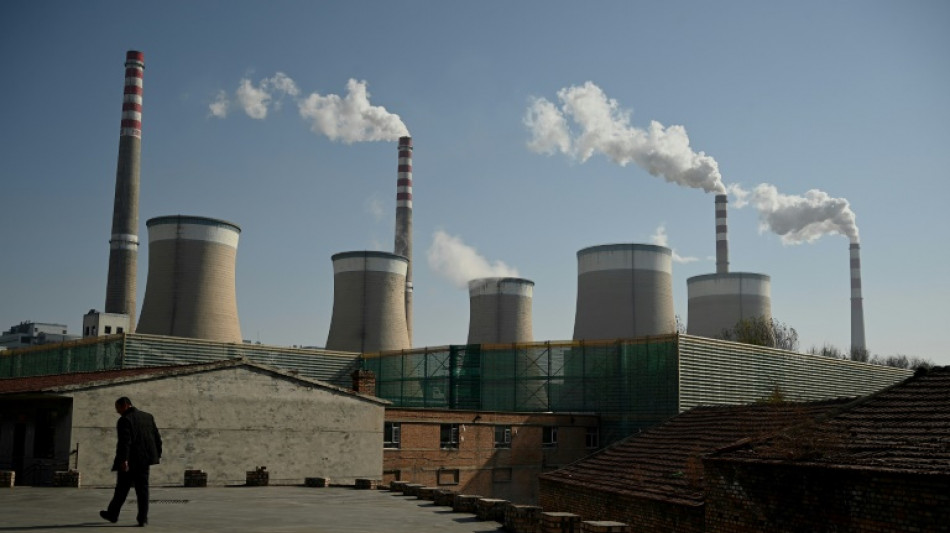
Three decades ago world told to 'act now' on climate

 Martin wins Austrian MotoGP sprint after Acosta crash

 Japan edge Fiji to win Pacific Nations Cup

 Black smoke, flames rising near Riyadh airport: residents to AFP

 UK actor Naomi Watts honoured at Spain film festival

 Japan emperor declares Asian Games open after turbulent build-up

 Asian Games open with unity message after troubled build-up

 Denmark hails 'binding' Greenland deal with Trump

 We don't want Games host Japan losing money, says Asian Olympic official

 Ed Sheeran returns to stage after Palestinian controversy

 Asian Games to open in Japan after troubled build-up

 Drone owners rush to offload devices ahead of Beijing ban

 Trump's beef policies irk Texas ranchers, testing their loyalty

 Kennedy Center: future unclear for iconic Washington arts hub

 Trump claims 'infinite' Greenland security deal with Denmark

 Helicopters battle wildfire threatening Ecuador's capital

 Brentford batter Chelsea to undo Alonso's promising start

 Kane hits Bundesliga century as Bayern rout Union
 Trump says CNN, MS NOW, Politico banned from White House
 Hushing and hedging: US companies retreat on climate

 Springboks to face Fiji before 2027 Rugby World Cup

 Nigeria miners struggled to breathe in cell before 37 died: survivors

 McIlroy on the charge at PGA Championship as Reed withdraws

 McIlroy on the charge at PGA Championship

 Crisis-wracked Volkswagen warns of 10-bn-euro hit to profits

 Costa Rica's Grynspan tops third informal poll for UN chief: diplomat

With the planet facing the "potentially serious consequences" of global warming, UN experts writing 32 years ago urged an indifferent world to take immediate action to reduce greenhouse gas emissions.
Planet-warming carbon pollution has increased ever since.
In 1990 the Intergovernmental Panel on Climate Change produced the first trio of reports in a cycle of climate change assessments -- one on the physical science of warming, one on the impacts and one on solutions -- that has repeated roughly every six years.
While the authors of the most recent IPCC report on impacts, released in February this year, can say the evidence of harm to humanity and the entire planet is "unequivocal", the authors of those first reports 30 years ago could not be as forthright.
But they were clear that the risks were so high we couldn't afford to wait.
"The potentially serious consequences of climate change on the global environment," they said "give sufficient reasons to begin by adopting response strategies that can be justified immediately even in the face of such significant uncertainties".
They said cuts to the planet-warming gases that humans were pumping into the atmosphere should be swift and drastic.
"Because climate change could potentially result in significant impacts on the global environment and human activities, it is important to begin considering now what measures might be taken in response," the report said.
There was never an easy answer.
The scientists writing the 1990 report underscored the need to reduce emissions of different gases -- especially carbon dioxide and methane -- across a range of different sectors, from energy generation to agriculture.
"Our understanding has been refined over 40 years, but the alarm has been ringing since the first IPCC report," said Celine Guivarch, one of the authors of the latest IPCC assessment of solutions, set to be published on April 4.
With each new cycle of climate evaluation, the description of risks in the IPCC reports has become ever clearer and more urgent. The forecasts have become increasingly catastrophic.
Meanwhile, emissions have risen almost every year, only breaking their relentless pace because of major economic crises, such as the one triggered by the Covid-19 pandemic.
As a result, CO2 in the atmosphere has never been higher.
According to data from the Mauna Loa observatory in Hawaii, which has monitored the atmosphere for decades, C02 concentrations reached 416 parts per million in 2021, up from 354 ppm in 1990 when the first IPCC report was published.
Earth has experienced periods of much higher C02 concentrations in the distant past.
But in its report on the physical science released in August 2021, the IPCC said the rate the gas has increased in the atmosphere since 1900 "is at least 10 times faster than at any other time during the last 800,000 years".
"Current levels of atmospheric CO2 have not been experienced for at least two million years," it added.
F.Ramirez--AT



