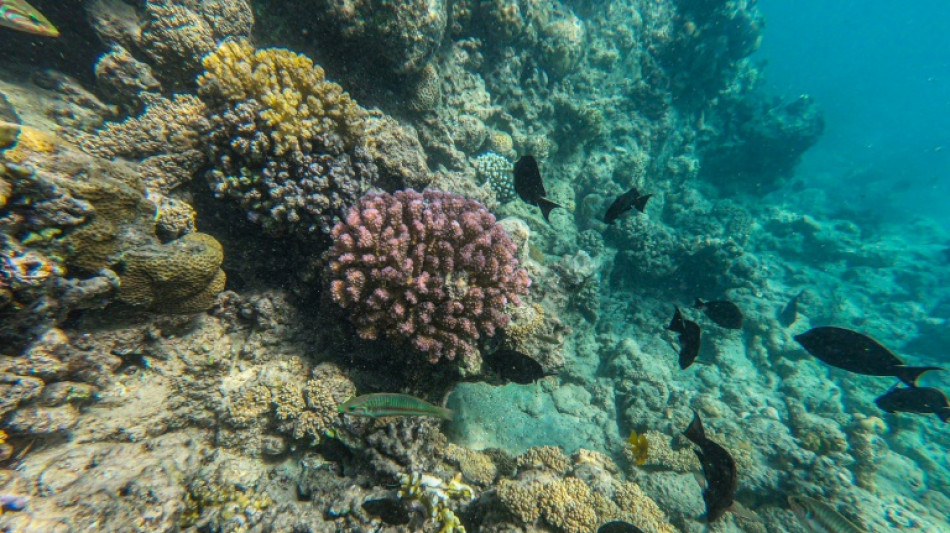
Marine heatwaves last longer in deeper water: study / Photo: Khaled DESOUKI - AFP

 Reusser retains world time-trial title

 Man City outgun Sunderland despite Brobbey hat-trick, Liverpool win at Bournemouth

 Top US, Chinese economic officials meet ahead of Trump-Xi summit

 Erdogan's LGBTQ crackdown 'first step of election campaign': activist

 Mass drone barrage on Moscow kills two

 82-year-old dies after beach fight in Greece over sun lounger

 US warns of rapid escalation in Mideast war

 Iran 'put hearts on the court' to win Asian Games basketball bronze

 School girl Yu helps China dominate in Asian Games swimming openers

 Myanmar win first Asian Games teqball gold as Spain great Puyol watches

 China's 13-year-old Yu scorches to first major gold at Asian Games

 Russians vote on last day of parliamentary elections

 Hong Kong pays final respects to former city leader Tung

 Typhoon put people off Asian Games opening ceremony, official says

 China's 13-year-old Yu cruises as Asian Games swimming begins

 AI 'warning shots' focus Beijing on national security risks

 Philippine tribe in limbo over US-led tech hub

 Leo XIV, first US pope transcends his restrained style

 Singer Ed Sheeran says Gaza situation 'unjustifiable' following controversy

 In 'Tenzing', a Sherpa mountaineer gets his due

 Gridko's New Live Drive PTO Roll-Off Trailer Wins the Heavy-Duty TRAILmakER Award 2026 at NATDA Awards

 Chile's Bachelet quits race to be next UN chief

 Raphinha treble fires perfect Barca to win at Sevilla

 Thiam makes winning heptathlon return at Decastar meet

 Czechs beat USA to qualify for Davis Cup finals

Marine heatwaves may last longer and be more intense in deeper water, potentially threatening sensitive species as climate change makes the extreme events more frequent, researchers said on Monday.
Oceans have absorbed 90 percent of the excess heat produced by the carbon pollution from human activity since the dawn of the industrial age.
Marine heatwaves -- episodes of abnormally high water temperatures -- have become more frequent and intense.
These can have a particularly severe impact on species that cannot migrate to escape intolerably warm waters, like corals in the Great Barrier Reef and kelp forests off southern Australia and the northeastern Pacific.
In a new study published in the journal Nature Climate Change, researchers looked at impacts of temperature spikes in deeper waters, which lead author Eliza Fragkopoulou said was "the first attempt to look into marine heatwaves below the surface".
"Marine heatwaves and their effects have been studied mostly at the ocean surface and we did not know much about their characteristics in the deep ocean," she told AFP.
Using on-site observations and modelling, researchers examined global marine heatwaves from 1993 to 2019, including data up to 2,000 metres (6,562 feet) below the surface.
They found the intensity was highest at 50 to 200 metres below the surface, occasionally up to 19 percent stronger than the surface heatwave.
The duration also increased with depth, with warming persisting up to two years after temperatures returned to normal on the surface, the study said.
The scientists looked at a proxy measure of thermal stress known as cumulative intensity and mapped that against distribution of biodiversity at the edge of their maximum heat limits to see areas where marine creatures are potentially more vulnerable to changes.
These high stress conditions overlapped in up to 22 percent of the global oceans, they found.
Regional variability of marine heatwaves makes measuring biodiversity exposure complex, and their duration varied by location due to different oceanic conditions.
In general, Fragkopoulou, of the Centre of Marine Sciences at Portugal's University of Algarve, said the impact on biodiversity was likely greatest from the surface to a depth of 250 metres.
The largest portions of the oceans categorised as highly exposed were found in the North Atlantic and Indian oceans, at depths between 1,000 and 2,000 metres.
- Better monitoring 'urgent' -
A separate study published last month in the journal Nature suggested that some marine creatures can withstand the heat better than others, with a finding that ocean fish can endure marine heatwaves with no major impact on their numbers.
Fragkopoulou told AFP that more research was needed on heatwaves in the deeper oceans to unpick the potential impacts on tourism and fisheries.
"Considering that marine heatwave impacts on deep-sea biodiversity are still largely unknown, there is an urgent need for more and better monitoring of the global ocean to understand their effects," she told AFP.
Y.Baker--AT



