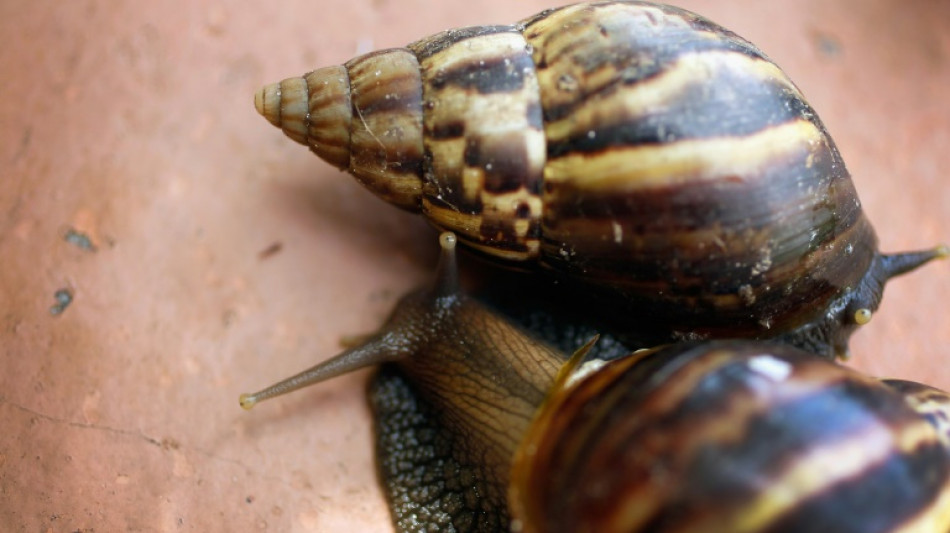
Invasive species problem will be 'worse before it gets better' / Photo: JOE RAEDLE - GETTY IMAGES NORTH AMERICA/AFP/File

 Reusser retains world time-trial title

 Man City outgun Sunderland despite Brobbey hat-trick, Liverpool win at Bournemouth

 Top US, Chinese economic officials meet ahead of Trump-Xi summit

 Erdogan's LGBTQ crackdown 'first step of election campaign': activist

 Mass drone barrage on Moscow kills two

 82-year-old dies after beach fight in Greece over sun lounger

 US warns of rapid escalation in Mideast war

 Iran 'put hearts on the court' to win Asian Games basketball bronze

 School girl Yu helps China dominate in Asian Games swimming openers

 Myanmar win first Asian Games teqball gold as Spain great Puyol watches

 China's 13-year-old Yu scorches to first major gold at Asian Games

 Russians vote on last day of parliamentary elections

 Hong Kong pays final respects to former city leader Tung

 Typhoon put people off Asian Games opening ceremony, official says

 China's 13-year-old Yu cruises as Asian Games swimming begins

 AI 'warning shots' focus Beijing on national security risks

 Philippine tribe in limbo over US-led tech hub

 Leo XIV, first US pope transcends his restrained style

 Singer Ed Sheeran says Gaza situation 'unjustifiable' following controversy

 In 'Tenzing', a Sherpa mountaineer gets his due

 Gridko's New Live Drive PTO Roll-Off Trailer Wins the Heavy-Duty TRAILmakER Award 2026 at NATDA Awards

 Chile's Bachelet quits race to be next UN chief

 Raphinha treble fires perfect Barca to win at Sevilla

 Thiam makes winning heptathlon return at Decastar meet

 Czechs beat USA to qualify for Davis Cup finals

On land and in the sea, invasive species are destroying ecosystems, spreading disease and causing hundreds of billions of dollars in damage every year, according to a landmark report Monday from the UN-backed science advisory panel for the UN Convention on Biodiversity.
AFP spoke on the eve of its release to the three co-chairs of the report, approved last week in Berlin by the 143 member nations of IPBES, the Intergovernmental Science-Policy Platform on Biodiversity and Ecosystem Services.
The co-chairs are ecologist Helen Roy, a professor at the UK Centre for Ecology and Hydrology; Peter Stoett, dean of Social Sciences and Humanities at Ontario Tech University; and Anibal Pauchard, a professor at the University of Concepcion in Chile.
The following has been condensed and edited for clarity.
Q. You conclude that the number of invasive species is rising at an "unprecedented rate". Can you quantify that?
Roy: The problem is going to get a lot worse before it gets better. On current "business-as-usual" trends, we anticipate an increase of 36 percent by 2050. But that's assuming current conditions remain constant, which they won't.
With so many drivers predicted to worsen -- population, land use, global trade, climate change -- the increase of invasive alien species and their impacts are likely to be significantly greater. But there are so many factors, it's difficult to predict how many.
Q. The report put the damages caused by invasive species at $423 billion in 2019, but calls this a "gross underestimation". Why don't you have a more accurate figure?
Stoett: We should look at this figure as the tip of the iceberg -- it's what we have been able to see and measure. There are many other hidden costs, such as on health, like with the expanding footprint of malaria.
Many are intangibles. If a species goes extinct, how do you put a price on that? Or if people are losing pillars of their cultural identity.
Then there's the labour that goes into dealing with invasive species. In some communities women are pulling invasive species out of the ground all day. They're not getting paid, or taxed, so there's no record of it.
Q. Most invasive species spread through trade, but do individual consumers play a role too?
Pauchard: Yes, they do. Take ornamental plants. With a couple of clicks on the internet you can get a packet of seeds from just about anywhere. It may be non-native species, or have contaminants. When you plant it in your garden it may not stay there.
And then there's the pet and wildlife trade. People even have snails as pets without having any clue as to whether they are invasive. When they get bored of the pet, they just throw it in the garden or the pond, but it probably won't stay there.
Q. Prevention, eradication and containment -- which is most important?
Stoett: There is no doubt: prevention, prevention, prevention. If there's one word to distill what needs to be done, that's it. It is by far the most cost-effective. You invest less, and you get more.
Q. Examples of how prevention can be effectively done?
Roy: New Zealand, Australia have amazing biosecurity, as does Hawaii. Small islands are especially vigilant. If you go to South Georgia (in the South Atlantic Ocean) they will check the bottom of your boots and all your equipment.
Stoett: Human transportation is of course important, but the biggest problems are elsewhere -- shipping vessels carrying contaminated products, or species attached to their hull or in their ballast water.
Then there's the (deliberate) use of invasive species in agriculture and forestry. Grasses imported into Maui for grazing livestock were linked to the wildfires there.
Q. The report warns against the danger of "homogenisation" of ecosystems. Can you explain?
Pauchard: We live in cities, the most homogenised ecosystems in the world. We are losing our local communities, our local ecosystems.
The native grasses I saw when I first came to Europe are invasive species in Chile, where I'm from, and in California.
Homogenisation also goes with losing species, reducing uniqueness. It threatens the resilience of ecosystems. A more diverse natural area will be more resilient to climate change.
P.Smith--AT



