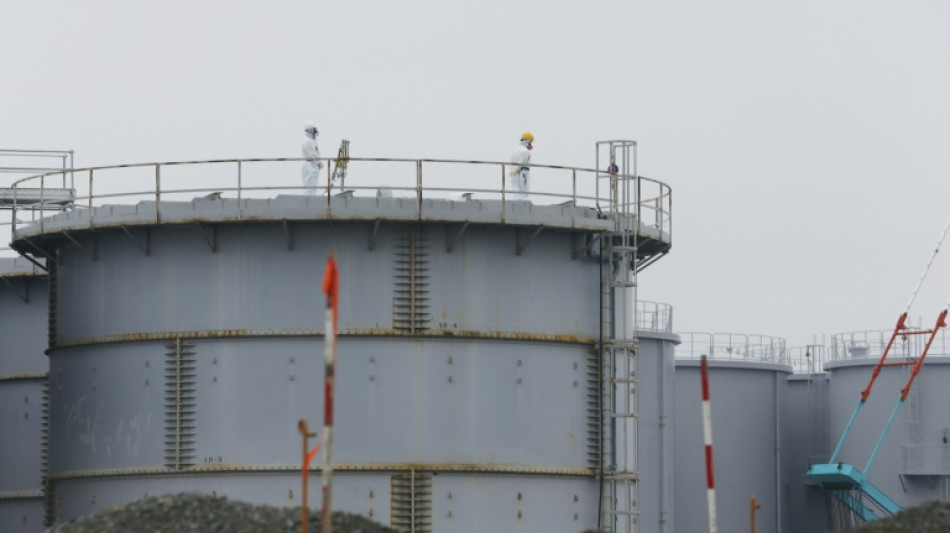
Japan begins release of water from Fukushima nuclear plant / Photo: SHIZUO KAMBAYASHI - POOL/AFP

 Reusser retains world time-trial title

 Man City outgun Sunderland despite Brobbey hat-trick, Liverpool win at Bournemouth

 Top US, Chinese economic officials meet ahead of Trump-Xi summit
 Erdogan's LGBTQ crackdown 'first step of election campaign': activist
 Mass drone barrage on Moscow kills two

 82-year-old dies after beach fight in Greece over sun lounger

 US warns of rapid escalation in Mideast war

 Iran 'put hearts on the court' to win Asian Games basketball bronze
 School girl Yu helps China dominate in Asian Games swimming openers

 Myanmar win first Asian Games teqball gold as Spain great Puyol watches

 China's 13-year-old Yu scorches to first major gold at Asian Games

 Russians vote on last day of parliamentary elections

 Hong Kong pays final respects to former city leader Tung

 Typhoon put people off Asian Games opening ceremony, official says

 China's 13-year-old Yu cruises as Asian Games swimming begins

 AI 'warning shots' focus Beijing on national security risks

 Philippine tribe in limbo over US-led tech hub

 Leo XIV, first US pope transcends his restrained style

 Singer Ed Sheeran says Gaza situation 'unjustifiable' following controversy

 In 'Tenzing', a Sherpa mountaineer gets his due

 Gridko's New Live Drive PTO Roll-Off Trailer Wins the Heavy-Duty TRAILmakER Award 2026 at NATDA Awards

 Chile's Bachelet quits race to be next UN chief

 Raphinha treble fires perfect Barca to win at Sevilla

 Thiam makes winning heptathlon return at Decastar meet

 Czechs beat USA to qualify for Davis Cup finals

Japan began releasing wastewater from the crippled Fukushima nuclear plant on Thursday in an operation it insists is safe but has generated a fierce backlash from China.
The beginning of the discharge of around 540 Olympic swimming pools' worth of water into the Pacific over several decades is a big step in decommissioning the still highly dangerous site 12 years after one of the world's worst nuclear accidents.
Live video provided by plant operator TEPCO showed engineers behind computer screens and an official saying -- after a countdown -- that the "valves near the seawater transport pumps are opening."
Monitors from the UN atomic watchdog, which has endorsed the plan, were due to be on site for the procedure, while TEPCO workers were scheduled to take water samples later on Thursday.
Ahead of the operation, about 10 people held a protest near the site and around 100 others gathered outside TEPCO headquarters in Tokyo, AFP journalists said.
"It's like dumping an atomic bomb in the ocean. Japan is the first country that was attacked with an atomic bomb in the world, and the prime minister of the country made this decision," said Kenichi Sato, 68.
China's environment ministry on Thursday blasted Japan's plan as "extremely selfish and irresponsible", saying it would "track and study" the impact on its waters.
- Multiple meltdowns -
With around 1,000 steel containers holding the water, TEPCO has said it needs to clear space for the removal of highly dangerous radioactive nuclear fuel and rubble from the wrecked reactors.
Three of the reactors at the Fukushima-Daiichi facility in northeastern Japan went into meltdown following a massive earthquake and tsunami that killed around 18,000 people in 2011.
Since then, TEPCO has collected 1.34 million cubic metres of water contaminated as it cooled the wrecked reactors, along with groundwater and rain that has seeped in.
TEPCO will carry out four releases of the treated water from Thursday until March 2024. The first discharge will take about 17 days.
About 5 trillion becquerels -- a measure of radioactivity -- of tritium will be released this fiscal year, TEPCO added.
Japan insists that all radioactive elements have been filtered out except the tritium, levels of which are harmless and lower than what is discharged by operational nuclear power plants, including in China.
This is backed by most experts.
"When released into the Pacific, the tritium is further diluted into a vast body of water and would quickly get to a radioactivity level which is not discernibly different from normal seawater," said Tom Scott from the University of Bristol in England.
"Hence, it poses very little risk and the risk itself decreases with time due to the relatively short radioactive half-life... meaning that the amount of tritium (and hence the risk) continually reduces."
- Sushi safety -
Not everyone is convinced, with environmental group Greenpeace saying that the filtration process is flawed, and China and Russia suggesting the water be vaporised and released into the atmosphere instead.
China has accused Japan of treating the Pacific like a "sewer", and even before the release, Beijing banned food imports from 10 out of 47 Japanese prefectures and imposed radiation checks.
Hong Kong and Macau, both Chinese territories, followed suit this week.
Restaurants in Beijing and Hong Kong serving sushi and sashimi are already reeling from the restrictions.
"About 80 percent of the seafood products we use come from Japan," Hong Kong caterer Jasy Choi, who runs a small kitchen for takeaway Japanese food, told AFP.
"If more than half of my Japan-imported ingredients are affected, then it would be difficult for me to continue to operate."
Analysts said that while China may have genuine safety concerns, its strong reaction is also at least in part motivated by its economic rivalry and frosty relations with Japan.
The South Korean government, which is seeking to improve ties with Japan, has not objected although many ordinary people are worried and have staged protests.
Social media posts in China and South Korea have included false claims about the release including doctored images of deformed fish with claims they were linked to Fukushima.
burs-stu/cwl
O.Ortiz--AT



