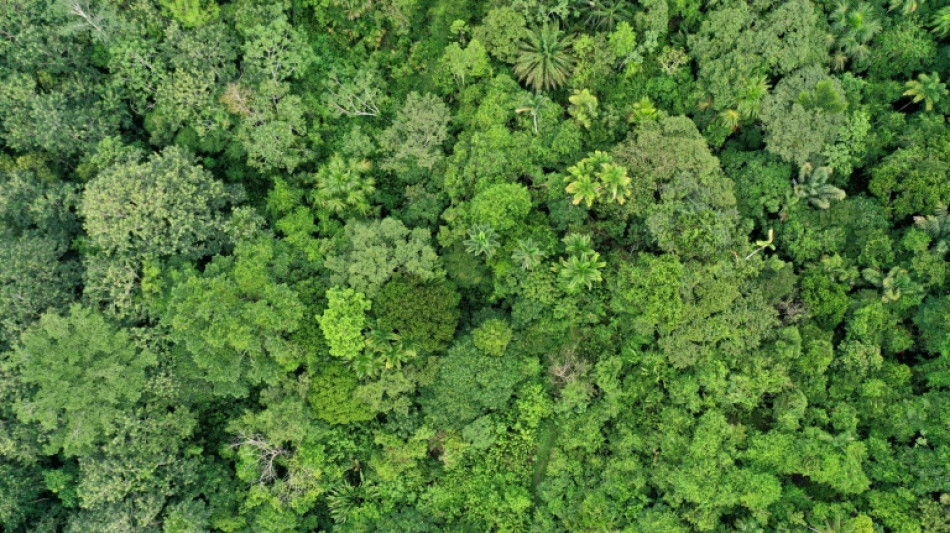
Tropical forests nearing critical temperatures thresholds / Photo: Raul ARBOLEDA - AFP

 Reusser retains world time-trial title

 Man City outgun Sunderland despite Brobbey hat-trick, Liverpool win at Bournemouth

 Top US, Chinese economic officials meet ahead of Trump-Xi summit
 Erdogan's LGBTQ crackdown 'first step of election campaign': activist

 Mass drone barrage on Moscow kills two

 82-year-old dies after beach fight in Greece over sun lounger

 US warns of rapid escalation in Mideast war

 Iran 'put hearts on the court' to win Asian Games basketball bronze

 School girl Yu helps China dominate in Asian Games swimming openers

 Myanmar win first Asian Games teqball gold as Spain great Puyol watches

 China's 13-year-old Yu scorches to first major gold at Asian Games

 Russians vote on last day of parliamentary elections

 Hong Kong pays final respects to former city leader Tung

 Typhoon put people off Asian Games opening ceremony, official says

 China's 13-year-old Yu cruises as Asian Games swimming begins

 AI 'warning shots' focus Beijing on national security risks

 Philippine tribe in limbo over US-led tech hub

 Leo XIV, first US pope transcends his restrained style

 Singer Ed Sheeran says Gaza situation 'unjustifiable' following controversy

 In 'Tenzing', a Sherpa mountaineer gets his due

 Gridko's New Live Drive PTO Roll-Off Trailer Wins the Heavy-Duty TRAILmakER Award 2026 at NATDA Awards

 Chile's Bachelet quits race to be next UN chief

 Raphinha treble fires perfect Barca to win at Sevilla

 Thiam makes winning heptathlon return at Decastar meet

 Czechs beat USA to qualify for Davis Cup finals

Global warming is driving leafy tropical canopies close to temperatures where they can no longer transform sunlight and CO2 into energy, threatening total collapse if the thermometer keeps climbing, according to a study Thursday.
A tiny percentage of upper canopy leaves have already crossed that threshold, reaching temperatures so high -- above 47 degrees Celsius -- as to prevent photosynthesis, the study published in Nature reported.
Currently, some leaves exceed such critical temperatures only 0.01 percent of the time, but impacts could quickly scale up because leaves warm faster than air, the researchers said.
"You heat the air by two to three degrees and the actual upper temperature of these leaves goes up by eight degrees," lead author Christopher Doughty of Northern Arizona University told journalists.
If tropical forest's average surface temperature warms 4C above current levels -- widely considered a worst-case scenario -- "we're predicting possible total leaf death," he said.
The new research suggests that leaf death could become a new factor in the predicted "tipping point" whereby tropical forests transition due to climate change and deforestation into savannah-like landscapes.
If air temperatures increase unabated by 0.03 C per year, the study projected, mass mortality among the canopies could happen in a little more than a century.
Doughty and his team used data from the NASA ECOSTRESS satellite -- designed to measure plant temperatures -- validated with ground observations, based in part on sensors attached to individual leaves.
- Increased tree death -
There remain uncertainties as to how high leaf temperatures might impact the forest as a whole, the scientists cautioned.
"Believe it or not, we don't know terribly much about why trees die," said co-author Gregory Goldsmith of Chapman University.
It doesn't take a scientist to know that when a tree loses its roots it dies, he said.
But the interactions and feedbacks between heat and drought -- and water and temperature -- on overall tree health aren't as clear.
Total leaf death might not necessarily mean total tree death.
The critical temperature at which leaves turn brown and die might also differ by species, depending on the size and thickness of their leaves and the breadth of their canopy.
But there are already concerning signs. In the Amazon, where temperatures are higher than in other tropical forests, the rate at which trees are dying has increased in recent decades.
"The Amazon is currently experiencing higher levels of mortality than Central Africa and that could possibly be due to the high temperatures we've seen there," said Doughty.
Increased fragmentation of the forests from deforestation has also been shown to make the remaining forest areas warmer.
Tropical biomes contain 45 percent of the Earth's forests, and play an outsized role in absorbing human-caused carbon pollution.
They also harbour half or more of the world's plant biodiversity, with at least 40,000 different tree species, according to the Intergovernmental Panel on Climate Change (IPCC).
The fact that a few leaves are overheating at current temperatures is a "canary in the coal mine," said senior author Joshua Fisher of Chapman University.
"You want to be able to detect something happening before it's widespread," he said.
"The fact that we can do that now gives us that ability to actually do something as a collective society."
Scientists not involved in the study said it should serve as a warning that nature's capacity to adapt to climate change has limits.
"It is true that trees and other kinds of vegetation can soak up emissions and provide cooling," commented Leslie Mabon, a lecturer in environmental systems at The Open University.
"However, this study illustrates that without concerted action by humans to reduce emissions and limit global heating at the same time as protecting and enhancing nature, some functions of nature may start to break down at higher temperatures."
P.Smith--AT