On the front line in Liberia's fight to save the pangolin

 Martin wins Austrian MotoGP sprint after Acosta crash

 Japan edge Fiji to win Pacific Nations Cup

 Black smoke, flames rising near Riyadh airport: residents to AFP

 UK actor Naomi Watts honoured at Spain film festival

 Japan emperor declares Asian Games open after turbulent build-up

 Asian Games open with unity message after troubled build-up

 Denmark hails 'binding' Greenland deal with Trump

 We don't want Games host Japan losing money, says Asian Olympic official

 Ed Sheeran returns to stage after Palestinian controversy

 Asian Games to open in Japan after troubled build-up

 Drone owners rush to offload devices ahead of Beijing ban

 Trump's beef policies irk Texas ranchers, testing their loyalty

 Kennedy Center: future unclear for iconic Washington arts hub

 Trump claims 'infinite' Greenland security deal with Denmark

 Helicopters battle wildfire threatening Ecuador's capital

 Brentford batter Chelsea to undo Alonso's promising start

 Kane hits Bundesliga century as Bayern rout Union

 Trump says CNN, MS NOW, Politico banned from White House

 Hushing and hedging: US companies retreat on climate

 Springboks to face Fiji before 2027 Rugby World Cup

 Nigeria miners struggled to breathe in cell before 37 died: survivors

 McIlroy on the charge at PGA Championship as Reed withdraws

 McIlroy on the charge at PGA Championship

 Crisis-wracked Volkswagen warns of 10-bn-euro hit to profits

 Costa Rica's Grynspan tops third informal poll for UN chief: diplomat

Clutching a single-barrelled rifle in lush northern Liberia, Emmanuel says his 10 children were able to get an education thanks to his gun.
The small wiry man, whose full name AFP is withholding, ignores a ban on hunting bushmeat and earns most of his cash catching pangolins or monkeys in the surrounding jungle.
In the dry season, Emmanuel waits for dark and then hikes into the jungle with his rifle and machete.
Pangolins, scale-covered insect-eating mammals that are typically the size of a full-grown cat, are mostly active at night, snuffling through deadwood for ants and termites.
The species is under increasing threat worldwide, but remains a delicacy in the impoverished West African country.
Their scales -- made of keratin, like human nails -- are also prized by consumers abroad for their supposed medicinal properties, fetching much-needed money.
"We kill it, we eat it," said Emmanuel, in a village in Gbarpolu County, five-hours drive north of the capital Monrovia along pitted dirt roads.
"Then the scales, we sell it," added the hunter. "There's no other option".
Believed to be the world's most trafficked animal, pangolins are only found in the wild in Asia and Africa, but their numbers are plummeting under pressure from poaching.
Asian pangolins once met the strong demand in East Asian countries such as China and Vietnam, where the animal's scales are used in traditional concoctions.
But Africa became the major source for the trade from 2013, according to the UN's drugs and crime office UNODC, in a shift likely prompted by falling pangolin numbers in Asia.
- Prime target -
Countries such as Liberia, as well as Nigeria, Cameroon and Guinea, are all origin markets.
Phillip Tem Dia, who works for Flora and Fauna International, a non-governmental organisation in Liberia, said pangolin killings "really, really increased" since the start of the scales trade.
Liberia is a prime target for traffickers. Over 40 percent of the country is covered in rainforest and governance is weak.
It is also still recovering from brutal civil wars from 1989 to 2003, and the 2014-16 Ebola crisis.
With conservationists sounding the alarm, Liberia's government has banned the hunting and sale of pangolins.
But it is battling a generations-old tradition of its impoverished citizens consuming the animal.
Patchy data hampers conservation efforts too. Pangolins are solitary and reclusive, and their number in the wild remains a mystery.
"There are huge gaps in our understanding," said Rebecca Drury, FFI head of wildlife trade.
Available evidence suggests a stark decline in numbers, however.
- 'Staggering' losses -
Known as "ants-bears" in Liberia after their favourite food, pangolins move at a waddle and have no jaws or teeth.
They roll up into a hedgehog-like ball when threatened. Their scales provide protection.
But humans can simply pick pangolins up and carry them off.
"They are very sensitive animals," said Julie Vanassche, the director of Liberia's Libassa Wildlife Sanctuary, near Monrovia, which rehabilitates rescued pangolins.
Many die of stress in captivity, she says, despite round-the-clock care.
The sanctuary has released 42 back into the wild since opening its doors 2017, but the number is likely a drop in the ocean.
A 2020 study by the US Agency for International Development estimated that between 650,000 and 8.5 million pangolins were removed from the wild between 2009 and 2020.
"Either way, the numbers are staggering," the study said, listing deforestation, bushmeat consumption, and the scales trade as reasons behind the decline in pangolins.
According to the UNODC, seizures of pangolin scales have also increased tenfold since 2014, suggesting a booming global trade. In July, China seized two tonnes of smuggled scales, for example.
Vanassche, a Belgian with a pangolin tattoo on her forearm, said the future is "not looking great".
"We need to act very fast -- it's almost over," she said.
- Market raids -
Outside a market in Monrovia, a forestry agent pours gasoline over a pile of confiscated bushmeat, and lights a match.
The mound of dead monkeys, and at least one pangolin, goes up in flames as women gather round to hurl abuse at a dozen agents from Liberia's Forestry Development Authority.
They have just conducted one their first market raids in the capital, after years of raising awareness about wildlife laws.
Liberia banned the sale of bushmeat in 2014 following the Ebola crisis.
In 2016, it also banned the unlicenced hunting of protected species, imposing up to six months in prison or a maximum $5,000 fine on wrongdoers.
The FDA agents -- all tall men who say they are dedicated to stopping the bushmeat trade -- appear to have little sympathy for the market traders, who are all women.
"Our protected species are being killed every day by poachers," said FDA anti-smuggling unit head Edward Appleton, in battledress, adding that the country's natural heritage was threatened.
But Comfort Saah, a market trader, was distraught as her merchandise burned by the roadside. She said she had lost the equivalent of nearly $3,000 in the raid.
The sum is enormous in a country where 44 percent of people survive on under $1.9 a day, according to World Bank figures.
"How are we going to live?" Saah said.
- 'We ate it' -
In rural areas, there are few signs of the government enforcing anti-poaching laws. Pangolin scales were ubiquitous in three villages in northern Gbarpolu County visited by AFP.
Many villagers had small bags stashed in wattle-and-daub homes. Some had sacks full.
"It's not easy to get them. The numbers are going down," said the chief hunter of one village, whose name AFP is withholding, dressed in a black tracksuit.
He explained he hunted because there were no jobs, and didn't understand why the practice was illegal.
Several local hunters said merchants tour the remote villages for scales, but that very few had come last year, suggesting that the pandemic had hampered them.
One young hunter told AFP he had sold scales within the last few months, however.
The product fetches comparatively little: A small plastic bag containing the scales of a couple of pangolins costs a few US dollars, according to several accounts.
The money often goes towards basic necessities such as soap, several said.
A 2020 study by the Netherlands-based Wildlife Justice Commission said that a kilogramme (2.2 pounds) of pangolins scales can sell for $355 in China.
Even during a lull in the scales market, pangolins are hunted for meat.
Matthew Shirley, the co-chair of the pangolin specialist group at the International Union for Conservation of Nature, told AFP it was "totally unrealistic" to expect people living in poverty not to eat protein-rich pangolins.
The focus should be on hunting sustainably, he said.
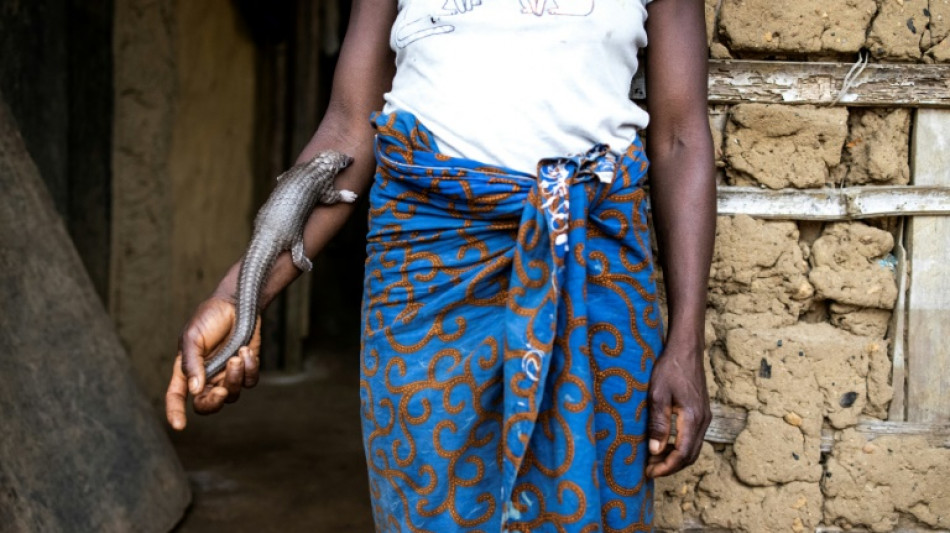
In one village, a woman named Mamie had a baby pangolin clinging to her body. Her husband had found it in a palm tree with its mother two days prior.
Ch.P.Lewis--AT



