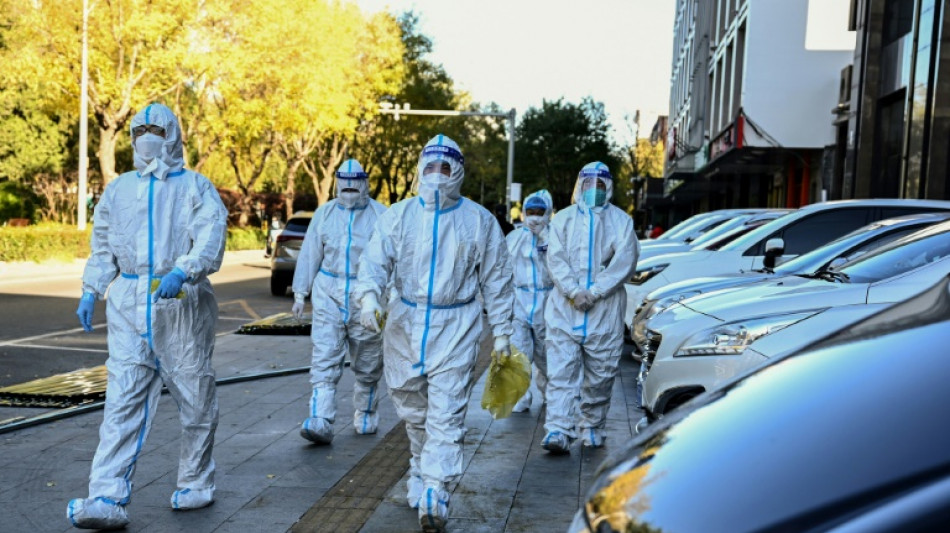
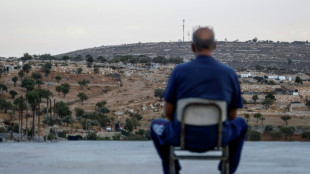
Confusion, fear cloud China's path out of zero-Covid / Photo: Noel CELIS - AFP/File

 Dangote to launch $16bn refinery in Kenya
 North Korean leader 'extremely obese': Seoul spy agency
 Yankees and pope-backed White Sox start MLB playoffs with wins
 Malaysia's ex-PM Mahathir in hospital for observation
 'No limits': Marathon world record holder Sawe chasing history

 Countdown begins to biggest-ever Rugby World Cup

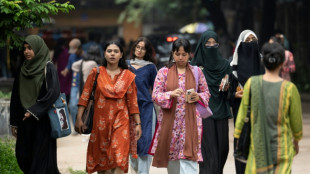 Bangladesh women lose ground after quota reform

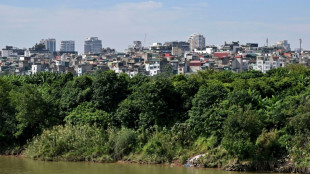 Vietnam admits 'differing opinions' on Hanoi development

 Stocks temper gains as oil pares heavy losses, US data in focus
 New Zealand denies breaching climate commitments to EU
 Albert becomes youngest US scorer in 4-2 win over Chile
 Pirate island's plunging population shows Greece's demographic decline
 With elections ahead, Latvia's Russian-speakers reject Moscow's help

 Brazil football clubs face massive sponsorship blow from betting ban
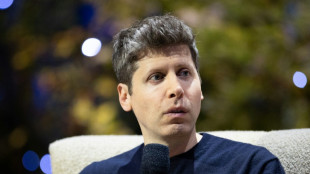 ChatGPT maker wants to be the App Store for AI as safety concerns grow

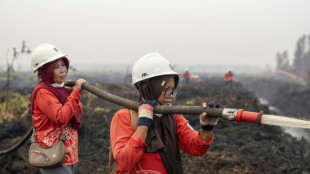 Women fight fires and sexism in Indonesian Borneo

 Forsling's OT blast lifts Florida over Carolina in NHL opener

 Alpha Growth Management Opens Rep Office in Japan

 NBA close to picking new $12-13bn Vegas team owners: report
 LA28 Olympics torch relay to visit all 50 states
 Spain brush aside Croatia in Nations League, England down Czechs
 Trump hails 'morally binding' AI self-regulation pledge
 Yamal inspires Spain to Croatia romp on World Cup homecoming

 UN to hold fourth informal poll of secretary-general candidates
 Who are the Emiratis behind crisis-hit Manchester City?
With megacities under lockdown, infection numbers climbing and sporadic protests, China's Covid-19 policy has reached a stalemate as authorities persist with seeking to contain the virus while trying to keep the economy alive.
China is the only major economy still attempting to stamp out the domestic spread of the virus, shutting down entire cities and placing contacts of infected patients into strict quarantine.
A series of new rules announced by Beijing earlier this month appeared to signal a shift away from the strategy, easing quarantine requirements for entering the country and simplifying a system for designating high-risk areas.
Yet daily cases driven by the evasive Omicron variant have neared 30,000 -- low compared to most other large countries but reaching peaks unseen since the chaotic days of Shanghai's harsh lockdown in the spring.
That has caused whiplash among China's urban residents, as officials first eased restrictions before reimposing curbs, all the while claiming to be finetuning the zero-Covid strategy personally championed by President Xi Jinping.
And the flip-flopping has rattled investors, causing global financial markets to wobble.
Yanzhong Huang, senior fellow for global health at the Council on Foreign Relations, told AFP it was too early to say if the new rules "signal that the central leadership is willing to give up zero-Covid anytime soon".
"Local governments' incentive structure has not been fundamentally changed by the new adjustments," Huang said, noting that lower level officials were still being held accountable for outbreaks.
- Mixed signals -
Chinese officials have responded to growing infections this month with vague and seemingly contradictory messaging that has sparked public confusion.
Multiple cities cancelled mandatory regular Covid tests last week, with some backtracking within days.
One of the capital's largest districts, Chaoyang, abruptly shuttered testing booths in its commercial areas early last week, with the faint explanation that it was in line with the central government's new Covid rules.
The closures were reversed the next day after local media reported that office workers had been left trawling residential compounds for hours in search of an open testing booth as public spaces tightened testing requirements over a surge in cases.
Public anger over seemingly arbitrary restrictions and sudden disruptions has erupted in numerous protests in recent months, including in southern China's Guangzhou this month when hundreds of residents took to the streets.
"Most officials in China know that the policy as it is no longer makes sense, but no one can fail to implement it as it is Xi's policy and must be upheld," Steve Tsang, director of the SOAS China Institute in London, told AFP.
"We are seeing some adjustments being made without sufficient clarity," he said.
Alfred Wu, associate professor at Singapore's Lee Kuan Yew School of Public Policy, said there was a growing tension between the goals of the central government and those of local officials.
"The anger actually comes from ordinary people and also local public officials," whose resources and time are spent overwhelmingly on zero-Covid measures, Wu told AFP.
- Reopening risks -
Another year of zero-Covid could mean the "Chinese economy will be derailed and social tensions may reach a tipping level, which threatens regime stability and may even cause a legitimacy crisis", Huang of the CFR said.
But opening up too suddenly could also threaten stability, as the country may "face a viral wave that results in mass die-off and quickly overwhelms its fragile healthcare system", he told AFP.
China has not yet approved more effective mRNA vaccines for public use, and only 85 percent of adults over 60 had received two doses of domestic vaccines by mid-August, according to Chinese health authorities.
Nomura analysts said on Monday the road to reopening could be "slow and bumpy".
"Reopening could be back and forth as policymakers may back down after observing rapid increases in cases and social disruptions," they said in a report.
They predicted a negative impact on GDP growth when Covid cases surge after the zero-Covid policy is lifted, as "a large percentage of the Chinese population may still believe Omicron has a high mortality rate."
Messaging on the virus will be a major challenge for Chinese authorities as they navigate a return to normality.
"The scary propaganda about the virus and how other countries have fared worse than China, ironically, is coming back to bite CCP leaders who may now indeed be eager to relax the very invasive and costly anti-Covid measures," Fei-Ling Wang, international affairs professor at Georgia Tech, told AFP.
"A quick turnaround to open up would risk losing face for the leaders," he said.
J.Gomez--AT


