Australia's 'irreplaceable' platypus threatened by dams: study / Photo: Handout - Thomas Rayner/AFP

 Dangote to launch $16bn refinery in Kenya

 North Korean leader 'extremely obese': Seoul spy agency

 Yankees and pope-backed White Sox start MLB playoffs with wins

 Malaysia's ex-PM Mahathir in hospital for observation

 'No limits': Marathon world record holder Sawe chasing history

 Countdown begins to biggest-ever Rugby World Cup
 Bangladesh women lose ground after quota reform

 Vietnam admits 'differing opinions' on Hanoi development

 Stocks temper gains as oil pares heavy losses, US data in focus

 New Zealand denies breaching climate commitments to EU

 Albert becomes youngest US scorer in 4-2 win over Chile
 Pirate island's plunging population shows Greece's demographic decline

 With elections ahead, Latvia's Russian-speakers reject Moscow's help

 Brazil football clubs face massive sponsorship blow from betting ban

 ChatGPT maker wants to be the App Store for AI as safety concerns grow

 Women fight fires and sexism in Indonesian Borneo

 Forsling's OT blast lifts Florida over Carolina in NHL opener

 Alpha Growth Management Opens Rep Office in Japan

 NBA close to picking new $12-13bn Vegas team owners: report

 LA28 Olympics torch relay to visit all 50 states

 Spain brush aside Croatia in Nations League, England down Czechs

 Trump hails 'morally binding' AI self-regulation pledge

 Yamal inspires Spain to Croatia romp on World Cup homecoming

 UN to hold fourth informal poll of secretary-general candidates

 Who are the Emiratis behind crisis-hit Manchester City?

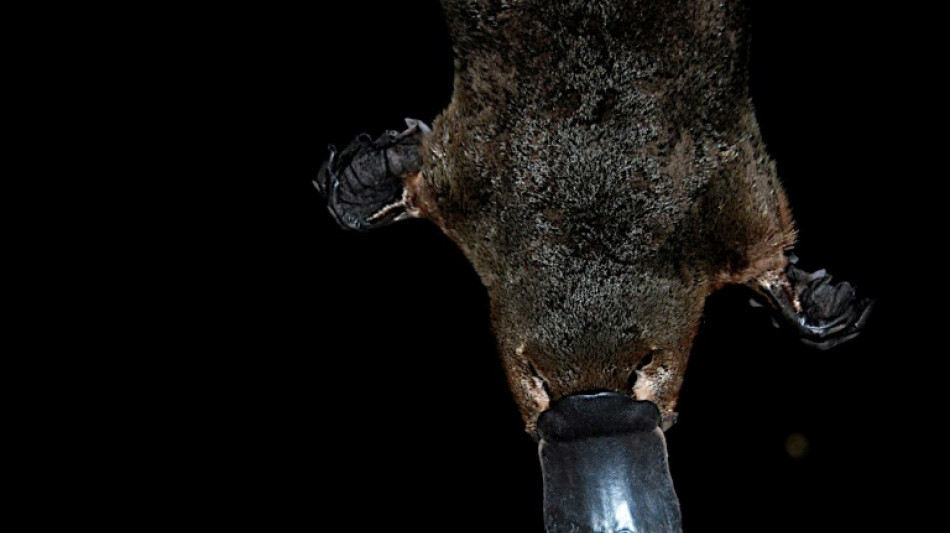
The future of the platypus, a unique duck-billed, egg-laying mammal only found in Australia, is under threat because they cannot climb over tall river dams, according to a new study.
The platypus is an oddity in many ways. As well as its duck-like bill and egg-laying, it is a rare venomous mammal, brandishing centimetre-long poisonous spurs on its hind legs.
They are also one of the only mammals who can locate prey by detecting electric fields and whose fur glows blue-green under an ultraviolet light. Platypuses even have 10 sex chromosomes -- most mammals have two.
But the number of platypuses has fallen by 50 percent since Europeans settled Australia more than two centuries ago, according to previous research.
Its habitat has increasingly come under threat from climate change-fuelled extreme weather events including drought and fire. They are also preyed upon by invasive species such as foxes, cats and dogs.
A new study published in the journal Communications Biology this week identified a new threat: platypuses are not able to climb over large, human-madedams in rivers.
The study's lead author, Jose Luis Mijangos of the University of New South Wales, told AFP that "there might be as few as 30,000 mature platypuses" left in Australia.
More than three quarters of Australia's dams measuring over 10 metres (33 feet) are in regions where platypuses live, the study said.
Some platypuses, which mostly live in rivers and streams but can use their webbed feet to walk on land, have been reported to be able to cross smaller dams.
But they cannot get over taller dams, isolating the animals from each other, the study found.
- Increased inbreeding -
The researchers took the DNA samples of 274 platypuses from nine rivers in the states of Victoria and New South Wales. Five of the rivers have dams between 85 to 180 metres tall, while the others flow unimpeded.
Comparing the samples, they found that genetic differences were four to 20 times higher in platypus populations around the dammed rivers compared to those not living near dams, indicating the first group rarely mixed with others.
They also estimated that the genetic differences had increased in every platypus generation since the nearby dams had been completed.
"These results suggest that almost no or no platypuses have passed around the dams since they were built," Mijangos said.
As a result, "populations are fragmented, which means that the ability to recolonise available habitat or migrate to areas with more suitable conditions is restricted," he added.
"Fragmentation also simultaneously reduces both local population size and gene flow, each of which is expected to lead to increased inbreeding and reduction of the genetic variation."
To address the problem, the researchers propose structures be built to help the platypuses scale the dams. They also suggested that humans could relocate some platypuses to promote diversity.
After all, the platypus is too weird to be lost.
"Platypuses are arguably the most irreplaceable mammal because they have a unique combination of features," Mijangos said.
A.Moore--AT