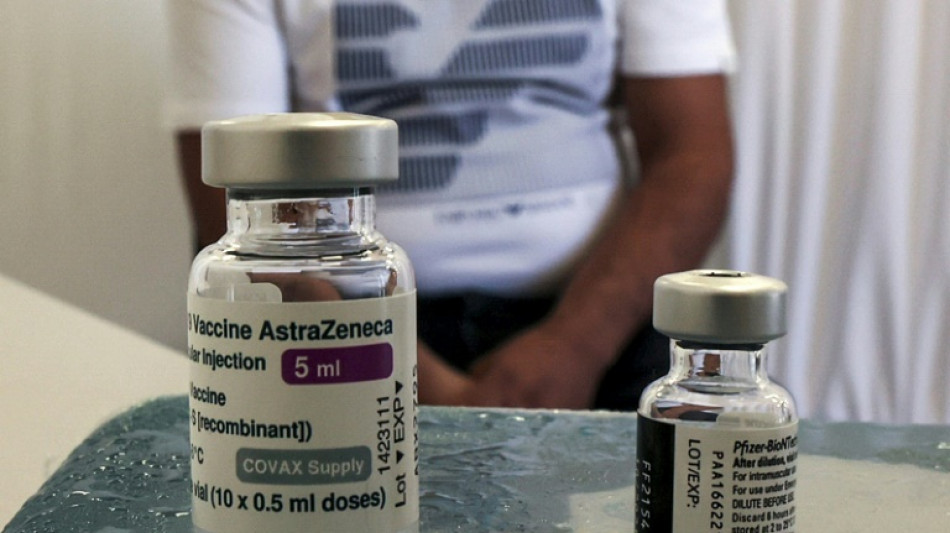
Study confirms AstraZeneca jab's higher risk of very rare clot / Photo: ABBAS MOMANI - AFP/File

 Dangote to launch $16bn refinery in Kenya

 North Korean leader 'extremely obese': Seoul spy agency

 Yankees and pope-backed White Sox start MLB playoffs with wins

 Malaysia's ex-PM Mahathir in hospital for observation

 'No limits': Marathon world record holder Sawe chasing history

 Countdown begins to biggest-ever Rugby World Cup

 Bangladesh women lose ground after quota reform

 Vietnam admits 'differing opinions' on Hanoi development

 Stocks temper gains as oil pares heavy losses, US data in focus

 New Zealand denies breaching climate commitments to EU

 Albert becomes youngest US scorer in 4-2 win over Chile

 Pirate island's plunging population shows Greece's demographic decline
 With elections ahead, Latvia's Russian-speakers reject Moscow's help

 Brazil football clubs face massive sponsorship blow from betting ban

 ChatGPT maker wants to be the App Store for AI as safety concerns grow

 Women fight fires and sexism in Indonesian Borneo

 Forsling's OT blast lifts Florida over Carolina in NHL opener

 Alpha Growth Management Opens Rep Office in Japan

 NBA close to picking new $12-13bn Vegas team owners: report
 LA28 Olympics torch relay to visit all 50 states

 Spain brush aside Croatia in Nations League, England down Czechs

 Trump hails 'morally binding' AI self-regulation pledge

 Yamal inspires Spain to Croatia romp on World Cup homecoming

 UN to hold fourth informal poll of secretary-general candidates
 Who are the Emiratis behind crisis-hit Manchester City?

AstraZeneca's Covid vaccine has been linked to a 30-percent higher risk of getting a very rare blood clotting condition compared to the Pfizer jab, a large international study said Thursday.
Several countries have already altered their advice after previous research indicated that -- in a tiny number of cases -- thrombosis with thrombocytopenia syndrome (TTS) can be a possible side effect of Covid vaccines that use an adenovirus vector, or "engineered" virus, such as those from AstraZeneca and Johnson & Johnson.
Thrombocytopenia produces potentially life-threatening blood clots with low levels of blood platelets -- the small cell fragments in our blood that prevent bleeding.
The new study, published in the journal BMJ, was the first to compare thrombocytopenia rates between adenovirus and mRNA vaccines -- such as Pfizer -- across multiple countries.
The international research team analysed health data from more than 10 million adults in France, Germany, the Netherlands, Spain, the United Kingdom and the United States who received at least one vaccine dose between December 2020 and mid-2021.
In Germany and the UK, they matched the data of 1.3 million people who had a first dose of AstraZeneca to 2.1 million who took Pfizer.
There were a total of 862 "thrombocytopenia events" recorded in the 28 days after a first dose of AstraZeneca, compared to 520 for Pfizer, the study said.
That meant AstraZeneca's vaccine had a 30-percent higher risk of thrombocytopenia than Pfizer.
However when it came to a second dose, there was no additional risk between any of the vaccines.
The study was observational, meaning it could not show cause and effect. But the researchers said that additional analysis found the results to be consistent.
While very rare, these risks "should be considered when planning further immunisation campaigns and future vaccine development," the study said.
- 'Safe and effective' -
Sarah Pitt, a microbiologist at the UK's Brighton University who was not involved in the research, said the "well-designed" study "adds to the data showing that all vaccines are safe and effective".
The "extremely rare" cases of thrombocytopenia occurred after just 0.04 percent of vaccine doses in Germany and the UK, she told AFP.
Most countries had already been avoiding using adenovirus Covid vaccines for the older and young age groups who are more at risk, she added.
European countries have largely pivoted towards mRNA vaccines. AstraZeneca's jab was never authorised in the US, which limited the use of the Janssen (Johnson & Johnson) COVID-19 jab to certain individuals earlier this year
However both AstraZeneca and Johnson & Johnson's vaccines play a pivotal role in Covax global vaccine distribution scheme, which provides doses to lower-income countries.
P.Smith--AT