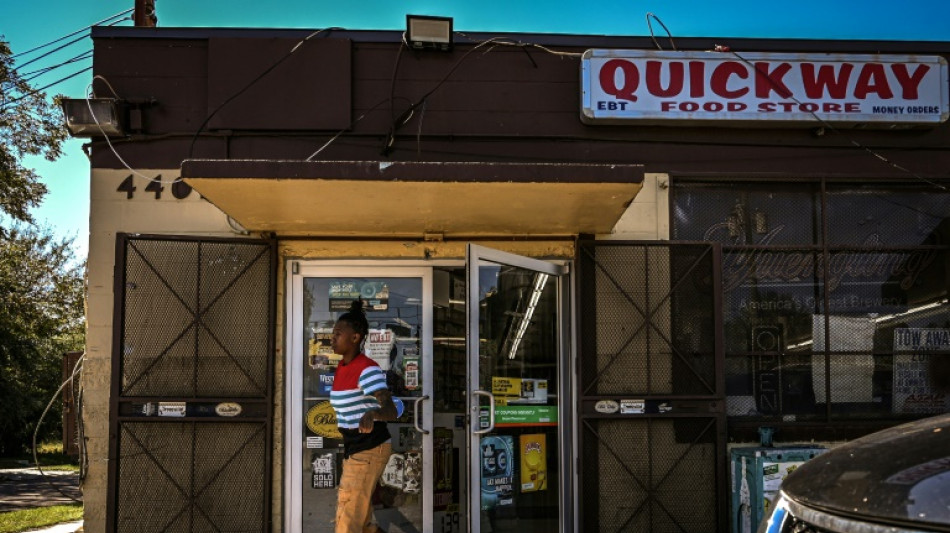
In a Florida 'food desert,' a gnawing sense of being left behind / Photo: Giorgio VIERA - AFP/File

 Dangote to launch $16bn refinery in Kenya
 North Korean leader 'extremely obese': Seoul spy agency
 Yankees and pope-backed White Sox start MLB playoffs with wins
 Malaysia's ex-PM Mahathir in hospital for observation

 'No limits': Marathon world record holder Sawe chasing history

 Countdown begins to biggest-ever Rugby World Cup
 Bangladesh women lose ground after quota reform
 Vietnam admits 'differing opinions' on Hanoi development
 Stocks temper gains as oil pares heavy losses, US data in focus
 New Zealand denies breaching climate commitments to EU

 Albert becomes youngest US scorer in 4-2 win over Chile
 Pirate island's plunging population shows Greece's demographic decline
 With elections ahead, Latvia's Russian-speakers reject Moscow's help
 Brazil football clubs face massive sponsorship blow from betting ban
 ChatGPT maker wants to be the App Store for AI as safety concerns grow

 Women fight fires and sexism in Indonesian Borneo

 Forsling's OT blast lifts Florida over Carolina in NHL opener

 Alpha Growth Management Opens Rep Office in Japan

 NBA close to picking new $12-13bn Vegas team owners: report
 LA28 Olympics torch relay to visit all 50 states
 Spain brush aside Croatia in Nations League, England down Czechs
 Trump hails 'morally binding' AI self-regulation pledge
 Yamal inspires Spain to Croatia romp on World Cup homecoming

 UN to hold fourth informal poll of secretary-general candidates
 Who are the Emiratis behind crisis-hit Manchester City?

Sitting outside her modest home in Jacksonville, Florida, on a street lined with nondescript buildings in faded shades of blue, a weary Brenda Jenkins expresses a simple wish: to be able to buy fresh fruit and produce in her own neighborhood.
It sounds simple enough. But for people like her, one of the 39 million Americans living in "food deserts" -- most of them low-income urban dwellers, and predominantly people of color -- fresh food is practically inaccessible.
In a country with often poor mass transit and persistent pockets of poverty, getting to grocery stores that sell fresh food can be daunting.
"It's very tiring," said the 26-year-old Jenkins, a mother of three.
The phrase "food desert" is misleading. The problem is not so much that fresh food is unavailable, as that it can be hard to get to, in a country where the car is king -- but also expensive.
There are no supermarkets in Jenkins' nearly all-Black neighborhood in the large city of Jacksonville on Florida's northern Atlantic coast.
Service stations, fast food restaurants and mom-and-pop groceries provide the only nearby food options.
Their shelves bulge with candy, chips, soda and cookies. But the only fresh products are likely to be a few wan-looking apples or bruised bananas near the cash register.
Yet the poorest residents have no other option. The city's mass transit system is skeletal. And the nearest supermarket is nearly an hour's walk away.
Jenkins has a car, and she often takes neighbors with her when she goes shopping.
But "what if I decided to move or what if I had something to do?" she asked. "How can they get groceries?"
And when her car breaks down -- a not-infrequent occurrence -- she has had no choice but to buy "processed foods" from a corner grocery -- "and it's just not healthy, especially with children."
With US midterm elections just weeks away -- and the prospect of major change in the Congress -- Jenkins complained that she has seen no candidates in her neighborhood, and received no campaign leaflets.
She thinks politicians ignore her area "because we're considered low-income."
If the authorities really cared, she said, "something would have been done" to address the food desert problem.
- 'A human right' -
The once-prosperous neighborhood has progressively fallen on hard times over the decades, making it less and less profitable for the big supermarket chains.
When the last one closed, "people lost access to healthy food," said Mika Hardison-Carr, a Black woman who manages a collective garden called White Harvest Farms.
Over time, local residents simply got used to living in a food desert and getting by on "processed food, canned food (and) noodles," said Hardison-Carr, holding a freshly picked kumquat.
"It is absolutely hard to change people's way of life," she said.
So the challenge now, Hardison-Carr added, is not just to give people access to fresh foods but to teach them to again make those foods a part of their daily diet.
Limited food options and poor eating habits are "contributing to all of these health issues that's causing us to die earlier, to be sicker, to be fatter," she said.
And she is adamant about this: "Access to fresh, healthy food should be a human right."
Her urban farm, created by the Clara White Mission with the help of public funds, provides free produce to the volunteers who help with the garden, and a low-price option to others in the neighborhood, who can pay with the federal food stamps that so many rely on.
On this autumn day, with Florida's normally stifling heat beginning to turn balmy, people are at work in the garden, a rare patch of green in the neighborhood's gritty urban landscape.
To attract buyers, the farm's crops include vegetables -- like collard greens -- that are essential to Southern and African-American cooking.
"They've already been in here asking us when the greens are ready," 43-year-old volunteer Nicole Boone noted with a laugh, adding, "we just seeded them!"
She has been with the program since it began last year.
Nearby, Sarah Salvatore, another garden manager, is planting flowers to attract insects that will help avoid the need for pesticides.
"Food deserts are very easy to eliminate," she said, hunched over her plants.
"We have to elect people that are putting their energy towards solving these issues," Salvatore said, "because they're solvable -- they're just underfunded."
F.Wilson--AT