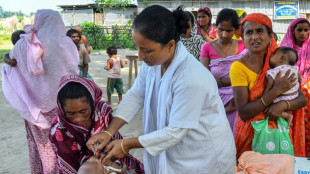
Rising obesity projected to hamper developing economies: report / Photo: MIGUEL RIOPA - AFP/File

 'No limits': Marathon world record holder Sawe chasing history

 Countdown begins to biggest-ever Rugby World Cup

 Bangladesh women lose ground after quota reform

 Vietnam admits 'differing opinions' on Hanoi development

 Stocks temper gains as oil pares heavy losses, US data in focus

 New Zealand denies breaching climate commitments to EU

 Albert becomes youngest US scorer in 4-2 win over Chile

 Pirate island's plunging population shows Greece's demographic decline
 With elections ahead, Latvia's Russian-speakers reject Moscow's help

 Brazil football clubs face massive sponsorship blow from betting ban

 ChatGPT maker wants to be the App Store for AI as safety concerns grow

 Women fight fires and sexism in Indonesian Borneo

 Forsling's OT blast lifts Florida over Carolina in NHL opener

 Hurricane Polo sweeps over Mexico's Pacific coast, heads inland

 Grynspan pulls ahead in race to lead UN: diplomat

 Trump touts AI boss pledge to self-regulate

 Oil down, but stocks lower as bond yields rise

 England break down stubborn Czechs to claim first Nations League win
 UN Security Council extends Haiti anti-gang force by 6 months

 Manchester City guilty of Premier League charges: What comes next?

 Man City chief Soriano slams Premier League 'conspiracy theory'

 Hurricane Polo sweeps over Mexico's Pacific coast

 Man City must be relegated after guilty verdict says club's former chairman

 German far-right aims to lead Saxony-Anhalt govt in December

 Little damage as Hurricane Polo sweeps over Mexico's Pacific coast

Rising levels of obesity are set to cost the world economy 3.3 percent of GDP by 2060, slowing development in lower-income countries and making it hard for people to lead healthy lives, according to a new study published Wednesday.
The peer-reviewed paper, published in BMJ Global Health, provides the first country-by-country estimate of the economic impacts of obesity, a major driver of other non-communicable diseases such as cancer, diabetes and heart conditions.
It also included projections for the numbers of people in each country who are overweight or obese -- defined as a body mass index in adults greater or equal to 25 and 30, respectively.
"Globally, nearly two in three adults are now living with overweight and obesity. And we project that will be three in four adults by 2060," lead author Rachel Nugent told reporters at a briefing on the margins of the UN General Assembly.
The conditions currently cost 2.2 percent of global GDP, and the biggest increases are expected to be seen in lower-resourced countries.
China, the United States and India are projected to experience the highest impact in absolute terms -- costing the countries $10 trillion, $2.5 trillion and $850 billion, respectively.
As a proportion of the economy, the worst impacted countries are set to include the United Arab Emirates, where obesity would account for 11 percent of GDP, and Trinidad and Tobago at 10.2 percent.
The report analyzed both direct costs, made up primarily of medical fees, and indirect costs from premature mortality and lost productivity. Previous papers had only focused on the former.
"Less visible costs constitute a drag on development," said Nugent, vice president of non-communicable diseases at non-profit research firm RTI International.
"We could be developing and growing faster, and improving people's livelihoods faster, if we were not sort of experiencing this lower productivity, early mortality."
- No to stigma -
Population and economic growth are the primary drivers of obesity prevalence -- as countries increase their incomes, they experience changes in diet to highly processed foods, she explained.
In rich nations, aging populations are also a major factor as older people find it harder to lose weight.
Francesco Branca of the World Health Organization said there were a number of ways to respond to the obesity epidemic and avoid the worst outcomes.
"Having policies that, for example, shape the pricing of food -- so the foods which are contributing most to obesity, such as drinks or foods high in fat and sugars need to be priced higher," he said.
Other steps include better labeling -- and in addition to prevention measures, better access to counseling and drug therapies as treatments.
The report stressed the economic costs of high weight and obesity "are not attributable to individual behavior" but rather a consequence of social and commercial priorities shaping environments.
As such, responsibility for tackling the issues lies with those in power.
"We need to recognize that obesity is a complex disease with complex interactions and solutions and stop blaming these conditions on individuals, stop the stigma," said Simon Barquera, director of Mexico's Nutrition and Health Research Center.
T.Sanchez--AT