The Ebola virus: profile of a dreaded killer / Photo: © AFP

 'No limits': Marathon world record holder Sawe chasing history

 Countdown begins to biggest-ever Rugby World Cup

 Bangladesh women lose ground after quota reform
 Vietnam admits 'differing opinions' on Hanoi development
 Stocks temper gains as oil pares heavy losses, US data in focus
 New Zealand denies breaching climate commitments to EU

 Albert becomes youngest US scorer in 4-2 win over Chile
 Pirate island's plunging population shows Greece's demographic decline
 With elections ahead, Latvia's Russian-speakers reject Moscow's help
 Brazil football clubs face massive sponsorship blow from betting ban
 ChatGPT maker wants to be the App Store for AI as safety concerns grow
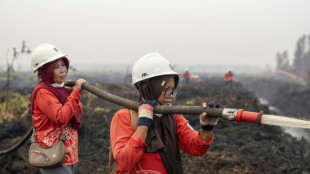 Women fight fires and sexism in Indonesian Borneo

 Forsling's OT blast lifts Florida over Carolina in NHL opener

 Hurricane Polo sweeps over Mexico's Pacific coast, heads inland

 Grynspan pulls ahead in race to lead UN: diplomat

 Trump touts AI boss pledge to self-regulate

 Oil down, but stocks lower as bond yields rise

 England break down stubborn Czechs to claim first Nations League win
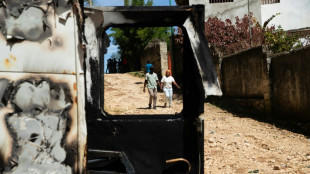 UN Security Council extends Haiti anti-gang force by 6 months

 Manchester City guilty of Premier League charges: What comes next?
 Man City chief Soriano slams Premier League 'conspiracy theory'

 Hurricane Polo sweeps over Mexico's Pacific coast

 Man City must be relegated after guilty verdict says club's former chairman

 German far-right aims to lead Saxony-Anhalt govt in December
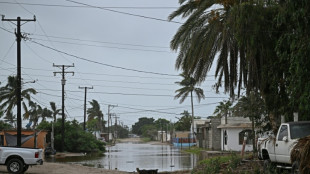 Little damage as Hurricane Polo sweeps over Mexico's Pacific coast

The highly contagious Ebola virus has claimed more than 15,000 lives since it was first identified in central Africa in 1976.
On Tuesday, Uganda announced its first Ebola fatality since 2019 in an outbreak in the central district of Mubende.
Here is a factfile on one of the world's most deadliest diseases:
- Origins -
Ebola is a viral haemorrhagic fever that was first discovered in the Democratic Republic of Congo (DR Congo).
Five of the virus species are known to cause disease in humans -- Zaire, Sudan, Bundibugyo, Reston and Tai Forest.
The first three have resulted in serious outbreaks in Africa.
The 24-year-old man whose death was announced Tuesday in Uganda tested positive for the Sudan strain.
- Transmission -
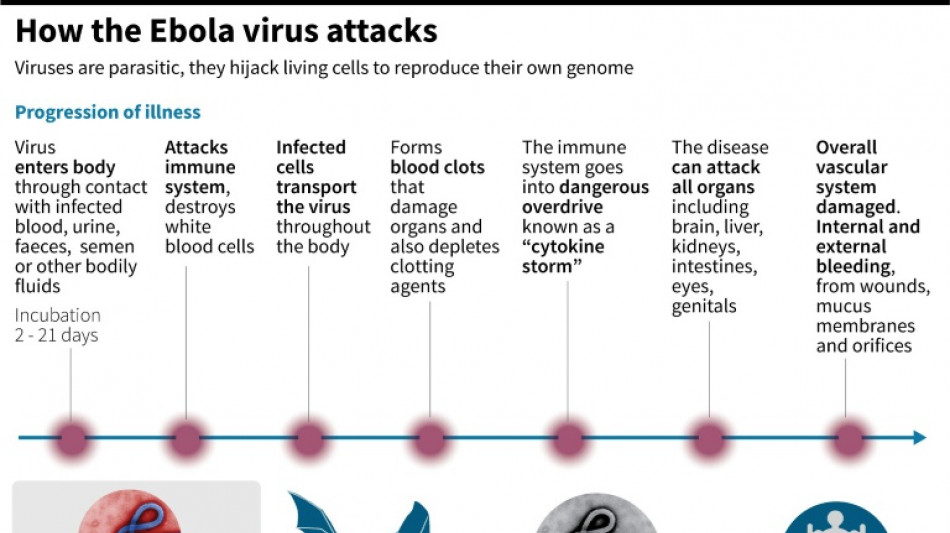
The virus' natural reservoir animal is suspected to be a species of fruit bat, which does not itself fall ill but can pass the disease on to primates, including humans. Humans become exposed to the virus if they kill or butcher infected bats for food.
Among humans, the virus is passed on by contact with the blood, body fluids, secretions or organs of an infected or recently deceased person.
Those infected do not become contagious until symptoms appear. They become more and more contagious until just after their death, which poses great risks during funerals.
Death rates are high, at around 50 percent on average of those infected, and up to 90 percent for some epidemics, World Health Organization (WHO) data show.
- Symptoms -
Following an incubation period of between two and 21 days, Ebola develops into a high fever, weakness, intense muscle and joint pain, headaches and a sore throat.
The initial symptoms are often followed by vomiting and diarrhoea, skin eruptions, kidney and liver failure, and sometimes internal and external bleeding.
- Vaccines and treatment -
Merck's Ervebo vaccine, the first Ebola jab approved by the US Food and Drug Administration (FDA) in December 2019, has been shown to be highly effective in protecting people from the Zaire strain.
US group Johnson & Johnson has also reported promising results against the Zaire strain of its two-dose Zabdeno vaccine, which has been authorised for use in the European Union.
In terms of treatment, the WHO in August recommended two life-saving medicines, Inmazeb and Ebanga, which were successfully trialled during Ebola outbreaks.
- Worst outbreaks -
The worst-ever outbreak began in December 2013 in southern Guinea before spreading to two neighbouring West African countries, Liberia and Sierra Leone.
More than 11,300 people were killed, according to WHO estimates.
The second-deadliest took place between 2018 and 2020 in DR Congo's conflict-plagued North Kivu province and killed 2,299 people according to the WHO.
DR Congo has experienced 14 Ebola outbreaks since the 1970s.
The first person infected outside Africa was a Spanish nurse who caught the disease in 2014 after cleaning the hospital room of a Spanish missionary who was repatriated from West Africa with the virus. The missionary died but the nurse survived.
E.Hall--AT