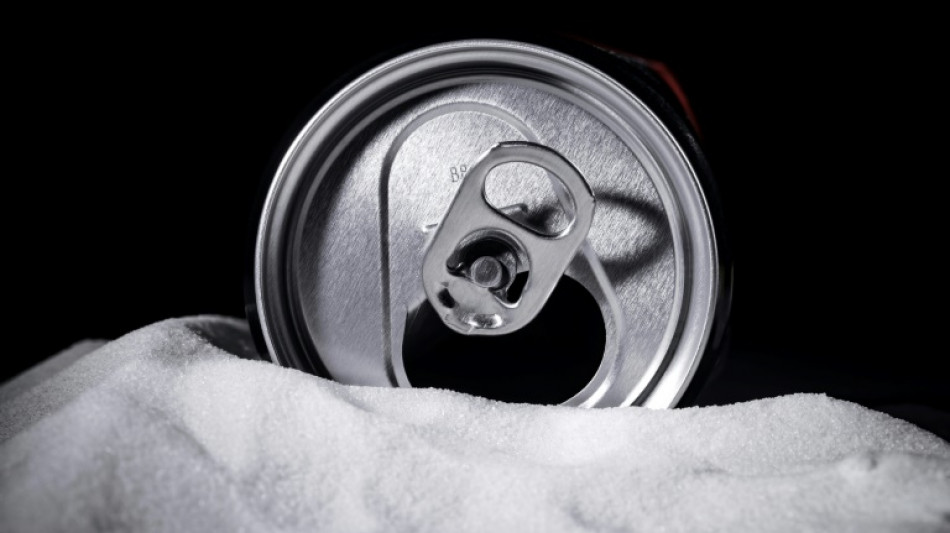
Sweeteners may be linked to heart disease risk, study suggests / Photo: JOEL SAGET - AFP/File

 'No limits': Marathon world record holder Sawe chasing history

 Countdown begins to biggest-ever Rugby World Cup

 Bangladesh women lose ground after quota reform

 Vietnam admits 'differing opinions' on Hanoi development

 Stocks temper gains as oil pares heavy losses, US data in focus

 New Zealand denies breaching climate commitments to EU

 Albert becomes youngest US scorer in 4-2 win over Chile

 Pirate island's plunging population shows Greece's demographic decline

 With elections ahead, Latvia's Russian-speakers reject Moscow's help

 Brazil football clubs face massive sponsorship blow from betting ban

 ChatGPT maker wants to be the App Store for AI as safety concerns grow

 Women fight fires and sexism in Indonesian Borneo

 Forsling's OT blast lifts Florida over Carolina in NHL opener

 Hurricane Polo sweeps over Mexico's Pacific coast, heads inland

 Grynspan pulls ahead in race to lead UN: diplomat

 Trump touts AI boss pledge to self-regulate

 Oil down, but stocks lower as bond yields rise

 England break down stubborn Czechs to claim first Nations League win

 UN Security Council extends Haiti anti-gang force by 6 months

 Manchester City guilty of Premier League charges: What comes next?

 Man City chief Soriano slams Premier League 'conspiracy theory'

 Hurricane Polo sweeps over Mexico's Pacific coast

 Man City must be relegated after guilty verdict says club's former chairman

 German far-right aims to lead Saxony-Anhalt govt in December

 Little damage as Hurricane Polo sweeps over Mexico's Pacific coast

A large study suggested Thursday that artificial sweetener could be associated with a higher risk of heart disease, however experts urged caution about the findings.
Sweeteners are consumed by millions every day in products like diet soda, partly as a way to avoid weight gain from sugar -- but the healthiness of these substitutes has long been a matter of controversy.
Aiming to assess the heart disease risk of sweeteners, researchers at the French INSERM institute analysed the data of more than 100,000 adults in France who self-reported their diet, lifestyle and medical history between 2009-2021 as part of the NutriNet-Sante study.
Thirty-seven percent of the participants consumed artificial sweeteners, with an average intake of 42 milligrams a day -- the equivalent of one packet of sweetener or about a third of a can of diet soda.
During the nine-year follow-up period, 1,502 heart problems were recorded, including heart attack, angina and stroke.
The research, published in the journal BMJ, indicated that heart disease occurred in 346 out of 100,000 people who consume a high level of sweetener, compared to 314 per 100,000 for non-consumers.
"These results, in line with the latest WHO report published this year, do not support the use of sweeteners as a safe alternative to sugar," said INSERM's Mathilde Touvier, who coordinated the study.
An April report from the World Health Organization said that "there is no clear consensus on whether non-sugar sweeteners are effective for long-term weight loss or maintenance, or if they are linked to other long-term health effects".
Another study published earlier this year using Nutri-Net data found a correlation between cancer and sweeteners such as aspartame, acesulfame potassium and sucralose.
However such observational studies have come under increased criticism because they cannot establish the cause of the differences they find, which could come from other sources.
Naveed Sattar, a professor of metabolic medicine at Glasgow University not involved in the sweetener study, said that it "cannot answer the question posed".
"This is because there are clearly major differences in many characteristics of people who consume artificial sweeteners compared to those who do not consume any," he said.
He called for governments to fund long-term, randomised trials "to get closer to the truth".
W.Morales--AT