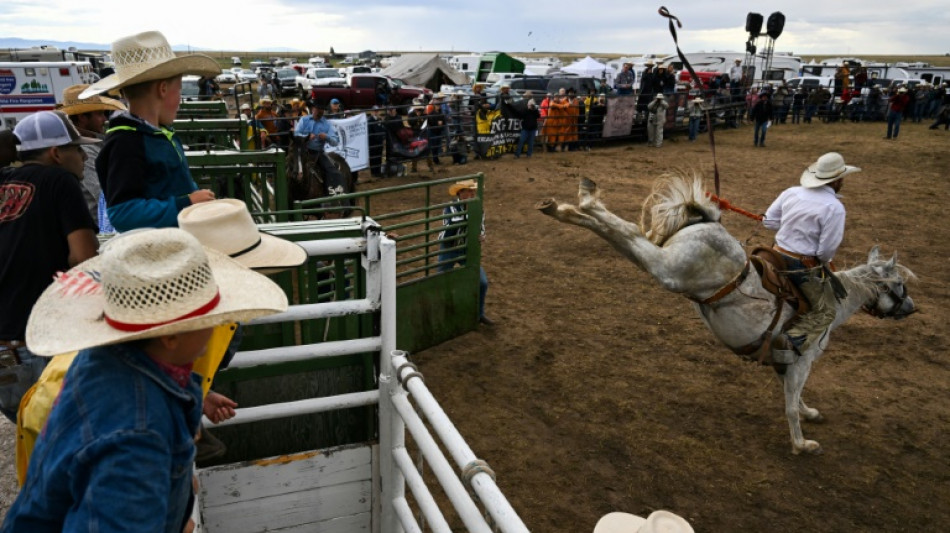
Wyoming cowboys open up about addiction and suicide / Photo: Patrick T. FALLON - AFP

 'No limits': Marathon world record holder Sawe chasing history

 Countdown begins to biggest-ever Rugby World Cup
 Bangladesh women lose ground after quota reform

 Vietnam admits 'differing opinions' on Hanoi development

 Stocks temper gains as oil pares heavy losses, US data in focus
 New Zealand denies breaching climate commitments to EU

 Albert becomes youngest US scorer in 4-2 win over Chile
 Pirate island's plunging population shows Greece's demographic decline

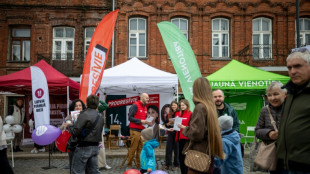 With elections ahead, Latvia's Russian-speakers reject Moscow's help

 Brazil football clubs face massive sponsorship blow from betting ban
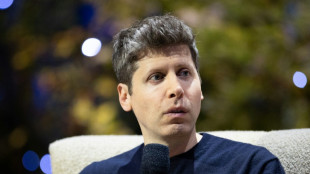 ChatGPT maker wants to be the App Store for AI as safety concerns grow

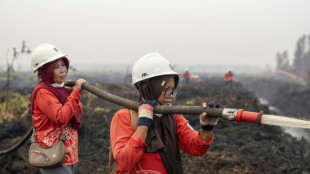 Women fight fires and sexism in Indonesian Borneo

 Forsling's OT blast lifts Florida over Carolina in NHL opener

 Hurricane Polo sweeps over Mexico's Pacific coast, heads inland

 Grynspan pulls ahead in race to lead UN: diplomat

 Trump touts AI boss pledge to self-regulate
 Oil down, but stocks lower as bond yields rise

 England break down stubborn Czechs to claim first Nations League win

 UN Security Council extends Haiti anti-gang force by 6 months

 Manchester City guilty of Premier League charges: What comes next?
 Man City chief Soriano slams Premier League 'conspiracy theory'

 Hurricane Polo sweeps over Mexico's Pacific coast
 Man City must be relegated after guilty verdict says club's former chairman

 German far-right aims to lead Saxony-Anhalt govt in December

 Little damage as Hurricane Polo sweeps over Mexico's Pacific coast

Jonn Beer's ashes rise in a cloud of dust from the saddle of a rodeo horse, the final journey for a young Wyoming cowboy killed by his addiction to opioids.
Beer, who was just 29 when he died, was one of millions of Americans dependent on OxyContin, a prescription opiate first given to him after he hurt his knee falling off a horse.
"They continued to prescribe them, until at some point, he had to have them," says his father, Don Beer.
"Eventually it turned into where we are today, in honor of my son because he's gone."
Horses were Jonn's life.
"Some people are drawn to horses because it helps them get through the day with their life challenges," says Don.
"Jonn was one of those that the more he was around horses, the better he felt."
But eventually even they weren't enough, and with every fall, the need for pain relief -- and the drugs that would provide it -- became more intense.
On October 31 last year, Jonn died from fentanyl poisoning after taking the synthetic opioid that is 50 times more powerful than heroin.
He left behind three heartbroken daughters.
- Tragedy -
Wyoming is frontier country. Its half-million-or-so people are spread thinly over tens of thousands of square miles (kilometers) of farmland, prairie and mountain range, where soaring summer temperatures give way to howling winter blizzards.
The landscape's exacting demands have fashioned a proud and ruggedly individual population whose watchword is self-sufficiency.
"Cowboys are supposed to be tough, we're born and raised to be independent and not rely on anyone, and a lot of stuff we do is on our own," says Rand Selle.
"We don't have that communication skill to go elsewhere and talk and share our emotions and I kind of think a lot of us struggle with that."
All too often, this bottling up ends in tragedy.
"We deal a lot with friends and family that are cowboys that have passed away, either by suicide or have an alcohol or drug addiction."
Jonn's death was a wake-up call for Rand, who has now founded "No More Empty Saddles," a group dedicated to giving cowboys the space and the tools to talk about drugs, addiction and their emotions, with the aim of preventing needless deaths.
"We just wanted to make a change," says the cowboy with piercing blue eyes and a red bandana around his neck.
- 'Being human' -
On a recent Saturday in the small town of Bosler, friends, family and fellow cowboys gather for a rodeo to honor the memory of Jonn Beer and to scatter his ashes -- and to do what he loved best.
The air thunders with the sound of hoofbeats as a stallion is released into the sand-filled arena, bucking and kicking at the belt tied around his belly.
A young man on the horse's back holds one hand aloft, reaching to doff his stetson to the whooping crowd, showboating his way through spine-jolting seconds of equine fury.
As for dozens of others who try their luck today, this bronc rider comes crashing to the ground, the hooves of his mount clattering perilously close.
"Yikes, he hit hard. He might need a little assistance," the announcer blares through the loud speaker, as men rush in to tame the horse and pick up the unseated cowboy.
"No More Empty Saddles" is beginning to make a difference to the community it serves, says Sheryl Foland, the group's mental health manager, with several cowboys sharing their stories on the Facebook page.
With events like the rodeo, that's starting to transform into real-life interactions.
"I was here early last night and I had a cowboy stop by," says Foland.
"He'd been following us on Facebook, and he was like 'Hey!'
"He just wanted a place to just talk, and that's what we gave him."
Foland uses these gatherings to give out gun-disabling padlocks -- almost three-quarters of the 189 people in Wyoming who died by suicide last year shot themselves -- as well as lockable boxes for storing powerful drugs.
But most of all, she uses rodeos like this one as a chance to get cowboys to accept the whole range of emotions that they have, and to think about them in a different way.
"As societies, somewhere we learned that we're supposed to be happy 24 hours a day, seven days a week, 365 days a year, and don't learn how to be comfortable with uncomfortable thoughts and feelings," she says.
"Negative feelings occur, that's part of being human; that's what makes us different than a horse."
T.Sanchez--AT