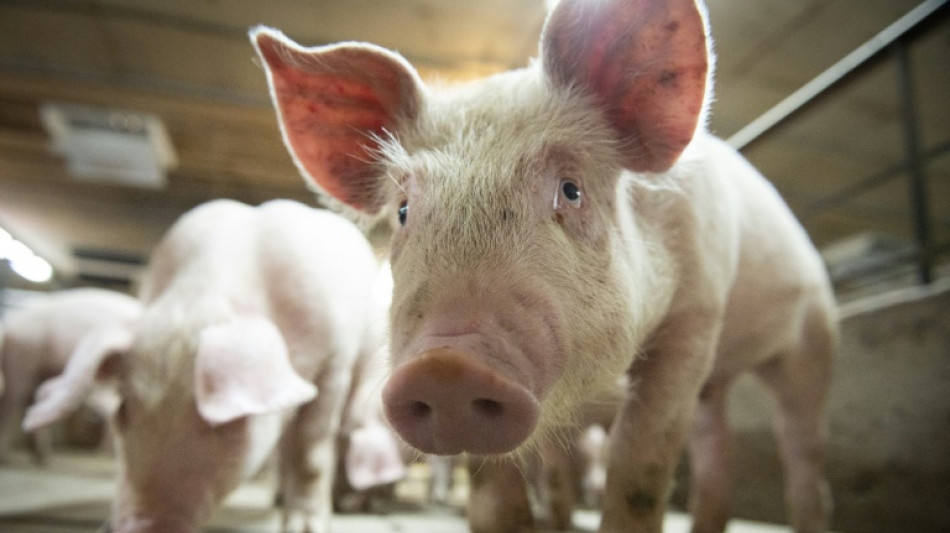
Scientists revive cells and organs in dead pigs / Photo: Sebastien St-Jean - AFP/File

 'No limits': Marathon world record holder Sawe chasing history

 Countdown begins to biggest-ever Rugby World Cup

 Bangladesh women lose ground after quota reform

 Vietnam admits 'differing opinions' on Hanoi development

 Stocks temper gains as oil pares heavy losses, US data in focus

 New Zealand denies breaching climate commitments to EU

 Albert becomes youngest US scorer in 4-2 win over Chile

 Pirate island's plunging population shows Greece's demographic decline

 With elections ahead, Latvia's Russian-speakers reject Moscow's help

 Brazil football clubs face massive sponsorship blow from betting ban

 ChatGPT maker wants to be the App Store for AI as safety concerns grow

 Women fight fires and sexism in Indonesian Borneo

 Forsling's OT blast lifts Florida over Carolina in NHL opener

 Hurricane Polo sweeps over Mexico's Pacific coast, heads inland

 Grynspan pulls ahead in race to lead UN: diplomat

 Trump touts AI boss pledge to self-regulate

 Oil down, but stocks lower as bond yields rise

 England break down stubborn Czechs to claim first Nations League win

 UN Security Council extends Haiti anti-gang force by 6 months

 Manchester City guilty of Premier League charges: What comes next?

 Man City chief Soriano slams Premier League 'conspiracy theory'

 Hurricane Polo sweeps over Mexico's Pacific coast

 Man City must be relegated after guilty verdict says club's former chairman

 German far-right aims to lead Saxony-Anhalt govt in December

 Little damage as Hurricane Polo sweeps over Mexico's Pacific coast

Scientists announced Wednesday they have restored blood flow and cell function throughout the bodies of pigs that were dead for an hour, in a breakthrough experts say could mean we need to update the definition of death itself.
The discovery raised hopes for a range of future medical uses in humans, the most immediate being that it could help organs last longer, potentially saving the lives of thousands of people worldwide in need of transplants.
However it could also spur debate about the ethics of such procedures -- particularly after some of the ostensibly dead pigs startled the scientists by making sudden head movements during the experiment.
The US-based team stunned the scientific community in 2019 by managing to restore cell function in the brains of pigs hours after they had been decapitated.
For the latest research, published in the journal Nature, the team sought to expand this technique to the entire body.
They induced a heart attack in the anaesthetised pigs, which stopped blood flowing through the bodies.
This deprives the body's cells of oxygen -- and without oxygen, cells in mammals die.
The pigs then sat dead for an hour.
- 'Demise of cells can be halted' -
The scientists then pumped the bodies with a liquid containing the pigs' own blood, as well as a synthetic form of haemoglobin -- the protein that carries oxygen in red blood cells -- and drugs that protect cells and prevent blood clots.
Blood started circulating again and many cells began functioning including in vital organs such as the heart, liver and kidney, for the next six hours of the experiment.
"These cells were functioning hours after they should not have been -- what this tells us is that the demise of cells can be halted," Nenad Sestan, the study's senior author and a researcher at Yale University, told journalists.
Co-lead author David Andrijevic, also from Yale, told AFP the team hopes the technique, called OrganEx, "can be used to salvage organs".
OrganEx could also make new forms of surgery possible as it creates "more medical wiggle room in cases with no circulation to fix things," said Anders Sandberg of Oxford University's Future of Humanity Institute.
The technique could potentially also be used to resuscitate people. However this could increase the risk of bringing back patients to a point where they are unable to live without life support -- trapped on what is called the "bridge to nowhere," Brendan Parent, a bioethicist at the NYU Grossman School of Medicine, said in a linked comment in Nature.
- Could death be treatable? -
Sam Parnia of the NYU Grossman School of Medicine said it was "a truly remarkable and incredibly significant study".
It showed that death was not black and white but rather a "biological process that remains treatable and reversible for hours after it has occurred", he said.
Benjamin Curtis, a philosopher focused on ethics at the UK's Nottingham Trent University, said the definition of death may need updating because it hinges on the concept of irreversibility.
"This research shows that many processes that we thought were irreversible are not in fact irreversible, and so on the current medical definition of death a person may not be truly dead until hours after their bodily functions have stopped," he told AFP.
"Indeed, there may be bodies lying in morgues right now that haven't yet 'died', if we take the current definition as valid."
During the experiment, pretty much all of the OrganEx pigs made powerful movements with their head and neck, said Stephen Latham, a Yale ethicist and study co-author.
"It was quite startling for the people in the room," he told journalists.
He emphasised that while it was not known what caused the movement, at no point was any electrical activity recorded in the pigs' brains, showing that they never regained consciousness after death.
While there was a "little burst" on the EEG machine measuring brain activity at the time of the movement, Latham said that was probably caused by the shifting of the head affecting the recording.
However Curtis said the movement was a "major concern" because recent neuroscience research has suggested that "conscious experience can continue even when electrical activity in the brain cannot be measured".
"So it is possible that this technique did in fact cause the subject pigs to suffer, and would cause human beings to suffer were it to be used on them," he added, calling for more research.
T.Sanchez--AT