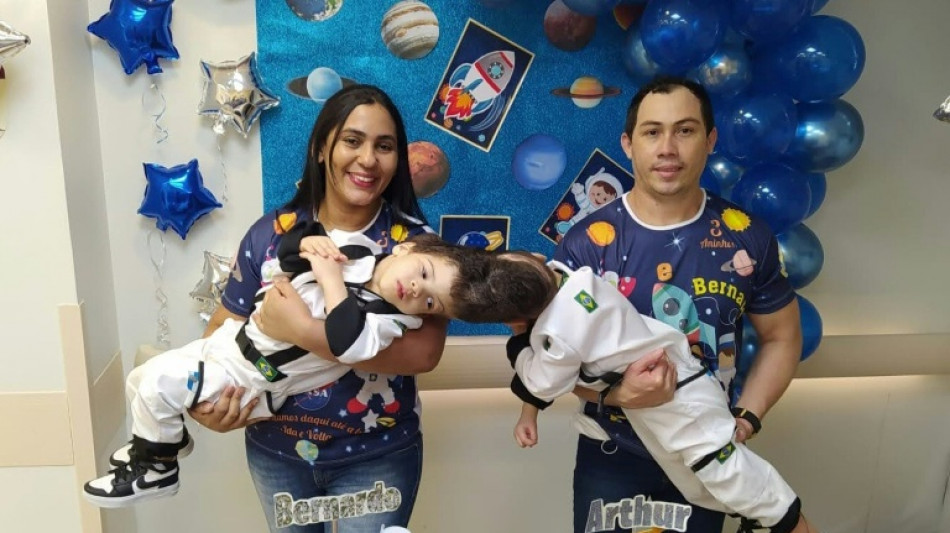
Conjoined twins separated with help of virtual reality in Brazil / Photo: Arthur PEREIRA - Fitamarela/AFP

 'No limits': Marathon world record holder Sawe chasing history

 Countdown begins to biggest-ever Rugby World Cup

 Bangladesh women lose ground after quota reform

 Vietnam admits 'differing opinions' on Hanoi development
 Stocks temper gains as oil pares heavy losses, US data in focus

 New Zealand denies breaching climate commitments to EU

 Albert becomes youngest US scorer in 4-2 win over Chile

 Pirate island's plunging population shows Greece's demographic decline

 With elections ahead, Latvia's Russian-speakers reject Moscow's help

 Brazil football clubs face massive sponsorship blow from betting ban

 ChatGPT maker wants to be the App Store for AI as safety concerns grow

 Women fight fires and sexism in Indonesian Borneo

 Forsling's OT blast lifts Florida over Carolina in NHL opener

 Hurricane Polo sweeps over Mexico's Pacific coast, heads inland

 Grynspan pulls ahead in race to lead UN: diplomat

 Trump touts AI boss pledge to self-regulate

 Oil down, but stocks lower as bond yields rise

 England break down stubborn Czechs to claim first Nations League win

 UN Security Council extends Haiti anti-gang force by 6 months

 Manchester City guilty of Premier League charges: What comes next?

 Man City chief Soriano slams Premier League 'conspiracy theory'

 Hurricane Polo sweeps over Mexico's Pacific coast

 Man City must be relegated after guilty verdict says club's former chairman

 German far-right aims to lead Saxony-Anhalt govt in December

 Little damage as Hurricane Polo sweeps over Mexico's Pacific coast

Conjoined twins born in Brazil with a fused head and brain have been separated in what doctors described Monday as the most complex surgery of its kind, which they prepared for using virtual reality.
Arthur and Bernardo Lima were born in 2018 in the state of Roraima in northern Brazil as craniopagus twins, an extremely rare condition in which the siblings are fused at the cranium.
Joined at the top of the head for nearly four years -- most of that spent in a Rio de Janeiro hospital outfitted with a custom bed -- the brothers are now able to look each other in the face for the first time, after a series of nine operations culminating in a marathon 27-hour surgery to separate them.
London-based medical charity Gemini Untwined, which helped carry out the procedure, described it as the "most challenging and complex separation to date," given that the boys shared several vital veins.
"The twins had the most serious and difficult version of the condition, with the highest risk of death for both," said neurosurgeon Gabriel Mufarrej of the Paulo Niemeyer State Brain Institute (IECPN) in Rio, where the procedure was performed.
"We're very satisfied with the outcome, because no one else believed in this surgery at first, but we always believed there was a chance," he said in a statement.
Members of the medical team, which included nearly 100 staff, prepared for the delicate final stages of the surgery on June 7 and 9 with the help of virtual reality, said Gemini Untwined.
Using brain scans to create a digital map of the boys' shared cranium, surgeons practiced for the procedure in a trans-Atlantic virtual-reality trial surgery.
British neurosurgeon Noor ul Owase Jeelani, the lead surgeon for Gemini Untwined, called the virtual reality prep session "space-age stuff."
"It's just wonderful, it's really great to see the anatomy and do the surgery before you actually put the children at any risk," he told British news agency PA.
"You can imagine how reassuring that is for the surgeons... To do it in virtual reality was just really man-on-Mars stuff."
Pictures and videos released by medical staff showed the boys lying side-by-side on a hospital bed post-surgery, little Arthur reaching out to touch his brother's hand.
In tears, the boys' mother, Adriely Lima, described the family's relief.
"We've been living in the hospital for nearly four years," she said.
B.Torres--AT