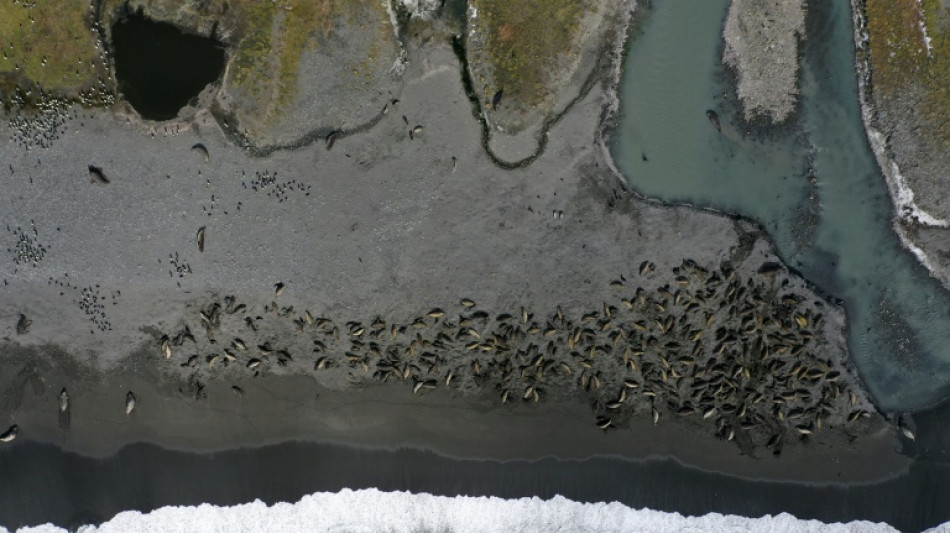
'Bleak' future for seals decimated by bird flu, scientists warn / Photo: Handout - BRITISH ANTARCTIC SURVEY/AFP

 Stocks move lower despite oil prices dropping

 AI driving up innovation investment: UN

 UN Security Council extends Haiti mission by 6 months

 Man Utd do not deserve medals if Man City stripped of titles: Rooney

 Vana Completes Expanded Staking as Part of the Vega Upgrade, Publishes Expanded VANA Token Economics

 Spain to cap gas price hikes, extend fuel discounts

 'We just need rain': Germany's Rhine river hits new low

 Yemen health system at 'breaking point': WHO

 Ireland undecided on second Israel match: coach

 France's Le Pen defiant after top ally hit by antisemitism claims

 Tom Cruise trades stunts for satire as toxic tycoon 'Digger'

 MEXC Unveils "WE SEE YOU" Brand Visual Refresh, Putting People Behind Every Trade in Focus

 Thai capital cleans up after deadly floods

 NATO, EU allies rally to Estonia after 'sabotage' blamed on Russia

 Families demand justice for Cameroon's 'nightmare' wave of murdered women

 Tebas says Man City should face 'most severe' sanctions if guilty of rule breaches

 Pochettino calls Man City success 'a period of deception'

 Settler attack on West Bank village injures Israeli forces, drawing rare rebuke

 Mystery over UK airbase scare after reports no explosives found

 Spanish govt races to adopt housing law under protest pressure

 Estonia slams Russian 'sabotage' after arson attack on defence company

 Slovenia sees surge in '.si' sites after Trump hypes 'super intelligence'

 'Like a dream' for An as Games organisers 'sorry' for latest mix-up

 Tokyo suffers longest streak of rainy days on record

 Indonesia charges train driver over crash that killed 16 women

The world's largest species of seal has been devastated by bird flu, which has wiped out half of all breeding females at a key wildlife haven near Antarctica, scientists warned Thursday.
The remote island of South Georgia is the home of a majority of all southern elephant seals. Males of these blubbery giants can grow up to two metres (six feet seven inches) long, weigh nearly four tonnes (8,800 pounds) -- and have a distinctive elephant-trunk-like proboscis on their face that earned the mammals their name.
Bird flu arrived on South Georgia in 2023 during an outbreak that has seen the virus spread across the world like never before, killing millions of birds and infecting many mammals, including several humans.
Earlier this year, scientists warned that bird flu had sparked the worst die-off on record for southern elephant seals when it spread among a population on Argentina's coast in 2023.
In a study published in the journal Communications Biology on Thursday, a UK team of researchers gave the first estimate for how hard South Georgia's seals have been hit.
"It paints a pretty stark and harrowing picture," Connor Bamford, a marine ecologist at the British Antarctic Survey and lead author of the study, told AFP.
According to the last count in 1995, South Georgia is home to 54 percent of all southern elephant seals.
On the same day of the year in 2022 and 2024, the scientists used hand-launched drones to take images of the island's three biggest breeding beaches.
After bird flu arrived, the number of breeding females plummeted by 47 percent, a loss of around 53,000 seals, according to the study.
- Sick mothers abandoning pups -
Many pups also died on the beach after being abandoned by their bird-flu-infected mothers.
Scientists at the breeding ground on the Valdes Peninsula along Argentina's coast have determined that 97 percent of elephant seal pups died either from being abandoned or contracting bird flu in 2023.
On the peninsula, an even higher rate of breeding females -- 67 percent -- were estimated to have been wiped out.
"If the South Georgia population responds similarly to the modelled outlook at Peninsula Valdes, the future is bleak," the authors of the new study said.
However, Bamford did not think the elephant seals would be pushed "close to extinction".
The South Georgia population is much larger -- numbering in the hundreds of thousands -- so is likely to be more resilient, he said.
"That being said, the impacts to this population will be felt for many years to come," he added.
For the Valdes seals, scientists have estimated that the aftermath of this bird flu outbreak will likely reverberate until the end of the century.
The researchers believe that the seals are transmitting the virus to each other via water droplets, Bamford said.
While elephants spend most of their time in the water, they breed in densely packed colonies on wide, sandy beaches.
"There are thousands of them together, all coughing and splattering," Bamford said, adding that the seals are also particularly "snotty".
The scientist called for "regular check-ups" on South Georgia's elephant seals.
Th.Gonzalez--AT