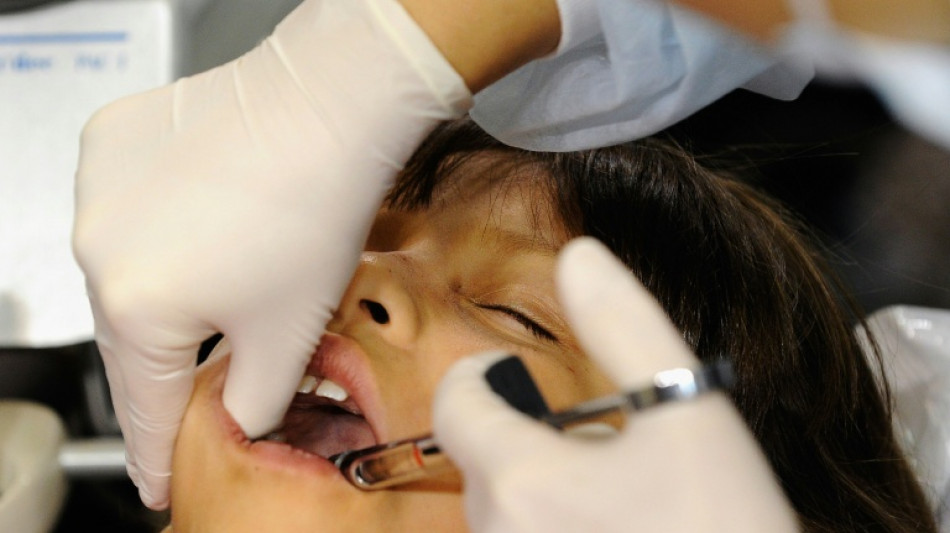
Countries agree to end mercury tooth fillings by 2034 / Photo: KEVORK DJANSEZIAN - GETTY IMAGES NORTH AMERICA/AFP/File

 Stocks move lower despite oil prices dropping

 AI driving up innovation investment: UN

 UN Security Council extends Haiti mission by 6 months
 Man Utd do not deserve medals if Man City stripped of titles: Rooney

 Vana Completes Expanded Staking as Part of the Vega Upgrade, Publishes Expanded VANA Token Economics

 Spain to cap gas price hikes, extend fuel discounts

 'We just need rain': Germany's Rhine river hits new low
 Yemen health system at 'breaking point': WHO

 Ireland undecided on second Israel match: coach

 France's Le Pen defiant after top ally hit by antisemitism claims

 Tom Cruise trades stunts for satire as toxic tycoon 'Digger'

 MEXC Unveils "WE SEE YOU" Brand Visual Refresh, Putting People Behind Every Trade in Focus

 Thai capital cleans up after deadly floods

 NATO, EU allies rally to Estonia after 'sabotage' blamed on Russia

 Families demand justice for Cameroon's 'nightmare' wave of murdered women

 Tebas says Man City should face 'most severe' sanctions if guilty of rule breaches

 Pochettino calls Man City success 'a period of deception'

 Settler attack on West Bank village injures Israeli forces, drawing rare rebuke

 Mystery over UK airbase scare after reports no explosives found
 Spanish govt races to adopt housing law under protest pressure

 Estonia slams Russian 'sabotage' after arson attack on defence company

 Slovenia sees surge in '.si' sites after Trump hypes 'super intelligence'

 'Like a dream' for An as Games organisers 'sorry' for latest mix-up

 Tokyo suffers longest streak of rainy days on record

 Indonesia charges train driver over crash that killed 16 women
Countries agreed Friday to phase out the use of mercury-based dental amalgams in tooth fillings by 2034, in a move that will change how dentistry is done around the world.
At a conference in Geneva, signatories to a treaty aimed at protecting human health and the environment from mercury pollution decided to call time on mercury amalgams.
Nations agreed "to end the use of dental amalgam by 2034, marking a historic milestone in reducing mercury pollution", the conference announced in its closing statement.
The World Health Organization considers mercury one of the top 10 chemicals of major public health concern, calling it "toxic to human health".
Some countries have already banned its use in dental amalgam, a common filling material for treating tooth decay used for more than 175 years.
The Minamata Convention on Mercury is an international treaty to protect human health and the environment from the adverse effects of mercury and mercury compounds.
More than 150 countries are party to the convention, which was adopted in 2013 and came into force in 2017.
The sixth conference of parties to the treaty, held in Geneva this week, adopted amendments "establishing a global phase-out of dental amalgam by 2034", the closing statement said.
"This science-based, time-bound agreement marks a decisive step toward the total elimination of mercury use in dentistry and a safer future for all communities."
- African initiative -
The treaty already stipulated that signatories must take measures to phase out the use of mercury-based dental amalgams.
However, a bloc of African countries wanted to go further, with a ban on their production, import and export, starting in 2030.
In a video message as the conference opened on Monday, US Health Secretary Robert F. Kennedy Jr. asked why mercury was deemed "dangerous in batteries, in over-the-counter medications and make-up", but acceptable in dental fillings.
"It's inexcusable that governments around the world still allow mercury-based compounds in healthcare -- and safe alternatives exist," he said.
A few countries opposed the idea of a phase-out by 2030, including Iran and India, and Britain, which said it was too soon.
But countries came together and agreed a phase-out by 2034.
"We have just opened the door to another chapter of the mercury history book," said the convention's executive secretary Monika Stankiewicz.
"Mercury pollution is a scourge."
However, "by understanding one another and bridging our differences, we can make a difference in the lives of people everywhere, and indeed in the life of this beautiful planet we share".
The conference's president Osvaldo Alvarez Perez added: "We have set ambitious new goals, and left mercury a little further behind."
Overall, the conference adopted 21 decisions aimed at advancing the convention's objective of protecting human health and the environment from mercury pollution.
T.Wright--AT