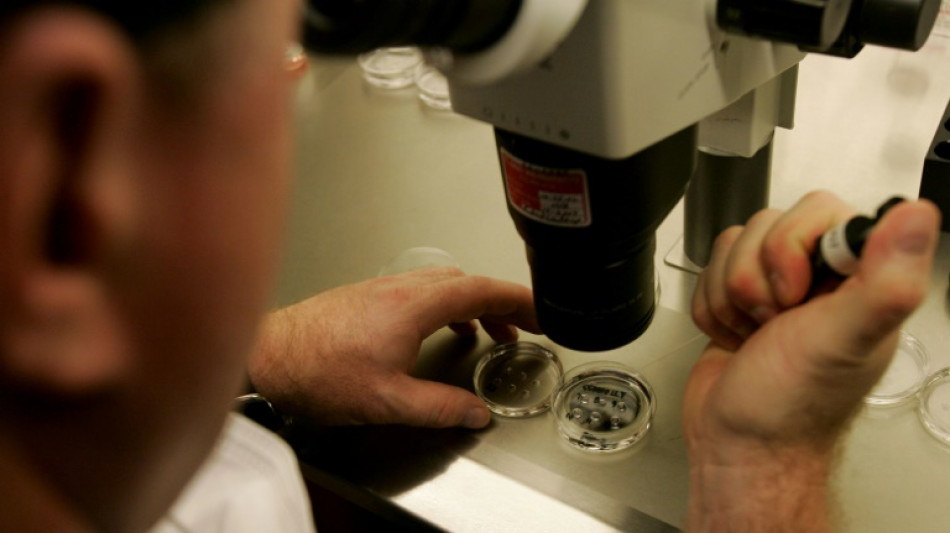
Human skin cells turned into fertilisable eggs for first time / Photo: Sandy Huffaker - GETTY IMAGES/Getty Images/AFP/File

 Stocks move lower despite oil prices dropping

 AI driving up innovation investment: UN

 UN Security Council extends Haiti mission by 6 months

 Man Utd do not deserve medals if Man City stripped of titles: Rooney

 Vana Completes Expanded Staking as Part of the Vega Upgrade, Publishes Expanded VANA Token Economics

 Spain to cap gas price hikes, extend fuel discounts

 'We just need rain': Germany's Rhine river hits new low

 Yemen health system at 'breaking point': WHO

 Ireland undecided on second Israel match: coach

 France's Le Pen defiant after top ally hit by antisemitism claims

 Tom Cruise trades stunts for satire as toxic tycoon 'Digger'

 MEXC Unveils "WE SEE YOU" Brand Visual Refresh, Putting People Behind Every Trade in Focus

 Thai capital cleans up after deadly floods

 NATO, EU allies rally to Estonia after 'sabotage' blamed on Russia

 Families demand justice for Cameroon's 'nightmare' wave of murdered women

 Tebas says Man City should face 'most severe' sanctions if guilty of rule breaches

 Pochettino calls Man City success 'a period of deception'

 Settler attack on West Bank village injures Israeli forces, drawing rare rebuke

 Mystery over UK airbase scare after reports no explosives found

 Spanish govt races to adopt housing law under protest pressure

 Estonia slams Russian 'sabotage' after arson attack on defence company

 Slovenia sees surge in '.si' sites after Trump hypes 'super intelligence'

 'Like a dream' for An as Games organisers 'sorry' for latest mix-up

 Tokyo suffers longest streak of rainy days on record

 Indonesia charges train driver over crash that killed 16 women

Scientists said Wednesday they have turned human skin cells into eggs and fertilised them with sperm in the lab for the first time -- a breakthrough that is hoped to one day let infertile people have children.
The technology is still years away from potentially becoming available to aspiring parents, the US-led team of scientists warned.
But outside experts said the proof-of-concept research could eventually change the meaning of infertility, which affects one in six people worldwide.
If successful, the technology called in-vitro gametogenesis (IVG) would allow older women or women who lack eggs for other reasons to genetically reproduce, Paula Amato, the co-author of a new study announcing the achievement, told AFP.
"It also would allow same-sex couples to have a child genetically related to both partners," said Amato, a researcher at the Oregon Health & Science University in the United States.
Scientists have been making significant advances in this field in recent years, with Japanese researchers announcing in July they had created mice with two biological fathers.
But the new study, published in the journal Nature Communications, marks a major advance by using DNA from humans, rather than mice.
The scientists first removed the nucleus from normal skin cells and transferred them into a donor egg which had its nucleus removed. This technique, called somatic cell nuclear transfer, was used to clone Dolly the sheep in 1996.
However a problem still had to be overcome: skin cells have 46 chromosomes, but eggs have 23.
The scientists managed to remove these extra chromosomes using a process they are calling "mitomeiosis", which mimics how cells normally divide.
They created 82 developing eggs called oocytes, which were then fertilised by sperm via in vitro fertilisation (IVF).
After six days, less than nine percent of the embryos developed to the point that they could hypothetically be transferred to the uterus for a standard IVF process.
However the embryos displayed a range of abnormalities, and the experiment was ended.
While the nine-percent rate was low, the researchers noted that during natural reproduction only around a third of embryos make it to the IVF-ready "blastocyst" stage.
Amato estimated the technology was at least a decade away from becoming widely available.
"The biggest hurdle is trying to achieve genetically normal eggs with the correct number and complement of chromosomes," she said.
- Breakthrough -
Ying Cheong, a reproductive medicine researcher at the UK's University of Southampton, hailed the "exciting" breakthrough.
"For the first time, scientists have shown that DNA from ordinary body cells can be placed into an egg, activated, and made to halve its chromosomes, mimicking the special steps that normally create eggs and sperm," she said.
"While this is still very early laboratory work, in the future it could transform how we understand infertility and miscarriage, and perhaps one day open the door to creating egg- or sperm-like cells for those who have no other options."
Other researchers trying to create eggs in the lab are using a different technique. It involves reprogramming skin cells into what are called induced pluripotent stem cells -- which have the potential to develop into any cell in the body -- then turning those into eggs.
"It's too early to tell which method will be more successful," Amato said. "Either way, we are still many years away."
The researchers followed existing US ethical guidelines regulating the use of embryos, the study said.
Ch.Campbell--AT