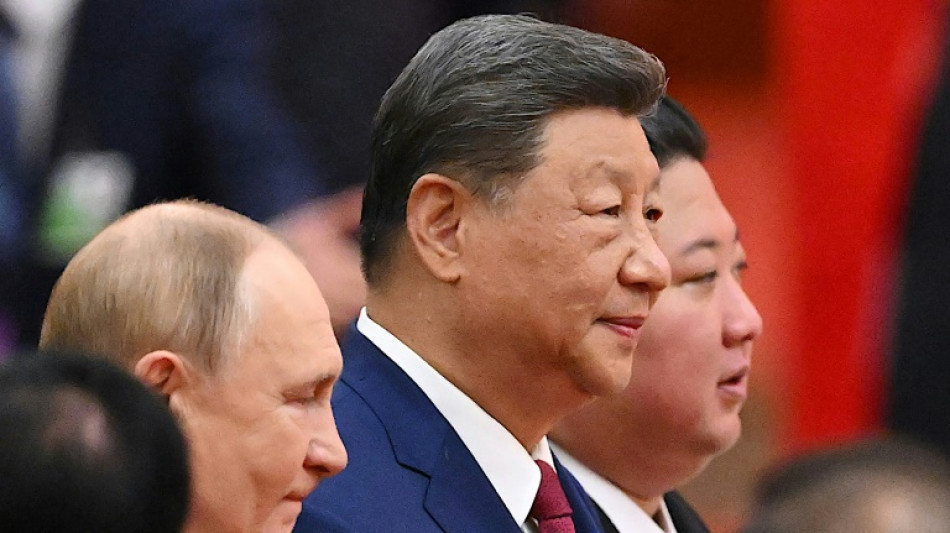
Could humans become immortal, as Putin was heard telling Xi? / Photo: Jade Gao - AFP

 Stocks move lower despite oil prices dropping
 AI driving up innovation investment: UN

 UN Security Council extends Haiti mission by 6 months

 Man Utd do not deserve medals if Man City stripped of titles: Rooney

 Vana Completes Expanded Staking as Part of the Vega Upgrade, Publishes Expanded VANA Token Economics

 Spain to cap gas price hikes, extend fuel discounts

 'We just need rain': Germany's Rhine river hits new low

 Yemen health system at 'breaking point': WHO
 Ireland undecided on second Israel match: coach
 France's Le Pen defiant after top ally hit by antisemitism claims

 Tom Cruise trades stunts for satire as toxic tycoon 'Digger'

 MEXC Unveils "WE SEE YOU" Brand Visual Refresh, Putting People Behind Every Trade in Focus
 Thai capital cleans up after deadly floods

 NATO, EU allies rally to Estonia after 'sabotage' blamed on Russia

 Families demand justice for Cameroon's 'nightmare' wave of murdered women

 Tebas says Man City should face 'most severe' sanctions if guilty of rule breaches

 Pochettino calls Man City success 'a period of deception'

 Settler attack on West Bank village injures Israeli forces, drawing rare rebuke
 Mystery over UK airbase scare after reports no explosives found

 Spanish govt races to adopt housing law under protest pressure

 Estonia slams Russian 'sabotage' after arson attack on defence company

 Slovenia sees surge in '.si' sites after Trump hypes 'super intelligence'
 'Like a dream' for An as Games organisers 'sorry' for latest mix-up

 Tokyo suffers longest streak of rainy days on record

 Indonesia charges train driver over crash that killed 16 women

Vladimir Putin and Xi Jinping have been recorded on a hot mic discussing how organ transplants and other medical advances could let humans live past 150 years -- or even become immortal.
But are these comments by the Russian and Chinese leaders, which were picked up during a Beijing summit on Wednesday, backed by scientific evidence?
Experts in human ageing told AFP that some of these ideas remain far-fetched, but serious research is also increasingly revealing more about why we age -- and how we could try to stop it.
- Is there a human lifespan limit? -
The conversation suggested that fending off the ravages of age was on the minds of Putin and Xi, who are both 72 and have not expressed any desire to step down.
Thanks to the "development of biotechnology, human organs can be continuously transplanted, people could get younger as they grow older, and may even become immortal", Putin told Xi.
The Chinese leader responded by saying there were predictions humans could "live to 150 years old" within this century.
There is no scientific evidence to support the idea that a human could live forever.
Scientists have not even reached a consensus on whether there is a biological limit on human lifespan.
"The debate is not settled," Ilaria Bellantuono, a researcher on the biology of ageing at the University of Sheffield, told AFP.
Indeed, despite massive progress in most areas of health in the last few decades, human longevity records have stopped being broken.
France's Jeanne Calment, who died at the age of 122 in 1997, still holds the record for oldest confirmed age.
This does not necessarily mean we have reached the limits of longevity.
According to 2018 research in the journal Science, mortality rates eventually level off, meaning a 115-year-old is no more at risk of dying than someone aged 105.
Other researchers have warned that data about extreme longevity could be misleading, citing numerous cases of people forging birth certificates to commit pension fraud.
- What about replacing organs? -
Putin's comments went beyond simply fending off death, suggesting that by regularly replacing misfiring organs people could actually become younger.
"It's pure madness," said Eric Boulanger, a professor of biology and ageing at France's Lille University.
Boulanger listed a broad range of medical barriers and ethical concerns, including the constant need for fresh organs and the traumatic effect that repeated transplant surgeries would have on the body.
And our bodies are made up of more than just organs, he emphasised.
They also have fatty tissue, bones and more, all impacted by ageing in a complex and interconnected way that makes the concept of changing out organs like car parts unrealistic.
- Money in long life? -
Huge amounts of money have recently been invested in longevity efforts, which have also been the subject of a booming lifestyle and wellness industry.
Putin himself has shown interest, with Russia launching a 38-billion-ruble ($460-million) project last year focused on regenerative medicine and longevity.
The subject is also a preoccupation of the Silicon Valley-led transhumanist movement, including billionaire Peter Thiel, a supporter of US President Donald Trump who has invested millions in longevity projects.
Fellow tech figure Bryan Johnson has become somewhat emblematic of the issue by setting himself the goal of eternal life -- and testing many of the latest anti-ageing theories, techniques and trends on himself.
However, mainstream scientists have been critical of such efforts, warning they lack scientific rigour and could even be dangerous.
- Realistic research? -
Some recent scientific advances have raised hopes we could one day fight back against ageing.
The researchers interviewed by AFP in particular highlighted a field called epigenetics.
Changes to DNA have long been thought to be an important factor in why humans age.
However, epigenetics -- which studies how genes can toggle on or off without altering DNA -- has recently gained attention.
Over time, this toggling seems to wear down in a process thought to be central to ageing.
Research published in the journal Aging Cell in June found that the drug rapamycin -- which appears to affect epigenetic ageing -- has helped extend the lifespan of several animals, including mice.
But there is no guarantee the drug will work in humans.
For now, the researchers suggested people worry less about hypothetical ways to increase how long they are alive and instead make sure the time they have left is lived well.
"The focus should be on extending the number of years in good health," Bellantuono said.
L.Adams--AT