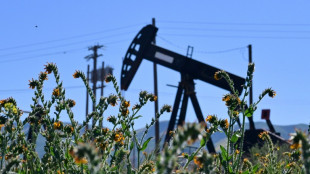
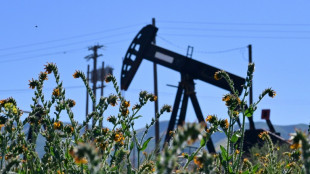
Summer 2025 already a cavalcade of climate extremes / Photo: Akram SHAHID - AFP/File

 Alleged Rihanna mansion shooter mentally fit for trial, says judge
 Mystery over UK airbase scare as police find petrol not explosives

 OpenAI unveils low-cost AI model, a day after shelving Astra upgrade

 Premier League confirms Man City guilty of serious financial breaches
 Brazil's Lula turns to Bad Bunny tune to criticise Trump ahead of polls

 Nigerian dancer eyes world record after seven-day marathon

 Swiss regulator concludes Julius Baer bank probe
 Brazil's patron saint pulled into latest election scrap

 Football overload leaves players near 'breaking point', warns Tebas
 Paris Eiffel Tower says chief to step down after uproar over removing women staff

 Amaze Holdings (NYSE: AMZE) Executes Binding LOI to Acquire BullionFX | Alchemy, a Decentralized Gold-Backed Financial Ecosystem for Valued at US$155 Million

 Clashes between French teens, police as school blockades intensify
 Stocks move sideways despite oil moving lower
 African leaders to gather in Egypt for business summit
 UK decides against charging foreign visitors for museums

 Dallaglio to sell England World Cup winners' medal

 Brazil come from behind to beat Australia 4-2 in friendly

 Ruthless An retains Asian Games badminton crown as Kunlavut triumphs

 Alonso to stay with F1 team Aston Martin in 2027
 China badminton 'still strong' despite Asian Games slump

 'Exceptional' Turner painting shown in Rome before sale

 European stocks climb as oil dips

 Spain aims to ban evictions until 2030 amid housing protests

 Kunlavut first Thai man to win Asian Games badminton singles gold

 French far right says antisemitism claims part of 'total war' to derail presidency bid

Record heat, massive fires, deadly floods... August has barely begun, but the summer of 2025 is already marked by a cascade of destructive and deadly weather in the northern hemisphere.
"Extreme temperatures and precipitation have become more intense and more frequent on a global scale," says Sonia Seneviratne, a professor at ETH Zurich and member of the UN-mandated climate science advisory panel, the IPCC.
"We are in the midst of climate change," Fred Hattermann, a scientist at the Potsdam Institute for Climate Impact Research (PIK), told AFP.
"The risk of extreme events has increased significantly," he said, noting that 2024 was the first year in which the planet's average surface temperature was 1.6 degrees Celsius above the preindustrial benchmark.
That deceptively small jump makes a huge difference.
Higher temperatures increase evaporation, so that more water is stored in the atmosphere. This, in turn, increases the risk of heavy rainfall and flooding.
"with every increment of temperature rise the risk of more and stronger extremes increases," Hattermann added.
- 50C in the Gulf, Turkey -
Already in May, temperatures exceeded 50C in the United Arab Emirates. On August 1, the thermometer hit 51.8C, just under the all-time record of 52C.
The entire Gulf region is suffocating: the Saudi capital Riyadh recorded temperatures of 44°C, while Kuwait frequently hit 50C.
As did Iraq, where air conditioning has become vulnerable to chronic power cuts, and water reserves are at their lowest level in years.
Turkey saw the 50C threshold exceeded for the first time: the town of Silopi on the border with Iraq and Syria reached 50.5C on July 26.
The country has experienced thousands of fires this summer amidst a severe drought.
In Asia, meanwhile, Japan broke its all-time temperature record on Tuesday with 41.8C in the city of Isesaki, northwest of Tokyo. The country's iconic cherry trees, emblematic of the archipelago, are blooming earlier than ever due to the heat.
- Torrential rains in Hong Kong -
On Tuesday, Hong Kong saw the highest rainfall total for August in more than 140 years of record-keeping: 35.5 centimetres (14 inches) in a single day.
On mainland China, a week earlier, severe weather killed at least 44 people and left nine missing in rural districts north of Beijing.
- Pakistan floods, Finland heat -
266 people, nearly half of them children, have already lost their lives in Pakistan due to torrential rains sweeping across the country.
The 2025 monsoon, which started early, was described as "unusual" by authorities. Punjab, Pakistan's most populous province, recorded 73 percent more rainfall in July than in 2024.
People come to Scandinavia to seek cooler climes, but since July Norway, Sweden and Finland have experienced sustained temperatures more typical of the Mediterranean.
August 3 marked the end of a 22-day period with temperatures above 30°C in Finland: a record.
In Rovaniemi, a Finnish city north of the Arctic Circle, temperatures reached 30C, higher than in southern Europe at the same time.
- Mega-fires in Canada -
Canada is experiencing one of the worst forest fire seasons on record, amplified by drought and above-normal temperatures.
Other parts of the world are also burning, from Scotland to Arizona and Greece.
According to the European Union's Copernicus weather and climate observatory, total smoke and greenhouse gas emissions since the beginning of summer in the northern hemisphere are among the highest ever recorded.
W.Moreno--AT