Deadly dengue fever impacts climate-hit Bangladesh coast / Photo: Arifir RAHMAN - AFP

 Alleged Rihanna mansion shooter mentally fit for trial, says judge
 Mystery over UK airbase scare as police find petrol not explosives

 OpenAI unveils low-cost AI model, a day after shelving Astra upgrade

 Premier League confirms Man City guilty of serious financial breaches
 Brazil's Lula turns to Bad Bunny tune to criticise Trump ahead of polls

 Nigerian dancer eyes world record after seven-day marathon

 Swiss regulator concludes Julius Baer bank probe
 Brazil's patron saint pulled into latest election scrap

 Football overload leaves players near 'breaking point', warns Tebas
 Paris Eiffel Tower says chief to step down after uproar over removing women staff

 Amaze Holdings (NYSE: AMZE) Executes Binding LOI to Acquire BullionFX | Alchemy, a Decentralized Gold-Backed Financial Ecosystem for Valued at US$155 Million

 Clashes between French teens, police as school blockades intensify

 Stocks move sideways despite oil moving lower
 African leaders to gather in Egypt for business summit
 UK decides against charging foreign visitors for museums

 Dallaglio to sell England World Cup winners' medal

 Brazil come from behind to beat Australia 4-2 in friendly

 Ruthless An retains Asian Games badminton crown as Kunlavut triumphs

 Alonso to stay with F1 team Aston Martin in 2027
 China badminton 'still strong' despite Asian Games slump

 'Exceptional' Turner painting shown in Rome before sale

 European stocks climb as oil dips

 Spain aims to ban evictions until 2030 amid housing protests

 Kunlavut first Thai man to win Asian Games badminton singles gold

 French far right says antisemitism claims part of 'total war' to derail presidency bid

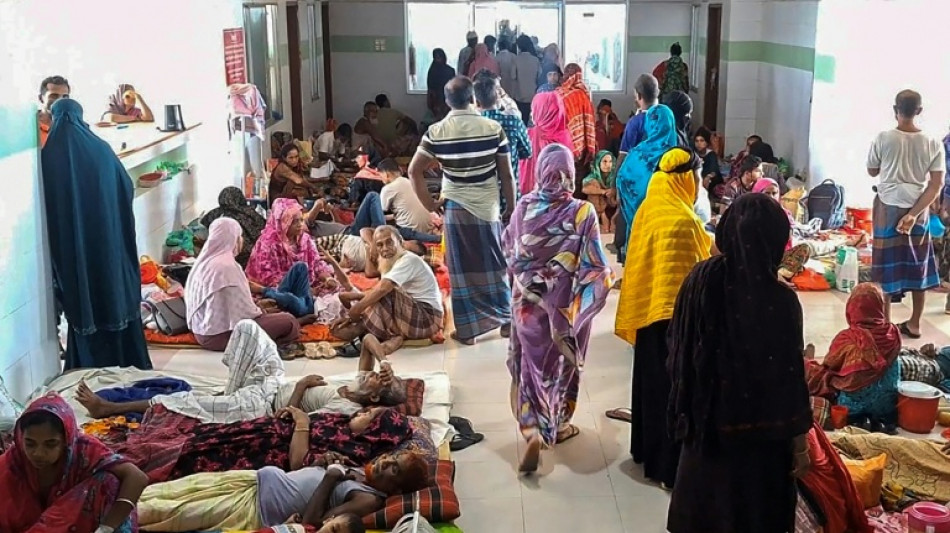
Mosquito-borne dengue fever was rarely a major problem in Bangladesh's coastal districts, but some hospitals are so full of those with the potentially deadly virus that patients are treated on the floor.
As climate change drives erratic weather patterns, experts point to a dire lack of clean drinking water in the wider delta -- where the snaking Brahmaputra and Ganges rivers reach the sea -- as a likely driving force for the surge.
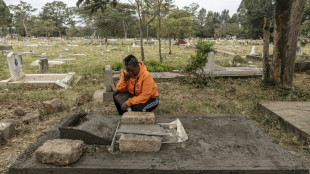
Rakibul Islam Rajan said his two-year-old daughter keeps searching for her mother, Azmeri Mona Lisa Zareen, who died of dengue in early June in the southern region of Barisal.
"Zareen developed high fever... her blood pressure collapsed -- and then she couldn't breathe," said 31-year-old Rajan.
"Our daughter keeps searching for her from one room to another".
In the worst cases, intense viral fevers trigger bleeding, internally or from the mouth and nose.
Barisal has recorded nearly half of the 7,500 dengue cases across Bangladesh this year, according to the Institute of Epidemiology, Disease Control and Research (IEDCR).
Five people have died there this year with dengue fever, out of 31 deaths recorded across the entire country of some 170 million people.
Numbers are still far below the deadly outbreak of 2023, when more than 1,700 people died across the South Asian nation, and more than 200,000 were infected.
In the Barisal district of Barguna, the hospital is packed full.
Barisal health chief Shyamol Krishna Mondal said it was the "worst we've seen".
Barguna's 250-bed public hospital was coping with more than 200 dengue patients.
"We couldn't even offer beds," Mondal said. "They are getting treatment while lying on the floor."
Kabirul Bashar, an expert on disease at Jahangirnagar University, said a lack of clean water was "one of the major reasons".
People store rainwater in containers, exactly the conditions mosquitoes love.
"The water distribution system is almost absent," Bashar said.
- 'Vulnerability is soaring' -
While a lack of clean water is a long-running problem, climate change is making it worse.
Rising seas driven by climate change threaten swathes of low-lying Bangladesh, with increasing numbers of powerful storms bringing seawater further inland, turning wells and lakes salty, according to government scientists.
Changing weather patterns, making once predictable rains uncertain, adds to the challenge -- with people storing rainwater when they can.
But Mushtuq Husain, a public health expert and adviser at IEDCR, said that the plentiful water storage pots also provided perfect mosquito breeding sites.
"We can't allow water stagnation anywhere -- that should be the rule of thumb, but it's not happening," he said.
"The vulnerability is soaring because of the high temperatures and erratic rainfall, which are conducive to mosquito breeding."
Bangladesh has recorded cases of dengue since the 1960s but documented its first outbreak of dengue haemorrhagic fever, a severe and sometimes fatal form of the disease, in 2000.
The World Health Organization (WHO) has warned that dengue and other mosquito-borne viruses are spreading faster and further due to climate change.
About half of the world's population is now at risk of dengue, with an estimated 100 to 400 million infections occurring each year, and many of those causing only mild illness, according to the WHO.
Rajan, mourning his wife, worries that there will be more deaths to come, accusing local authorities of failing to stem mosquitoes.
"Dengue has taken her," he said of his late wife. "I don't know how many more are in the queue... but I don't see enough cleanup activities."
Ch.Campbell--AT