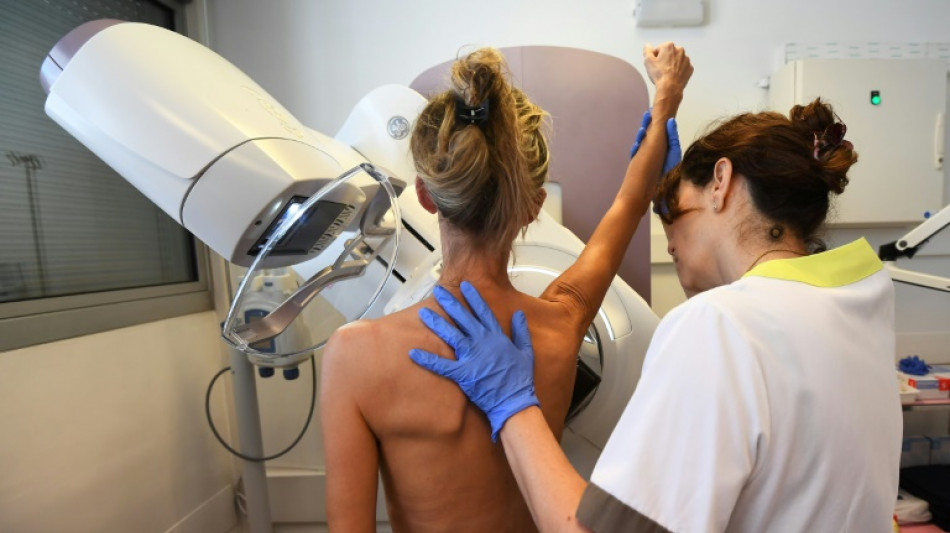
New hope for patients with less common breast cancer / Photo: ANNE-CHRISTINE POUJOULAT - AFP/File

 Alleged Rihanna mansion shooter mentally fit for trial, says judge

 Mystery over UK airbase scare as police find petrol not explosives

 OpenAI unveils low-cost AI model, a day after shelving Astra upgrade

 Premier League confirms Man City guilty of serious financial breaches

 Brazil's Lula turns to Bad Bunny tune to criticise Trump ahead of polls

 Nigerian dancer eyes world record after seven-day marathon

 Swiss regulator concludes Julius Baer bank probe

 Brazil's patron saint pulled into latest election scrap

 Football overload leaves players near 'breaking point', warns Tebas

 Paris Eiffel Tower says chief to step down after uproar over removing women staff

 Amaze Holdings (NYSE: AMZE) Executes Binding LOI to Acquire BullionFX | Alchemy, a Decentralized Gold-Backed Financial Ecosystem for Valued at US$155 Million
 Clashes between French teens, police as school blockades intensify

 Stocks move sideways despite oil moving lower

 African leaders to gather in Egypt for business summit

 UK decides against charging foreign visitors for museums

 Dallaglio to sell England World Cup winners' medal

 Brazil come from behind to beat Australia 4-2 in friendly

 Ruthless An retains Asian Games badminton crown as Kunlavut triumphs

 Alonso to stay with F1 team Aston Martin in 2027

 China badminton 'still strong' despite Asian Games slump

 'Exceptional' Turner painting shown in Rome before sale

 European stocks climb as oil dips

 Spain aims to ban evictions until 2030 amid housing protests

 Kunlavut first Thai man to win Asian Games badminton singles gold

 French far right says antisemitism claims part of 'total war' to derail presidency bid

A new treatment nearly halves the risk of disease progression or death from a less common form of breast cancer that hasn't seen major drug advances in over a decade, researchers reported Monday.
Results from the study, presented at the annual meeting of the American Society for Clinical Oncology, are expected to be submitted to regulators and could soon establish a new first-line therapy for people with HER2-positive metastatic breast cancer -- the advanced stage of a form that comprises 15–20 percent of all breast cancer cases.
HER2-positive cancers are fueled by an overactive HER2 gene, which makes too much of a protein called human epidermal growth factor receptor 2 that helps cancer cells grow and spread.
Patients with HER2-positive breast cancer that has spread to other parts of the body live around five years.
"Seeing such a striking improvement was really impressive to us -- we were taking a standard and almost doubling how long patients could have their cancer controlled for," oncologist Sara Tolaney, chief of the breast oncology division at Dana-Farber Cancer Institute, told AFP.
The current standard of care, known as THP, combines chemotherapy with two antibodies that block growth signals from the HER2 protein. The new approach uses a drug called trastuzumab deruxtecan (T-DXd), an antibody attached to a chemotherapy drug.
- 'Smart bomb' -
This "smart bomb" strategy allows the drug to target cancer cells directly. "You can bind to the cancer cell and dump all that chemo right into the cancer cells," explained Tolaney.
"Some people call them smart bombs because they're delivering chemo in a targeted fashion -- which is how I think we're able to really increase efficacy so much."
Common side effects included nausea, diarrhea and a low white blood cell count, with a less common effect involving lung scarring.
T-DXd is already approved as a "second-line" option -- used when first-line treatments stop working. But in the new trial, it was given earlier, paired with another antibody, pertuzumab.
In a global trial led by Tolaney, just under 400 patients were randomly assigned to receive T-DXd in combination with pertuzumab, thought to enhance its effects.
A similar number received the standard THP regimen. A third group, who received T-DXd without pertuzumab, was also enrolled -- but those results haven't yet been reported.
- 44 percent risk reduction -
At a follow-up of 2.5 years, the T-DXd and pertuzumab combination reduced the risk of disease progression or death by 44 percent compared to standard care.
Fifteen percent of patients in the T-DXd group saw their cancer disappear entirely, compared to 8.5 percent in the THP group.
Because this was an interim analysis, the median progression-free survival -- meaning the point at which half the patients had seen their cancer return or worsen -- was 40.7 months with the new treatment, compared to 26.9 months with the standard, and could rise further as more data come in.
Tolaney said the results would be submitted to regulators around the world, including the US Food and Drug Administration, and that future work would focus on optimizing how long patients remain on the treatment, particularly those showing complete remission.
"This represents a new first-line standard treatment option for HER2-positive metastatic breast cancer," said Dr. Rebecca Dent, a breast cancer specialist at the National Cancer Center Singapore who was not involved in the study
W.Nelson--AT