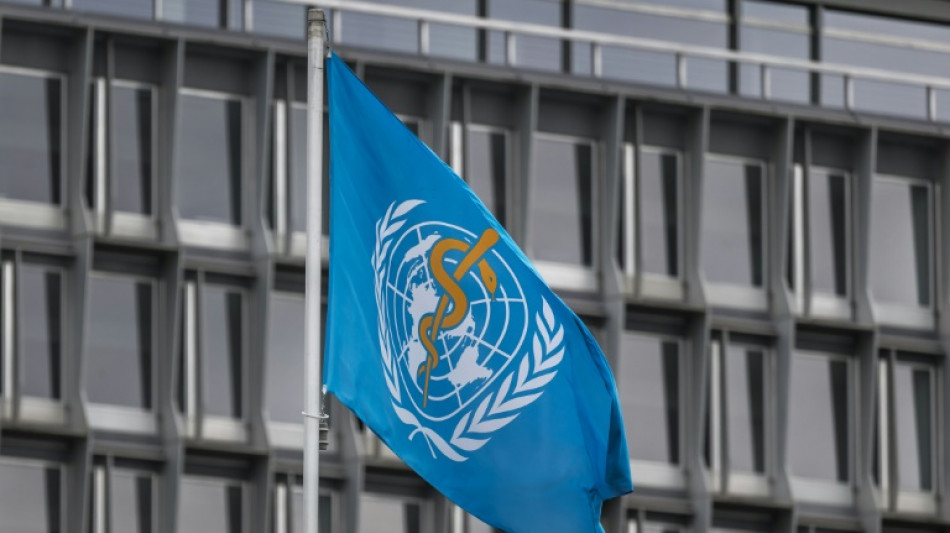
Pandemic accord, tightened budget on menu at big WHO meet / Photo: Fabrice COFFRINI - AFP

 Alleged Rihanna mansion shooter mentally fit for trial, says judge
 Mystery over UK airbase scare as police find petrol not explosives

 OpenAI unveils low-cost AI model, a day after shelving Astra upgrade
 Premier League confirms Man City guilty of serious financial breaches
 Brazil's Lula turns to Bad Bunny tune to criticise Trump ahead of polls
 Nigerian dancer eyes world record after seven-day marathon
 Swiss regulator concludes Julius Baer bank probe
 Brazil's patron saint pulled into latest election scrap

 Football overload leaves players near 'breaking point', warns Tebas
 Paris Eiffel Tower says chief to step down after uproar over removing women staff
 Amaze Holdings (NYSE: AMZE) Executes Binding LOI to Acquire BullionFX | Alchemy, a Decentralized Gold-Backed Financial Ecosystem for Valued at US$155 Million
 Clashes between French teens, police as school blockades intensify

 Stocks move sideways despite oil moving lower

 African leaders to gather in Egypt for business summit
 UK decides against charging foreign visitors for museums

 Dallaglio to sell England World Cup winners' medal
 Brazil come from behind to beat Australia 4-2 in friendly
 Ruthless An retains Asian Games badminton crown as Kunlavut triumphs

 Alonso to stay with F1 team Aston Martin in 2027
 China badminton 'still strong' despite Asian Games slump
 'Exceptional' Turner painting shown in Rome before sale

 European stocks climb as oil dips
 Spain aims to ban evictions until 2030 amid housing protests

 Kunlavut first Thai man to win Asian Games badminton singles gold

 French far right says antisemitism claims part of 'total war' to derail presidency bid

Next week promises to be a crucial one for the World Health Organization, with member states coming together in Geneva to adopt a landmark pandemic agreement and a slimmed-down budget amid US funding cuts.
Dozens of high-ranking officials and thousands of delegates are set to gather for the United Nations health agency's annual decision-making assembly, due to last from May 19 to 27.
"This huge gathering comes... at a pivotal moment for global health," Catharina Boehme, WHO's assistant director-general for external relations and governance, told reporters.
It comes as countries are confronting "emerging threats and major shifts in the landscape for global health and international development", she said.
More than five years after the emergence of Covid-19, which killed millions of people, much of the focus next week will be on the expected adoption of a hard-won international agreement on how to better protect against and tackle future pandemics.
After more than three years of negotiations, countries reached consensus on a text last month but final approval by the World Health Assembly is needed -- a discussion expected to take place on Tuesday.
- 'Without the US' -
The United States, which has thrown the global health system into crisis by slashing foreign aid spending, was not present during the final stretch of the talks.
US President Donald Trump ordered a withdrawal from the WHO and from the pandemic agreement talks after taking office in January.
The agreement "is a jab in the arm for multilateralism, even if it is multilateralism in this case without the US", said a European diplomat who asked not to be named.
The WHA will be called upon to ratify the adoption of the agreement and to launch an intergovernmental working group to negotiate technical details of the so-called Pathogen Access and Benefit-Sharing System (PABS), said negotiations co-chair Anne-Claire Amprou.
Core to the agreement, that system will be aimed at allowing the swift sharing of pathogen data with pharmaceutical companies, enabling them to quickly start working on pandemic-fighting products.
Once the PABS annex is completed and adopted at the 2026 WHA, "the whole (agreement) will open for signature", Steven Solomon, WHO's principal legal officer, told reporters.
Ratification by 60 states will be needed for the accord to come into force.
- Deep cuts -
Also high on the agenda next week will be the dramatic overhaul of WHO operations and finances.
WHO chief Tedros Adhanom Ghebreyesus told member states last month that the agency would need to slim down due to deep US funding cuts.
The agency has been bracing for Trump's planned full withdrawal of the United States -- by far its largest donor -- next January.
The United States gave WHO $1.3 billion for its 2022-2023 budget, mainly through voluntary contributions for specific projects rather than fixed membership fees.
"The loss of US funding, combined with reductions in official development assistance by some other countries, mean we are facing a salary gap for the next biennium of more than $500 million," Tedros said on Wednesday.
Tedros has not said how many jobs will be lost, but on Wednesday he announced the organisation would cut its leadership team nearly in half.
- Budget gap -
Next week, member states will vote on a proposed 20-percent increase of WHO's mandatory membership fees for the 2026-27 budget period, Boehme said.
Members already agreed in 2022 to increase the mandatory fees to cover 50 percent of the WHO budget.
Without that decision, Tedros said Wednesday that "our current financial situation would be much worse -– $300 million worse".
"It is essential, therefore, that member states approve this next increase, to make another step towards securing the long-term financial sustainability and independence of WHO."
Countries will also be asked to adopt the 2026-2027 budget, at a time when development assistance funding, including for health resources, are dwindling globally.
"We have proposed a reduced budget of $4.2 billion for the 2026-2027 biennium, a 21-percent reduction on the original proposed budget of 5.3 billion," Tedros said.
If the increase in membership fees is approved, the WHO estimates it can raise more than $2.6 billion, or more than 60 percent of the budget.
"That leaves an anticipated budget gap of more than $1.7 billion," Tedros said.
E.Flores--AT