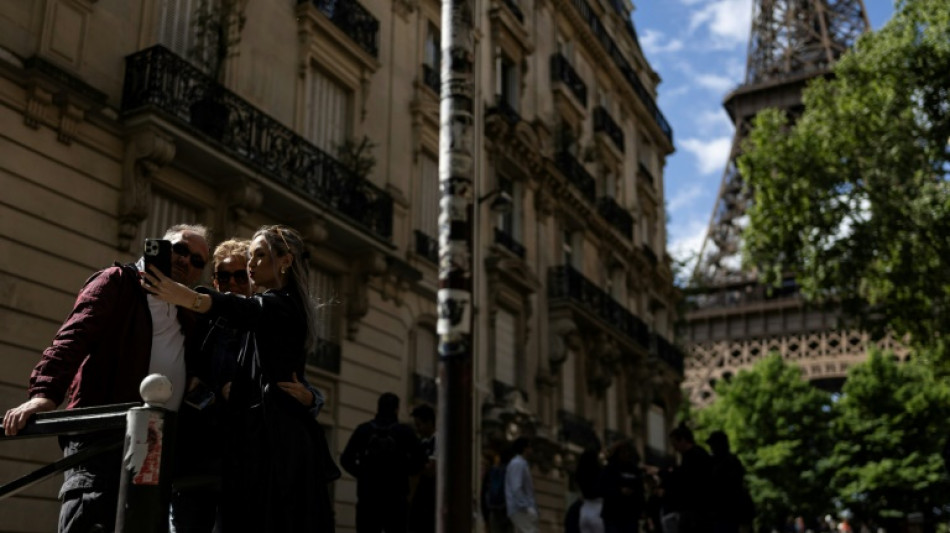
AI tool uses selfies to predict biological age and cancer survival / Photo: Ian LANGSDON - AFP/File

 NBA close to picking new $12-13bn Vegas team owners: report

 LA28 Olympics torch relay to visit all 50 states
 Spain brush aside Croatia in Nations League, England down Czechs

 Trump hails 'morally binding' AI self-regulation pledge

 Yamal inspires Spain to Croatia romp on World Cup homecoming

 UN to hold fourth informal poll of secretary-general candidates

 Who are the Emiratis behind crisis-hit Manchester City?

 Singer Angelique Kidjo urges Africans to 'create together'

 Alleged Rihanna mansion shooter mentally fit for trial, says judge
 Mystery over UK airbase scare as police find petrol not explosives

 OpenAI unveils low-cost AI model, a day after shelving Astra upgrade
 Premier League confirms Man City guilty of serious financial breaches
 Brazil's Lula turns to Bad Bunny tune to criticise Trump ahead of polls

 Nigerian dancer eyes world record after seven-day marathon

 Swiss regulator concludes Julius Baer bank probe

 Brazil's patron saint pulled into latest election scrap

 Football overload leaves players near 'breaking point', warns Tebas

 Paris Eiffel Tower says chief to step down after uproar over removing women staff

 Amaze Holdings (NYSE: AMZE) Executes Binding LOI to Acquire BullionFX | Alchemy, a Decentralized Gold-Backed Financial Ecosystem for Valued at US$155 Million
 Clashes between French teens, police as school blockades intensify

 Stocks move sideways despite oil moving lower

 African leaders to gather in Egypt for business summit

 UK decides against charging foreign visitors for museums

 Dallaglio to sell England World Cup winners' medal

 Brazil come from behind to beat Australia 4-2 in friendly
Doctors often start exams with the so-called "eyeball test" -- a snap judgment about whether the patient appears older or younger than their age, which can influence key medical decisions.
That intuitive assessment may soon get an AI upgrade.
FaceAge, a deep learning algorithm described Thursday in The Lancet Digital Health, converts a simple headshot into a number that more accurately reflects a person's biological age rather than the birthday on their chart.
Trained on tens of thousands of photographs, it pegged cancer patients on average as biologically five years older than healthy peers. The study's authors say it could help doctors decide who can safely tolerate punishing treatments, and who might fare better with a gentler approach.
"We hypothesize that FaceAge could be used as a biomarker in cancer care to quantify a patient's biological age and help a doctor make these tough decisions," said co-senior author Raymond Mak, an oncologist at Mass Brigham Health, a Harvard-affiliated health system in Boston.
Consider two hypothetical patients: a spry 75‑year‑old whose biological age clocks in at 65, and a frail 60‑year‑old whose biology reads 70. Aggressive radiation might be appropriate for the former but risky for the latter.
The same logic could help guide decisions about heart surgery, hip replacements or end-of-life care.
- Sharper lens on frailty -
Growing evidence shows humans age at different rates, shaped by genes, stress, exercise, and habits like smoking or drinking. While pricey genetic tests can reveal how DNA wears over time, FaceAge promises insight using only a selfie.
The model was trained on 58,851 portraits of presumed-healthy adults over 60, culled from public datasets.
It was then tested on 6,196 cancer patients treated in the United States and the Netherlands, using photos snapped just before radiotherapy. Patients with malignancies looked on average 4.79 years older biologically than their chronological age.
Among cancer patients, a higher FaceAge score strongly predicted worse survival -- even after accounting for actual age, sex, and tumor type -- and the hazard rose steeply for anyone whose biological reading tipped past 85.
Intriguingly, FaceAge appears to weigh the signs of aging differently than humans do. For example, being gray-haired or balding matters less than subtle changes in facial muscle tone.
FaceAge boosted doctors' accuracy, too. Eight physicians were asked to examine headshots of terminal cancer patients and guess who would die within six months. Their success rate barely beat chance; with FaceAge data in hand, predictions improved sharply.
The model even affirmed a favorite internet meme, estimating actor Paul Rudd's biological age as 43 in a photo taken when he was 50.
- Bias and ethics guardrails -
AI tools have faced scrutiny for under‑serving non-white people. Mak said preliminary checks revealed no significant racial bias in FaceAge's predictions, but the group is training a second‑generation model on 20,000 patients.
They're also probing how factors like makeup, cosmetic surgery or room lighting variations could fool the system.
Ethics debates loom large. An AI that can read biological age from a selfie could prove a boon for clinicians, but also tempting for life insurers or employers seeking to gauge risk.
"It is for sure something that needs attention, to assure that these technologies are used only in the benefit for the patient," said Hugo Aerts, the study's co-lead who directs MGB's AI in medicine program.
Another dilemma: What happens when the mirror talks back? Learning that your body is biologically older than you thought may spur healthy changes -- or sow anxiety.
The researchers are planning to open a public-facing FaceAge portal where people can upload their own pictures to enroll in a research study to further validate the algorithm. Commercial versions aimed at clinicians may follow, but only after more validation.
B.Torres--AT