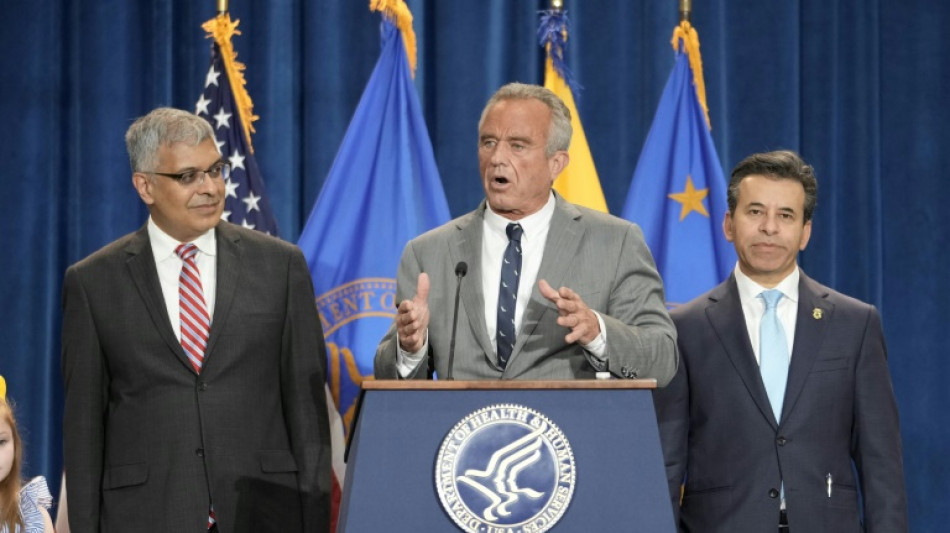
Trump's administration moves to scrap artificial food dyes / Photo: Oliver Contreras - AFP

 NBA close to picking new $12-13bn Vegas team owners: report

 LA28 Olympics torch relay to visit all 50 states
 Spain brush aside Croatia in Nations League, England down Czechs
 Trump hails 'morally binding' AI self-regulation pledge
 Yamal inspires Spain to Croatia romp on World Cup homecoming

 UN to hold fourth informal poll of secretary-general candidates

 Who are the Emiratis behind crisis-hit Manchester City?

 Singer Angelique Kidjo urges Africans to 'create together'

 Alleged Rihanna mansion shooter mentally fit for trial, says judge
 Mystery over UK airbase scare as police find petrol not explosives
 OpenAI unveils low-cost AI model, a day after shelving Astra upgrade
 Premier League confirms Man City guilty of serious financial breaches
 Brazil's Lula turns to Bad Bunny tune to criticise Trump ahead of polls
 Nigerian dancer eyes world record after seven-day marathon
 Swiss regulator concludes Julius Baer bank probe
 Brazil's patron saint pulled into latest election scrap

 Football overload leaves players near 'breaking point', warns Tebas

 Paris Eiffel Tower says chief to step down after uproar over removing women staff
 Amaze Holdings (NYSE: AMZE) Executes Binding LOI to Acquire BullionFX | Alchemy, a Decentralized Gold-Backed Financial Ecosystem for Valued at US$155 Million
 Clashes between French teens, police as school blockades intensify

 Stocks move sideways despite oil moving lower

 African leaders to gather in Egypt for business summit

 UK decides against charging foreign visitors for museums

 Dallaglio to sell England World Cup winners' medal
 Brazil come from behind to beat Australia 4-2 in friendly
President Donald Trump's administration on Tuesday announced plans to remove synthetic dyes from the US food supply, marking a rare point of bipartisan convergence in an otherwise sharply divided political climate.
Health Secretary Robert F Kennedy Jr. has vowed to overhaul America's food system under the banner of his "Make America Healthy Again" (MAHA) agenda, and the push would phase out the eight approved artificial food dyes by the end of 2026.
It builds upon a prohibition on Red Dye 3 by the government of former president Joe Biden but accelerates the timeline and also calls on the National Institutes of Health to carry out comprehensive research on how additives impact children's development.
"For the last 50 years, American children have increasingly been living in a toxic soup of synthetic chemicals," Food and Drug Administration commissioner Marty Makary said at a news conference, surrounded by young families and MAHA supporters.
He cited studies linking synthetic dyes to conditions including attention deficit hyperactivity disorder (ADHD), diabetes, cancer, genomic disruption, gastrointestinal issues and more.
Kennedy, for his part, called the issue of dyes and additives more generally an "existential" threat.
"When my uncle was president in the 1960s, we had the healthiest people in the world -- and one of the basic assumptions of our country was that because we were robust people... that was responsible for our country being the land of the brave and the home of the free," he said.
Of the eight synthetic dyes derived from petroleum, Yellow 5, Yellow 6 and Red 40 make up the lion's share of those in use, Peter Lurie, president and executive director of the nonprofit Center for Science in the Public Interest, told AFP.
They are found in a range of products, from beverages and candies to cereals, sauces and dairy products.
Under the new plan, the FDA would revoke authorization for two of the eight dyes, while relying on the food industry to voluntarily eliminate the other six, but Kennedy said they have been receptive in talks.
"None of them convey anything of any nutritional significance, and what they're really there for is to mislead -- to make food appear somehow redder, somehow bluer, somehow fruitier or more attractive than it is," said Lurie.
"And the purpose of all that is to drive up sales, it's not anything that benefits the American public."
- Bipartisan momentum -
Momentum has been building at the state level. In March, Republican-leaning West Virginia enacted a broad ban on synthetic dyes, following California's 2024 decision to restrict them in public schools.
While Red Dye 3 was previously targeted for phaseout in foods and drugs by 2027 and 2028 respectively due to cancer concerns, the remaining dyes have been linked to behavioral issues such as attention deficit disorder in children.
In Europe, these dyes are not banned outright -- but the requirement to carry warning labels has led many companies to switch to natural alternatives.
Kennedy's stance puts him in rare alignment with mainstream scientific consensus -- a shift from his controversial record of promoting vaccine misinformation, downplaying the country's worst measles outbreak in years, and suggesting bird flu should be allowed to spread naturally among poultry.
Still, opposition from the food industry may yet surface. Manufacturers have long resisted tighter regulations, though Kennedy insisted they are ready to adapt.
"They want clear guidelines, they want to know what they can and can't do, and we're going to give them that," he said.
Lurie remained skeptical.
"All I know is that industry wasn't up there on the podium," he said. "If they were so clearly on board, you have to ask yourself why they weren't there."
S.Jackson--AT