US firm says it brought back extinct dire wolves / Photo: - - Colossal Biosciences/AFP

 NBA close to picking new $12-13bn Vegas team owners: report

 LA28 Olympics torch relay to visit all 50 states

 Spain brush aside Croatia in Nations League, England down Czechs

 Trump hails 'morally binding' AI self-regulation pledge

 Yamal inspires Spain to Croatia romp on World Cup homecoming

 UN to hold fourth informal poll of secretary-general candidates

 Who are the Emiratis behind crisis-hit Manchester City?

 Singer Angelique Kidjo urges Africans to 'create together'

 Alleged Rihanna mansion shooter mentally fit for trial, says judge

 Mystery over UK airbase scare as police find petrol not explosives

 OpenAI unveils low-cost AI model, a day after shelving Astra upgrade

 Premier League confirms Man City guilty of serious financial breaches

 Brazil's Lula turns to Bad Bunny tune to criticise Trump ahead of polls

 Nigerian dancer eyes world record after seven-day marathon

 Swiss regulator concludes Julius Baer bank probe

 Brazil's patron saint pulled into latest election scrap

 Football overload leaves players near 'breaking point', warns Tebas

 Paris Eiffel Tower says chief to step down after uproar over removing women staff

 Amaze Holdings (NYSE: AMZE) Executes Binding LOI to Acquire BullionFX | Alchemy, a Decentralized Gold-Backed Financial Ecosystem for Valued at US$155 Million

 Clashes between French teens, police as school blockades intensify

 Stocks move sideways despite oil moving lower

 African leaders to gather in Egypt for business summit

 UK decides against charging foreign visitors for museums

 Dallaglio to sell England World Cup winners' medal

 Brazil come from behind to beat Australia 4-2 in friendly

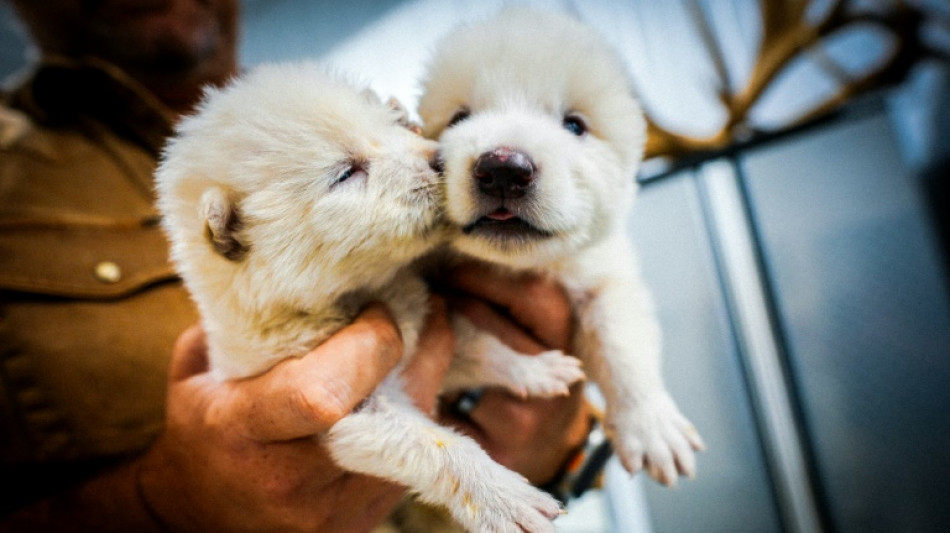
They whimper, drink from baby bottles and crawl oh so tentatively -- they look like cute white puppies, not the fruit of a daring project to resuscitate an extinct species.
A Texas startup called Colossal Biosciences made a big splash this week by releasing footage of canines they say are dire wolves, a species that vanished more than 12,000 years ago.
"For the first time in human history, Colossal successfully restored a once-eradicated species through the science of de-extinction," the company states on its website.
Photos and video of these critters have flooded social media and shaken the scientific community, which has reacted with a mix of enthusiasm and skepticism over this experiment reminiscent of "Jurassic Park" -- the fictional story of a quirky rich man's attempt to bring back the dinosaurs.
The company says it did it by tweaking the DNA of a modern-day gray wolf with carefully chosen genes from dire wolf fossils. This modified genetic material was then inserted in a grey wolf egg and implanted in a common dog as a surrogate mom.
The result: three baby dire wolves, Colossal Biosciences claims.
"I think the claims are vastly overblown," Alan Cooper, an evolutionary molecular biologist who took part in a previous study of dire wolf DNA, told AFP.
"It would be like me putting a couple of genes into you from Neanderthals that made you extra hairy and grow more muscles, and then called you a Neanderthal," said Cooper.
"That's a million miles from Neanderthal. It's a hairy human."
"This is not the dire wolf. This is something they have created that has phenotypic characteristics of dire wolf,” said Lisette Waits, an ecologist and professor of wildlife resources at the University of Idaho.
Waits, who has worked extensively on grey wolf genetics and red wolf conservation issues, nonetheless called this achievement a breakthrough.
The pups are named Romulus and Remus, in a nod to the twin brothers of Roman mythology, and Khaleesi, of "Game of Thrones" fame.
- Debate -
The Colossal Biosciences team studied DNA from two dire wolf fossils -- a tooth from 13,000 years ago and a skull fragment dated back 72,000 years -- and compared them to the DNA of the gray wolf, a species that is alive and well.
The team concluded these two kinds of DNA are around 99.5 percent identical, Beth Shapiro, the company's chief science officer, told AFP.
An analysis of the differences between the two kinds of DNA determined which genes could be responsible for the dire wolf's size, muscle structure and its white fur.
With this information the team modified blood cells from a grey wolf by inserting some of those dire wolf genes. A total of 20 changes were made using the genetic manipulation technique known as Crispr-Cas 9, which is also used in human genetics.
The blood cells were then transferred to a gray wolf egg cell that was implanted in a dog. The results: Romulus, Remus and Khaleesi.
Whether these animals are actual dire wolves or simply genetically modified gray wolves, Shapiro insisted, "is a semantic, philosophical argument."
She added that it will never be possible to create an animal that is 100 percent genetically identical to a species that is extinct.
"But neither is that the goal. Our goal is to create functional equivalents of those species,” the scientist said.
- Dodos and wooly mammoths -
The company plans to apply this technique to dodo birds and woolly mammoths.
Just last month it released photos of mice injected with genetic material from one of those extinct pachyderms, yielding controversy and some very furry rodents.
Some scientists say the goal of recreating extinct species is unattainable and even dangerous. But others welcome it as an ambitious way to fight the planet's steady loss of biodiversity.
Waits, the conservation specialist, said that aside from the hoopla over this experiment this technique could help endangered species recover.
Colossal Biosciences has managed to lure more than $200 million in investment money, which would be a very tall task for other conservation causes, she added.
Ronald Sandler, a professor of philosophy and ethics at Northeastern University, said he worries this technique might lead to "moral distraction" away from the causes of animals going extinct, like climate change and habitat loss.
Ch.Campbell--AT