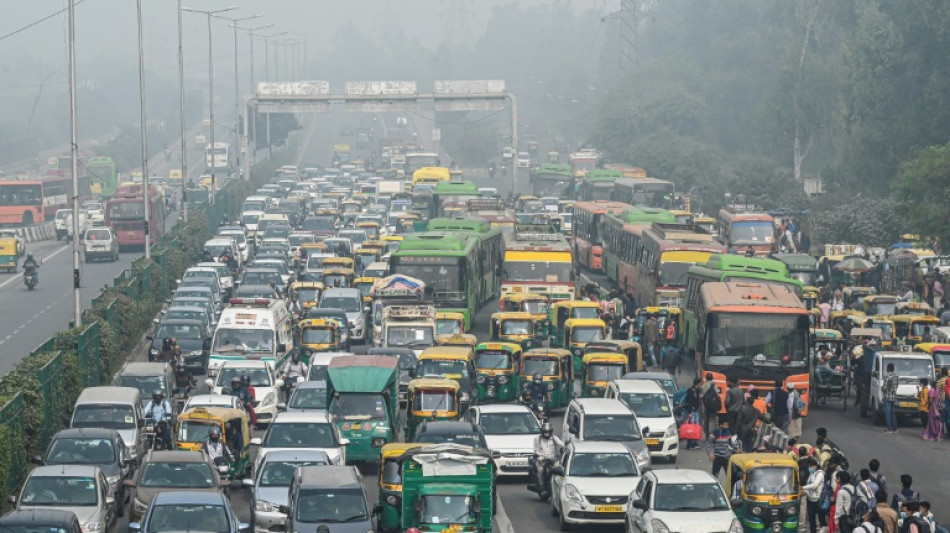
Polluted air cuts global life expectancy by two years / Photo: Prakash SINGH - AFP/File

 NBA close to picking new $12-13bn Vegas team owners: report
 LA28 Olympics torch relay to visit all 50 states

 Spain brush aside Croatia in Nations League, England down Czechs

 Trump hails 'morally binding' AI self-regulation pledge

 Yamal inspires Spain to Croatia romp on World Cup homecoming

 UN to hold fourth informal poll of secretary-general candidates

 Who are the Emiratis behind crisis-hit Manchester City?

 Singer Angelique Kidjo urges Africans to 'create together'

 Alleged Rihanna mansion shooter mentally fit for trial, says judge
 Mystery over UK airbase scare as police find petrol not explosives

 OpenAI unveils low-cost AI model, a day after shelving Astra upgrade

 Premier League confirms Man City guilty of serious financial breaches
 Brazil's Lula turns to Bad Bunny tune to criticise Trump ahead of polls

 Nigerian dancer eyes world record after seven-day marathon

 Swiss regulator concludes Julius Baer bank probe
 Brazil's patron saint pulled into latest election scrap

 Football overload leaves players near 'breaking point', warns Tebas

 Paris Eiffel Tower says chief to step down after uproar over removing women staff

 Amaze Holdings (NYSE: AMZE) Executes Binding LOI to Acquire BullionFX | Alchemy, a Decentralized Gold-Backed Financial Ecosystem for Valued at US$155 Million

 Clashes between French teens, police as school blockades intensify
 Stocks move sideways despite oil moving lower

 African leaders to gather in Egypt for business summit
 UK decides against charging foreign visitors for museums

 Dallaglio to sell England World Cup winners' medal

 Brazil come from behind to beat Australia 4-2 in friendly

Microscopic air pollution caused mostly by burning fossil fuels shortens lives worldwide by more than two years, researchers reported Tuesday.
Across South Asia, the average person would live five years longer if levels of fine particulate matter met World Health Organization standards, according to a report from the University of Chicago's Energy Policy Institute.
In the Indian states of Uttar Pradesh and Bihar, home to 300 million, crippling lung and heart disease caused by so-called PM2.5 pollution reduces life expectancy by eight years, and in the capital city of New Delhi by a decade.
PM2.5 pollution -- 2.5 microns across or less, roughly the diameter of a human hair -- penetrates deep into the lungs and enters the bloodstream.
In 2013, the United Nations classified it as a cancer-causing agent.
The WHO says PM2.5 density in the air should not top 15 microgrammes per cubic metre in any 24-hour period, or 5 mcg/m3 averaged across an entire year.
Faced with mounting evidence of damaging health impacts, the WHO tightened these standards last year, the first change since establishing air quality guidance in 2005.
"Clean air pays back in additional years of life for people across the world," lead research Crista Hasenkopf and colleagues said in the Air Quality Life Index report.
"Permanently reducing global air pollution to meet the WHO's guidelines would add 2.2 years onto average life expectancy."
- Major gains in China -
Almost all populated regions in the world exceed WHO guidelines, but nowhere more so that in Asia: by 15-fold in Bangladesh, 10-fold in India, and nine-fold in Nepal and Pakistan.
Central and West Africa, along with much of Southeast Asia and parts of central America, also face pollution levels -- and shortened lives -- well above the global average.
Surprisingly, PM2.5 pollution in 2020, the most recent data available, was virtually unchanged from the year before despite a sharp slow-down in the global economy and a corresponding drop in CO2 emissions due to Covid lockdowns.
"In South Asia, pollution actually rose during the first year of the pandemic," the authors noted.
One country that has seen major improvements is China.
PM2.5 pollution fell in the nation of 1.4 billion people by almost 40 percent between 2013 and 2020, adding two years to life expectancy.
But even with this progress, lives in China are on average cut short today by 2.6 years.
The worst-hit provinces include Henan and Hebei, in north-central China, and the coastal province of Shandong.
Compared to other causes of premature death, the impact of PM2.5 pollution is comparable to smoking tobacco, more than three times that of alcohol use, and six times that of HIV/AIDS, the report said.
H.Thompson--AT