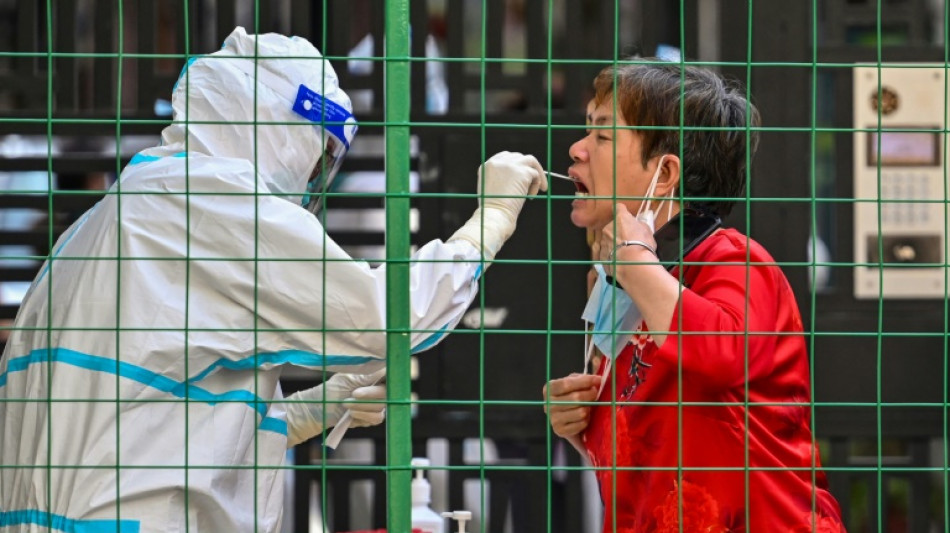
Covid lab leak theory needs more research: WHO advisors / Photo: Hector RETAMAL - AFP

 NBA close to picking new $12-13bn Vegas team owners: report

 LA28 Olympics torch relay to visit all 50 states

 Spain brush aside Croatia in Nations League, England down Czechs

 Trump hails 'morally binding' AI self-regulation pledge
 Yamal inspires Spain to Croatia romp on World Cup homecoming

 UN to hold fourth informal poll of secretary-general candidates
 Who are the Emiratis behind crisis-hit Manchester City?

 Singer Angelique Kidjo urges Africans to 'create together'

 Alleged Rihanna mansion shooter mentally fit for trial, says judge
 Mystery over UK airbase scare as police find petrol not explosives

 OpenAI unveils low-cost AI model, a day after shelving Astra upgrade
 Premier League confirms Man City guilty of serious financial breaches
 Brazil's Lula turns to Bad Bunny tune to criticise Trump ahead of polls
 Nigerian dancer eyes world record after seven-day marathon
 Swiss regulator concludes Julius Baer bank probe

 Brazil's patron saint pulled into latest election scrap

 Football overload leaves players near 'breaking point', warns Tebas
 Paris Eiffel Tower says chief to step down after uproar over removing women staff
 Amaze Holdings (NYSE: AMZE) Executes Binding LOI to Acquire BullionFX | Alchemy, a Decentralized Gold-Backed Financial Ecosystem for Valued at US$155 Million
 Clashes between French teens, police as school blockades intensify

 Stocks move sideways despite oil moving lower

 African leaders to gather in Egypt for business summit
 UK decides against charging foreign visitors for museums

 Dallaglio to sell England World Cup winners' medal

 Brazil come from behind to beat Australia 4-2 in friendly
Scientists advising the World Health Organization on how to move forward investigating the origins of Covid-19 said Thursday further studies were needed into whether the disease escaped from a lab.
In its first preliminary report, the so-called Scientific Advisory Group for the Origins of Novel Pathogens (SAGO) stressed that it had no conclusive findings on the origins of the virus behind the worst global pandemic in a century.
The team of 27 experts was set up by the WHO last year to produce a new global framework for studies into emerging pathogens with the potential of sparking epidemics or pandemics.
It has been tasked with providing an independent assessment on a way forward in the thorny investigation into the origins of the SARS CoV-2 virus that causes Covid-19 disease.
"There are key pieces of data that are not yet available for a complete understanding of how the Covid-19 pandemic began," they acknowledged in their report, stressing that a range of further studies were needed "to follow up on several gaps in our knowledge".
- 'Zoonotic transmission' -
The experts evaluated a wide range of existing research, including the findings of a joint WHO-China scientific mission last year, as well as more recent published and unpublished studies.
They seemed to back a key finding by the joint mission that the virus most likely jumped from bats to humans via an intermediate animal, so-called zoonotic transmission.
"The strongest evidence is still around zoonotic transmission," SAGO chair Marietjie Venter told reporters, although the original host, intermediate hosts or how the virus had jumped to humans have not been identified.
But while the joint mission had deemed a competing theory that the virus may have escaped due to a laboratory incident was "extremely unlikely" and proposed no further investigation into that hypothesis, the SAGO team insisted that this issue too required further study.
Among a long line of studies requested, the team stressed that "it remains important to consider all reasonable scientific data that is available either through published or other official sources to evaluate the possibility of the introduction of SARS-CoV-2 into the human population through a laboratory incident".
The issue is highly controversial, and SAGO acknowledged that three members of the team, from China, Russia and Brazil, had objected to including the recommendation.
- 'Need to be open-minded' -
Venter told reporters it was important to be open to various hypotheses.
"Having it in the report doesn't say that that's definitely what we think it is," she said, insisting that it merely means "we are open to scientific data... so if anything comes up that's new, we will not ignore it".
"We need to be open-minded and cover all the hypotheses, including that one," her co-chair Jean-Claude Manuguerra agreed, stressing that so far there had been no real investigation into the lab leak theory.
Among other things, the experts said access was needed to staff and data from labs both in China and elsewhere that work with coronaviruses, including SARS-CoV-2, to assess biosafety and biosecurity practices.
This could be tricky, especially in the case of China, which has so far pushed back against suggestions of fresh international missions to the country.
WHO chief Tedros Ahanom Ghebreyesus insisted that it was vital that the scientific work to determine Covid's origins "be kept separate from politics".
In a briefing to member states, he said the UN health agency would strive to follow SAGO's advice, emphasising that "all hypotheses must remain on the table until we have evidence that enables us to rule certain hypotheses out".
"The longer it takes, the harder it becomes. We need to speed up and act with a sense of urgency."
M.O.Allen--AT