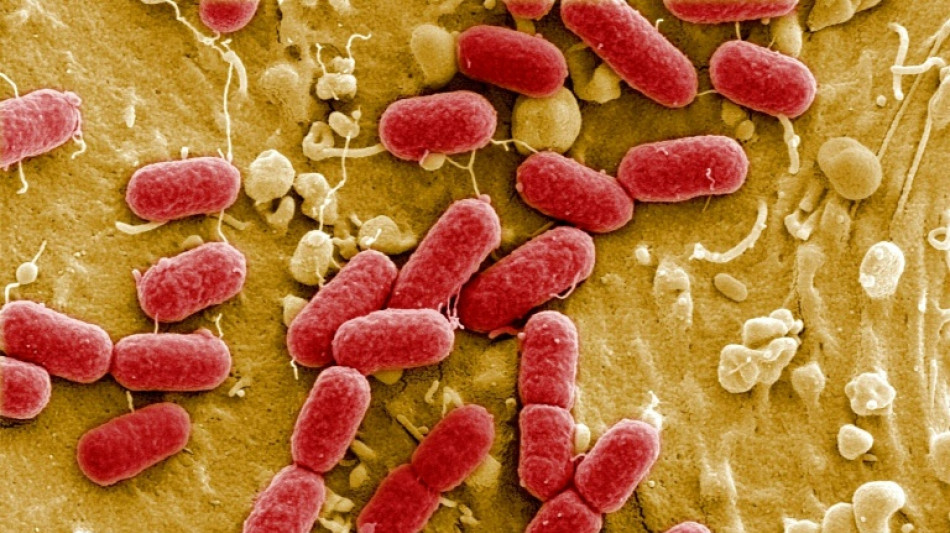
Drug-resistant superbugs projected to kill 39 million by 2050 / Photo: Manfred Rohde - Helmholtz-Zentrum für Infektions/AFP

 Dangote to launch $16bn refinery in Kenya

 North Korean leader 'extremely obese': Seoul spy agency

 Yankees and pope-backed White Sox start MLB playoffs with wins

 Malaysia's ex-PM Mahathir in hospital for observation

 'No limits': Marathon world record holder Sawe chasing history

 Countdown begins to biggest-ever Rugby World Cup

 Bangladesh women lose ground after quota reform

 Vietnam admits 'differing opinions' on Hanoi development

 Stocks temper gains as oil pares heavy losses, US data in focus

 New Zealand denies breaching climate commitments to EU

 Albert becomes youngest US scorer in 4-2 win over Chile

 Pirate island's plunging population shows Greece's demographic decline
 With elections ahead, Latvia's Russian-speakers reject Moscow's help

 Brazil football clubs face massive sponsorship blow from betting ban

 ChatGPT maker wants to be the App Store for AI as safety concerns grow

 Women fight fires and sexism in Indonesian Borneo

 Forsling's OT blast lifts Florida over Carolina in NHL opener

 Alpha Growth Management Opens Rep Office in Japan

 NBA close to picking new $12-13bn Vegas team owners: report

 LA28 Olympics torch relay to visit all 50 states

 Spain brush aside Croatia in Nations League, England down Czechs

 Trump hails 'morally binding' AI self-regulation pledge

 Yamal inspires Spain to Croatia romp on World Cup homecoming

 UN to hold fourth informal poll of secretary-general candidates

 Who are the Emiratis behind crisis-hit Manchester City?

Infections of drug-resistant superbugs are projected to kill nearly 40 million people over the next 25 years, a global analysis predicted on Monday, as the researchers called for action to avoid this grim scenario.
Superbugs -- strains of bacteria or pathogens that have become resistant to antibiotics, making them much harder to treat -- have been recognised as a rising threat to global health.
The analysis has been billed as the first research to track the global impact of superbugs over time, and estimate what could happen next.
More than a million people died from the superbugs -- also called antimicrobial resistance (AMR) -- a year across the world between 1990 and 2021, according to the study in The Lancet journal.
Deaths among children under five from superbugs actually fell by more than 50 percent over the last three decades, the study said, due to improving measures to prevent and control infections for infants.
However when children now catch superbugs, the infections are much harder to treat.
And deaths of over-70s have surged by more than 80 percent over the same period, as an ageing population became more vulnerable to infection.
Deaths from infections of MRSA, a type of staph bacteria that has become resistant to many antibiotics, doubled to 130,000 in 2021 from three decades earlier, the study said.
- 'This threat is growing' -
The researchers used modelling to estimate that -- based on current trends -- the number of direct deaths from AMR would rise by 67 percent to reach nearly two million a year by 2050.
It will also play a role in a further 8.2 million annual deaths, a jump of nearly 75 percent, according to the modelling.
Under this scenario, AMR will have directly killed 39 million people over the next quarter century, and contributed to a total of 169 million deaths, it added.
But less dire scenarios are also possible.
If the world works to improve care for severe infections and access to antimicrobial drugs, it could save the lives of 92 million people by 2050, the modelling suggested.
"These findings highlight that AMR has been a significant global health threat for decades and that this threat is growing," study co-author Mohsen Naghavi of the US-based Institute of Health Metrics said in a statement.
The researchers looked at 22 pathogens, 84 combinations of drugs and pathogens, and 11 infectious syndromes such as meningitis. The study involved data from 520 million individual records across 204 countries and territories.
It was released ahead of a high-level AMR meeting at the United Nations scheduled for September 26.
Antimicrobial resistance is a natural phenomenon, but the overuse and misuse of antibiotics in humans, animals and plants has made the problem worse.
S.Jackson--AT