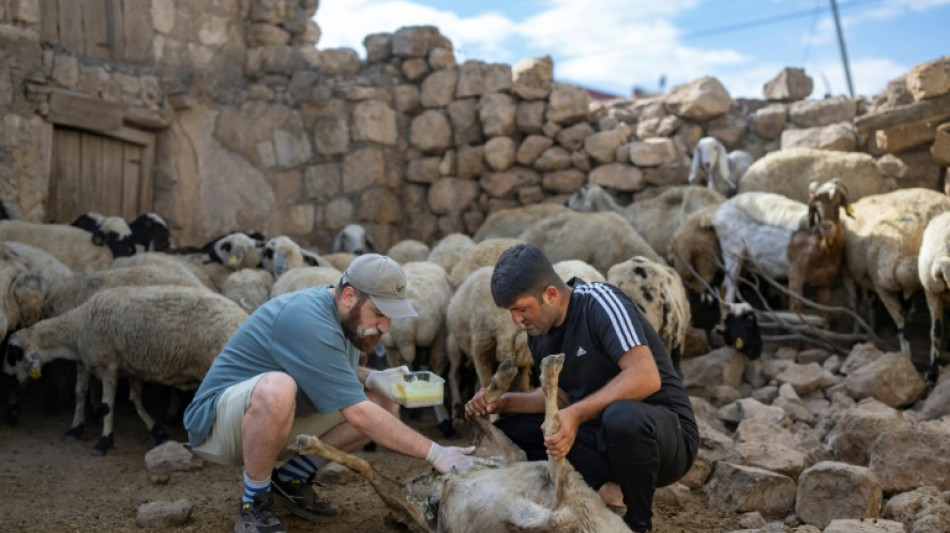
Turkish volunteer fights to save fire-scarred sheep / Photo: Yasin AKGUL - AFP

 Dangote to launch $16bn refinery in Kenya
 North Korean leader 'extremely obese': Seoul spy agency

 Yankees and pope-backed White Sox start MLB playoffs with wins

 Malaysia's ex-PM Mahathir in hospital for observation

 'No limits': Marathon world record holder Sawe chasing history

 Countdown begins to biggest-ever Rugby World Cup

 Bangladesh women lose ground after quota reform
 Vietnam admits 'differing opinions' on Hanoi development
 Stocks temper gains as oil pares heavy losses, US data in focus
 New Zealand denies breaching climate commitments to EU

 Albert becomes youngest US scorer in 4-2 win over Chile
 Pirate island's plunging population shows Greece's demographic decline
 With elections ahead, Latvia's Russian-speakers reject Moscow's help
 Brazil football clubs face massive sponsorship blow from betting ban
 ChatGPT maker wants to be the App Store for AI as safety concerns grow

 Women fight fires and sexism in Indonesian Borneo

 Forsling's OT blast lifts Florida over Carolina in NHL opener

 Alpha Growth Management Opens Rep Office in Japan

 NBA close to picking new $12-13bn Vegas team owners: report
 LA28 Olympics torch relay to visit all 50 states

 Spain brush aside Croatia in Nations League, England down Czechs

 Trump hails 'morally binding' AI self-regulation pledge

 Yamal inspires Spain to Croatia romp on World Cup homecoming

 UN to hold fourth informal poll of secretary-general candidates
 Who are the Emiratis behind crisis-hit Manchester City?

Lying on her back, the sheep struggled as the man approached to bandage her udders, which had been burned in a fire last month that killed hundreds of sheep in southeast Turkey.
Since the fire, Hasan Kizil has been driving on hilly roads in his van, treating traumatised animals and convincing farmers not to sell injured sheep to the slaughterhouse.
The blaze ripped through the southeastern cities of Diyarbakir and Mardin on June 22, claiming 15 lives. Experts pointed to faulty wiring as a possible cause.
More than 1,000 sheep and goats died in the fire, according to the agriculture ministry, including those in the Mazidagi area, 36 kilometres (22 miles) from Mardin.
"Most of them had their eyes completely closed, too swollen to see in front of them," the 29-year-old, who largely taught himself how to care for the animals, said while treating burns around blackened hooves and udders.
"Had it continued for a few more days, the spoiled milk would have caused septicaemia," he said, referring to blood poisoning by bacteria. "We almost lost them."
- 'I love my animals' -
Every day, Kizil voluntarily visits farms to monitor the animals and convince farmers to keep their damaged herds.
Caring for injured and unproductive animals is a heavy burden for the young breeder, who owes 27,000 Turkish lira ($825) to the bank while also paying for medicine and hay.
Former kebab seller Mehmet Celebioglu, in his 30s, went into debt to buy 160 sheep and a few goats. Now only about 40 remain -- female sheep unable to produce milk and young goats orphaned by the fire.
"They were lying in the fields when the fire broke out. 120 sheep burned on the spot. Their eyes melted... these are all that are left," he said.
"My brothers risked their lives to save them," added his 18-year-old sister Gulistan, recalling how the fire cut off the electricity and water supplies as hot wind raged over the hills.
But selling the remaining stock is not an option for Celebioglu, originally from Adana, a large city in the south.
"Selling them? They'd pay me 2,000 to 3,000 lira," he said.
"I've spent two years teaching myself this job and most of all, I love my animals."
-'Battlefield'-
The farmers' attachment to their sheep encouraged Kizil to support them and reach out to disaster victims, as he did after treating injured animals following the massive earthquake that struck southeastern Turkey in February 2023, killing 55,000 people.
Now a local star on Instagram, he is known for making braces and prostheses for disabled animals. More than 240,000 followers track his work rehabilitating foxes, cats and injured birds.
Recalling the night of the fire, he said: "It was a battlefield around here."
"The butchers were trying to grab the wounded animals and slaughter them, while we were trying to keep them alive."
Images of the animals moved vets from several cities to rush to the scene voluntarily.
The municipality in the predominantly Kurdish city of Diyarbakir took in injured animals at its shelter, while others were sent to clinics in Izmir (west Turkey), Adana, and Istanbul.
"We are still fighting," said Kizil, in a region where agriculture and livestock farming are the mainstay of the economy.
Applying ointment to the black wounds on the female sheep, he added: "If we can recover the udders, these will be saved."
O.Gutierrez--AT