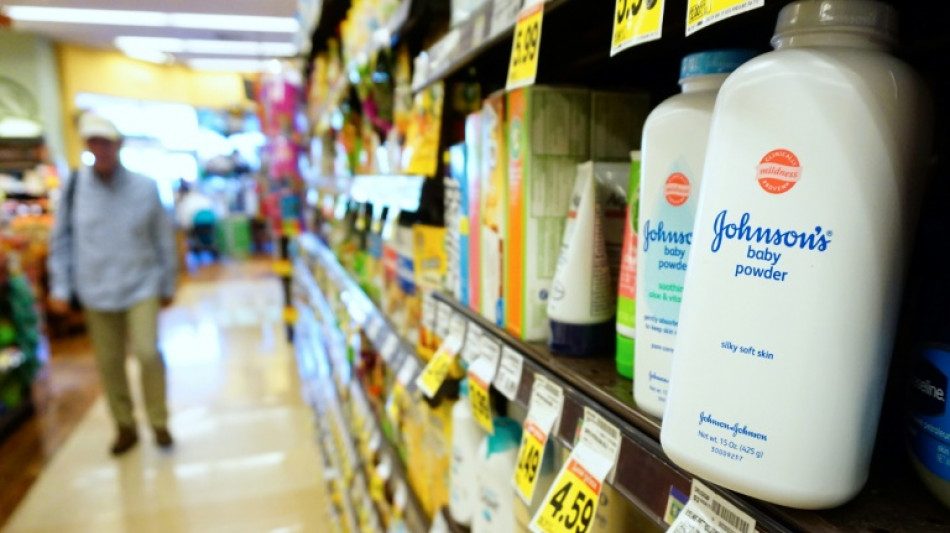
WHO agency says talc is 'probably' cancer-causing / Photo: FREDERIC J. BROWN - AFP/File

 Dangote to launch $16bn refinery in Kenya

 North Korean leader 'extremely obese': Seoul spy agency

 Yankees and pope-backed White Sox start MLB playoffs with wins

 Malaysia's ex-PM Mahathir in hospital for observation

 'No limits': Marathon world record holder Sawe chasing history

 Countdown begins to biggest-ever Rugby World Cup

 Bangladesh women lose ground after quota reform

 Vietnam admits 'differing opinions' on Hanoi development

 Stocks temper gains as oil pares heavy losses, US data in focus

 New Zealand denies breaching climate commitments to EU

 Albert becomes youngest US scorer in 4-2 win over Chile

 Pirate island's plunging population shows Greece's demographic decline
 With elections ahead, Latvia's Russian-speakers reject Moscow's help

 Brazil football clubs face massive sponsorship blow from betting ban

 ChatGPT maker wants to be the App Store for AI as safety concerns grow

 Women fight fires and sexism in Indonesian Borneo

 Forsling's OT blast lifts Florida over Carolina in NHL opener

 Alpha Growth Management Opens Rep Office in Japan

 NBA close to picking new $12-13bn Vegas team owners: report

 LA28 Olympics torch relay to visit all 50 states

 Spain brush aside Croatia in Nations League, England down Czechs

 Trump hails 'morally binding' AI self-regulation pledge

 Yamal inspires Spain to Croatia romp on World Cup homecoming

 UN to hold fourth informal poll of secretary-general candidates

 Who are the Emiratis behind crisis-hit Manchester City?

The World Health Organization's cancer agency on Friday classified talc as "probably carcinogenic" for humans, however an outside expert warned against misinterpreting the announcement as a "smoking gun".
The decision was based on "limited evidence" talc could cause ovarian cancer in humans, "sufficient evidence" it was linked to cancer in rats and "strong mechanistic evidence" that it shows carcinogenic signs in human cells, the WHO's International Agency for Research on Cancer (IARC) said.
Talc is a naturally occurring mineral which is mined in many parts of the world and is often used to make talcum baby powder.
Most people are exposed to talc in the form of baby powder or cosmetics, according to the Lyon-based IARC.
But the most significant exposure to talc occurs when talc is being mined, processed or used to make products, it added.
The agency said there were numerous studies which consistently showed an increase in the rate of ovarian cancer in women who use talc on their genitals.
But it could not rule out that the talc in some studies was contaminated with cancer-causing asbestos.
"A causal role for talc could not be fully established," according the agency's findings published in The Lancet Oncology.
Kevin McConway, a statistician at the UK's Open University not involved the research, warned that for the IARC's evaluation, the "most obvious interpretation is actually misleading".
The agency is only aiming "to answer the question of whether the substance has the potential to cause cancer, under some conditions that IARC do not specify," he said.
Because the studies were observational and so could not prove causation, "there isn’t a smoking gun that the talc use causes any increased cancer risk," he added.
The announcement comes just weeks after US pharmaceutical and cosmetics giant Johnson & Johnson agreed to pay $700 million to settle allegations it misled customers about the safety of its talcum-based powder products.
Johnson & Johnson did not admit wrongdoing in its settlement, even though it withdrew the product from the North American market in 2020.
A summary of studies published in 2020 covering 250,000 women in the United States did not find a statistical link between the use of talc on the genitals and the risk of ovarian cancer.
Also on Friday, the IARC classified acrylonitrile, a chemical compound used to make polymers, as "carcinogenic to humans", its highest warning level.
It cited "sufficient evidence" linking acrylonitrile to lung cancer.
The polymers made with acrylonitrile are used in everything from fibres in clothes to carpets, plastics and other consumer products.
A.Williams--AT