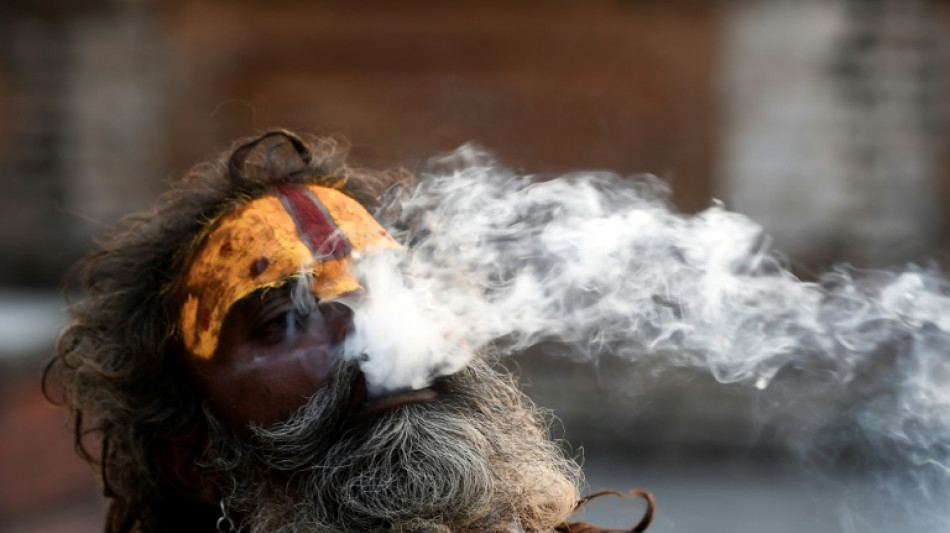
Nepal ganja campaign seeks return of Himalayan high times / Photo: Prakash MATHEMA - AFP

 Alleged Rihanna mansion shooter mentally fit for trial, says judge
 Mystery over UK airbase scare as police find petrol not explosives

 OpenAI unveils low-cost AI model, a day after shelving Astra upgrade
 Premier League confirms Man City guilty of serious financial breaches
 Brazil's Lula turns to Bad Bunny tune to criticise Trump ahead of polls

 Nigerian dancer eyes world record after seven-day marathon
 Swiss regulator concludes Julius Baer bank probe
 Brazil's patron saint pulled into latest election scrap

 Football overload leaves players near 'breaking point', warns Tebas
 Paris Eiffel Tower says chief to step down after uproar over removing women staff

 Amaze Holdings (NYSE: AMZE) Executes Binding LOI to Acquire BullionFX | Alchemy, a Decentralized Gold-Backed Financial Ecosystem for Valued at US$155 Million

 Clashes between French teens, police as school blockades intensify

 Stocks move sideways despite oil moving lower
 African leaders to gather in Egypt for business summit
 UK decides against charging foreign visitors for museums

 Dallaglio to sell England World Cup winners' medal

 Brazil come from behind to beat Australia 4-2 in friendly
 Ruthless An retains Asian Games badminton crown as Kunlavut triumphs

 Alonso to stay with F1 team Aston Martin in 2027
 China badminton 'still strong' despite Asian Games slump
 'Exceptional' Turner painting shown in Rome before sale
 European stocks climb as oil dips

 Spain aims to ban evictions until 2030 amid housing protests

 Kunlavut first Thai man to win Asian Games badminton singles gold

 French far right says antisemitism claims part of 'total war' to derail presidency bid

Nepal's marijuana ban could soon be up in smoke, as lawmakers mull a return to the liberal drug policies that once made the Himalayan republic a popular pit stop on the overland "hippie trail".
Half a century ago, thousands of fun-seeking backpackers from around the world made their way to Kathmandu to buy potent hash strains from government-licensed stores on "Freak Street" -- a lane named for long-haired and unkempt foreign visitors.
Washington's global war on drugs, and its accompanying pressure on foreign governments, prompted the closure of the capital's dispensaries in 1973, along with a cultivation ban that forced farmers to rip up their cannabis plants.
Now, with Western countries easing their own prohibitions on marijuana, the government and legal reform campaigners say it is time to stop criminalising a potent cash crop with centuries-old ties to the country's culture and religious practices.
- Corruption and smuggling -
"It is not justifiable that a poor country like ours has to treat cannabis as a drug," Nepal's Health Minister Birodh Khatiwada told AFP.
"Our people are being punished... and our corruption increases because of smuggling as we follow decisions of developed countries that are now doing as they please."
Khatiwada sponsored Nepal's first parliamentary motion advocating an end to the ban in January 2020, and two months later a bill was put to lawmakers seeking partial legalisation.
A change in government has stalled progress since, but in December of that year Nepal backed a successful campaign to have the United Nations reclassify cannabis out of its list of the world's most harmful drugs.
Nepal's home ministry has since launched a study into the medicinal properties and export potential of marijuana that is expected to support a revived parliamentary push to end the ban.
"It is a medicine," said prominent activist Rajiv Kafle, who lives with HIV and began campaigning for legalisation after using the drug to treat his symptoms.
Kafle said ending the ban would be an "important booster" to Nepal's tourism industry, which is still reeling from the Covid pandemic, and would also benefit Nepalis suffering from chronic illnesses.
While the current law allows for medicinal cannabis, there is no established framework for therapeutic use and the government still enforces a blanket ban on consumption and trafficking.
"So many patients are using it, but they are forced to do it illegally," Kafle told AFP. "They can get caught anytime."
Enforcement of the ban is already patchy: tourists visiting Nepal's backpacker haunts are unlikely to encounter the long arm of the law for lighting up a joint in a Kathmandu back alley.
Authorities also look the other way during an annual festival held to honour the Hindu deity Shiva, the destroyer of evil, who is regularly depicted clasping a chillum pipe used to smoke cannabis.
Ganja smoke wafts around the grounds of Kathmandu's Pashupatinath Temple each year as holy men gather to celebrate and worshippers fill their own chillums with Shiva's "gift".
But elsewhere, penalties are harsh and regularly enforced. Marijuana dealers risk up to 10 years jail time and police seize and destroy thousands of cannabis plants across the country each year.
- 'Part of our culture' -
Prohibition interrupted a long tradition of cannabis cultivation in Nepal, where plants grew wild and their stems, leaves and resin were used in food, as clothing fibres or as a component of traditional Ayurvedic medicines.
"The ban destroyed an important income source in this region," a farmer in western Dang district told AFP, speaking on condition of anonymity. "It ignored how it was part of our culture and everyday life, not just... an intoxicant."
Several Western countries have ended their own bans on marijuana use in recent years, including parts of the United States, which once spearheaded the global campaign to criminalise the drug.
In California, dispensaries sell "Himalayan Gold", a strain which originated from Nepal and calls to mind the country's historic associations with weed culture.
A rejuvenated marijuana trade tailored to burgeoning export demand and cashing in on Nepal's existing "international brand value" could prove highly lucrative, said Barry Bialek, a doctor working at a cannabis research centre at Kathmandu University.
"As a cash crop it can be good locally but also in the global market," he told AFP. "It can be a leader in the world."
M.White--AT