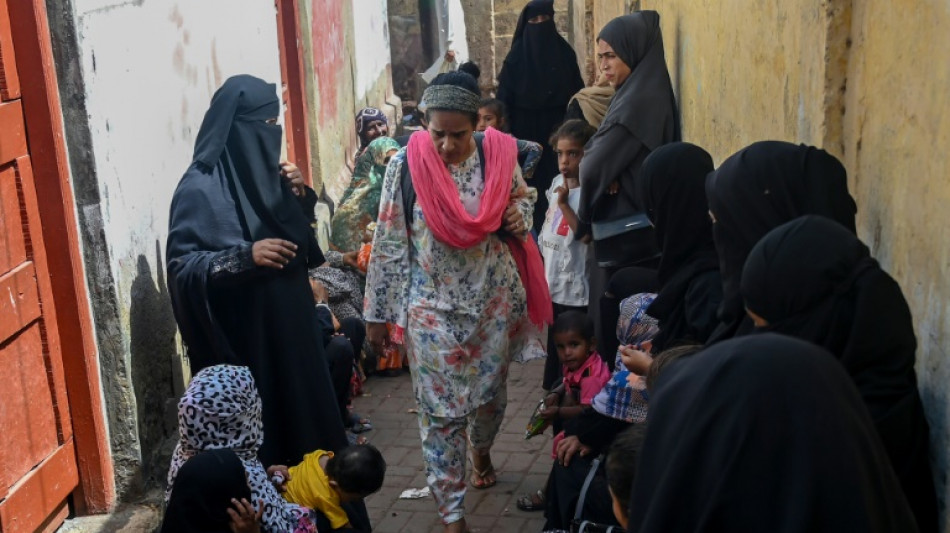
Midwife on the frontline of climate change on Pakistan's islands / Photo: Rizwan TABASSUM - AFP

 Dangote to launch $16bn refinery in Kenya
 North Korean leader 'extremely obese': Seoul spy agency

 Yankees and pope-backed White Sox start MLB playoffs with wins

 Malaysia's ex-PM Mahathir in hospital for observation

 'No limits': Marathon world record holder Sawe chasing history

 Countdown begins to biggest-ever Rugby World Cup
 Bangladesh women lose ground after quota reform
 Vietnam admits 'differing opinions' on Hanoi development
 Stocks temper gains as oil pares heavy losses, US data in focus
 New Zealand denies breaching climate commitments to EU

 Albert becomes youngest US scorer in 4-2 win over Chile
 Pirate island's plunging population shows Greece's demographic decline
 With elections ahead, Latvia's Russian-speakers reject Moscow's help
 Brazil football clubs face massive sponsorship blow from betting ban
 ChatGPT maker wants to be the App Store for AI as safety concerns grow
 Women fight fires and sexism in Indonesian Borneo

 Forsling's OT blast lifts Florida over Carolina in NHL opener

 Alpha Growth Management Opens Rep Office in Japan

 NBA close to picking new $12-13bn Vegas team owners: report

 LA28 Olympics torch relay to visit all 50 states

 Spain brush aside Croatia in Nations League, England down Czechs

 Trump hails 'morally binding' AI self-regulation pledge

 Yamal inspires Spain to Croatia romp on World Cup homecoming

 UN to hold fourth informal poll of secretary-general candidates
 Who are the Emiratis behind crisis-hit Manchester City?

On a densely populated island off Pakistan's megacity of Karachi, a group of pregnant women wait in a punishing heatwave for the only midwife to arrive from the mainland.
Each week Neha Mankani comes by boat ambulance to Baba, an old fishing settlement and reportedly one of the world's most crowded islands with around 6,500 people crammed into 0.15 square kilometres (0.06 miles).
Climate change is swelling the surrounding seas and baking the land with rising temperatures. Until Mankani's ambulance launched last year, expectant mothers were marooned at the mercy of the elements.
At the gate of her island clinic waits 26-year-old Zainab Bibi, pregnant again after a second-trimester miscarriage last summer.
"It was a very hot day, I was not feeling well," she recalled. It took her husband hours of haggling with boat owners before one agreed to ferry them to the mainland -- but it was too late.
"By the time I delivered my baby in the hospital, she was already dead," she said.
- Summer heat hits pregnancies -
Heatwaves are becoming hotter, longer and more frequent in Pakistan, one of the countries most vulnerable to extreme weather conditions resulting from climate change.
In May and June, a string of heatwaves have seen temperatures top 52 degrees Celcius (126 degrees Fahrenheit) for days.
"Climate change doesn't affect everyone equally," 38-year-old Mankani told AFP during the 20-minute boat journey.
"Pregnant women and newborns, postpartum women are definitely more affected," she said.
"In the summer months, we see a real increase in low-birth weights, preterm births, and in pregnancy losses."
Women are at higher risk of stillbirth when exposed to temperatures above 90 percent of the normal range for their location, according to experts published in the British Journal of Obstetrics and Gynaecology last year.
"Before we didn't have the evidence, a lot of it was anecdotal," said Mankani. "But we've been seeing the impact of climate change for a while."
In Pakistan, 154 women die for every 100,000 live births -— a high maternal mortality rate shaped by socioeconomic status, barriers to healthcare access and limited decision-making powers, especially among young women, according to the United Nations.
Mankani began her 16-year career as a midwife in a Karachi hospital, where she worked at a high-risk ward, often treating women from the five islands dotted off the coast.
She founded the Mama Baby Fund in 2015 and set up the first clinics on the islands for expectant and new mothers. "Everyone opened their homes to us," she said.
The free 24/7 boat ambulance followed last year, crucially equipped to navigate rough seas in a region increasingly prone to flooding.
Sabira Rashid, 26, gave birth to a girl she named Eesha two months ago, following one stillbirth and a miscarriage at seven months -- painful losses she blames on not reaching the hospital in time.
"At the dock, they make us wait because they don't want to ferry only two or three people. They told us to wait for more passengers, no matter what the emergency," she said.
- Rising, dirty waters -
Girls on the impoverished islands are often wed as young as 16, with marriage considered the source of security for women in an area where polluted water is killing off the fishing trade.
"Most of these girls don't know how to take care of themselves, they get severe infections from the dirty water they are constantly exposed to," said Shahida Sumaar, an assistant at the clinic, wiping the sweat from her face.
The 45-year-old said basic advice is offered to young mothers during heatwaves, such as using dry, clean towels to wrap their newborns in, washing their breasts before feeding and staying hydrated.
But with no access to running water and little electricity, warding off heat stress is a challenge for all the islanders.
Women are at particular risk, typically responsible for cooking over open flames in small rooms with no fans or proper ventilation.
Ayesha Mansoor, 30, has four children and lives on the fringes of Baba, with just four to five hours of electricity a day.
The path to her home is covered by a carpet of discarded plastic bags which disappear underwater when the tide is high.
"Only those who have solar can deal better with the heat. We can't afford it," she said, swatting away flies that settled on her baby.
Mariam Abubakr, an 18-year-old assistant at the clinic who has grown up on the island, hopes to become its first full-time midwife.
"I used to wonder why we women didn't have any facilities here, a clinic that could just cater to us," she said.
"When Neha opened her clinic, I saw a way that I could help the women of my community."
W.Nelson--AT