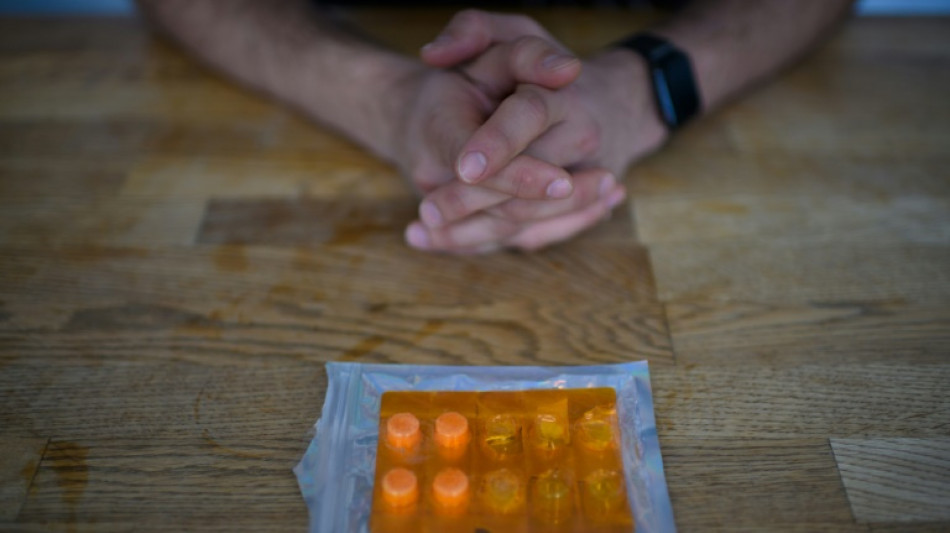
Ketamine pill treats depression without psychedelic effects: study / Photo: Ed JONES - AFP/File

 Dangote to launch $16bn refinery in Kenya

 North Korean leader 'extremely obese': Seoul spy agency

 Yankees and pope-backed White Sox start MLB playoffs with wins

 Malaysia's ex-PM Mahathir in hospital for observation

 'No limits': Marathon world record holder Sawe chasing history

 Countdown begins to biggest-ever Rugby World Cup

 Bangladesh women lose ground after quota reform

 Vietnam admits 'differing opinions' on Hanoi development

 Stocks temper gains as oil pares heavy losses, US data in focus

 New Zealand denies breaching climate commitments to EU

 Albert becomes youngest US scorer in 4-2 win over Chile

 Pirate island's plunging population shows Greece's demographic decline

 With elections ahead, Latvia's Russian-speakers reject Moscow's help

 Brazil football clubs face massive sponsorship blow from betting ban

 ChatGPT maker wants to be the App Store for AI as safety concerns grow

 Women fight fires and sexism in Indonesian Borneo

 Forsling's OT blast lifts Florida over Carolina in NHL opener

 Alpha Growth Management Opens Rep Office in Japan

 NBA close to picking new $12-13bn Vegas team owners: report

 LA28 Olympics torch relay to visit all 50 states

 Spain brush aside Croatia in Nations League, England down Czechs

 Trump hails 'morally binding' AI self-regulation pledge

 Yamal inspires Spain to Croatia romp on World Cup homecoming

 UN to hold fourth informal poll of secretary-general candidates

 Who are the Emiratis behind crisis-hit Manchester City?

A new pill that slowly releases ketamine could treat people with severe depression without giving them the psychedelic side effects of the often-misused drug, early trial results suggested on Monday.
First developed in the 1960s as an anaesthetic, ketamine's hallucinogenic and dissociative effects led to it becoming a party drug dubbed "Special K".
However, mounting research has demonstrated that ketamine is effective for the roughly quarter of people suffering from depression who see little benefit from common anti-depressant drugs.
In many countries, ketamine has been prescribed for depression for years.
US billionaire Elon Musk told CNN in March that he regularly uses a small amount of prescribed ketamine because it is "helpful for getting one out of the negative frame of mind".
The drug has long been administered intravenously in clinics, but more recently a nasal spray using a derivative called esketamine has increased in popularity.
Both can cause patients to have side effects such as dissociation, high blood pressure and an elevated heart rate.
There are also fears that medical use of the drug could slide into abuse.
The pill described in the journal Nature Medicine on Monday takes more than 10 hours to break down in the liver, lead study author Paul Glue told AFP.
"The really interesting feedback from patients is the lack of side effects -- no euphoria, no dissociation," said the researcher at New Zealand's University of Otago.
"I don't think these tablets would appeal to people who are abusing ketamine."
- Electro-shock alternative -
The phase 2 trial involved more than 270 people with depression who had previously tried an average of four different anti-depressant drugs.
More than half taking the ketamine pill went into remission for their depression, while 70 percent of the placebo group relapsed after 13 weeks, the study said.
Julaine Allan, an expert on mental health and addiction at Australia's Charles Sturt University who was not involved in the study, praised the trial while emphasising that more research is needed.
Ketamine does not work for everyone, and the "positive effects may wear off over time," she told AFP.
Michel Hoffmann, a psychiatrist at Geneva University Hospitals, said there is "real enthusiasm" in the medical community for ketamine's potential for treating depression.
"For patients who don't respond to conventional drugs, ketamine offers a way to avoid electro-shock therapy," he told AFP.
This last-resort treatment, which involves sending electric currents through the brain, has been proven to be effective.
But it can cause memory loss -- and some patients fear the procedure after seeing depictions of it in films such as "One Flew Over the Cuckoo's Nest".
- Fears of 'opioid style crisis' -
Some psychiatrists remain hesitant to prescribe ketamine for depression, fearing their patients could end up misusing the drug.
Last year, "Friends" actor Matthew Perry became the latest high-profile death from a ketamine overdose.
US police are investigating how Perry obtained the doses that caused his death -- he had reportedly not had a supervised infusion session for several days.
One potential benefit of quick-acting ketamine seen in previous research is that it could help patients considering suicide.
But there is "the plausible concern that the widespread use of ketamine might trigger a new opioid style crisis," Oxford researcher Riccardo De Giorgi said in a 2022 BMJ editorial.
By ridding ketamine of the side effects sought by some partygoers, the slow-release pill could alleviate some of these concerns.
There were still some side effects from the pill, the most common being headaches, dizziness and anxiety.
More research including phase 3 trials is needed before the drug can be reviewed by national medicine agencies, meaning it will be at least two or three years before patients could potentially access the pills, Glue said.
H.Thompson--AT


