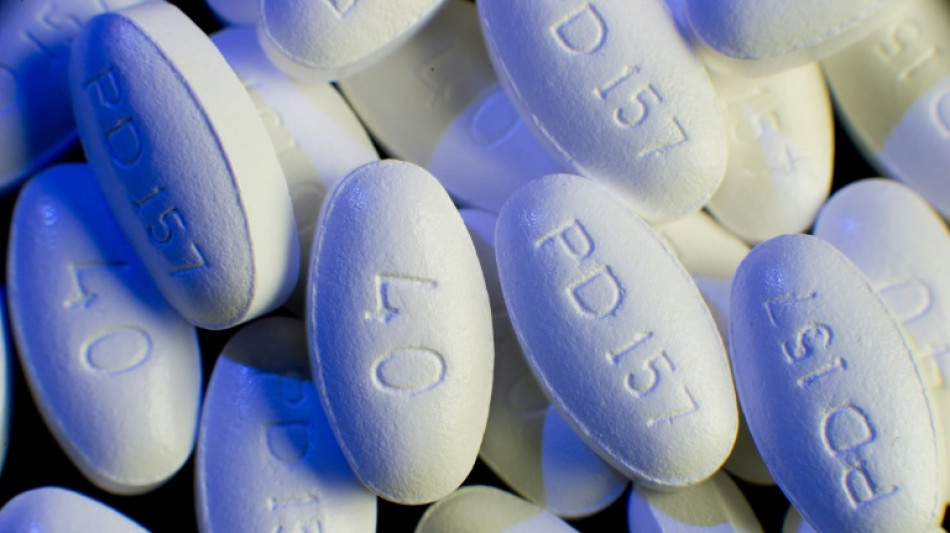
Japan biochemist who discovered statins, Akira Endo, dies / Photo: Paul J. RICHARDS - AFP

 Dangote to launch $16bn refinery in Kenya

 North Korean leader 'extremely obese': Seoul spy agency

 Yankees and pope-backed White Sox start MLB playoffs with wins

 Malaysia's ex-PM Mahathir in hospital for observation

 'No limits': Marathon world record holder Sawe chasing history

 Countdown begins to biggest-ever Rugby World Cup

 Bangladesh women lose ground after quota reform

 Vietnam admits 'differing opinions' on Hanoi development

 Stocks temper gains as oil pares heavy losses, US data in focus

 New Zealand denies breaching climate commitments to EU

 Albert becomes youngest US scorer in 4-2 win over Chile

 Pirate island's plunging population shows Greece's demographic decline

 With elections ahead, Latvia's Russian-speakers reject Moscow's help

 Brazil football clubs face massive sponsorship blow from betting ban

 ChatGPT maker wants to be the App Store for AI as safety concerns grow

 Women fight fires and sexism in Indonesian Borneo

 Forsling's OT blast lifts Florida over Carolina in NHL opener

 Alpha Growth Management Opens Rep Office in Japan

 NBA close to picking new $12-13bn Vegas team owners: report

 LA28 Olympics torch relay to visit all 50 states

 Spain brush aside Croatia in Nations League, England down Czechs

 Trump hails 'morally binding' AI self-regulation pledge
 Yamal inspires Spain to Croatia romp on World Cup homecoming

 UN to hold fourth informal poll of secretary-general candidates

 Who are the Emiratis behind crisis-hit Manchester City?

Japanese biochemist Akira Endo, who discovered cholesterol-lowering statins, has died aged 90, his former student and colleague said on Tuesday.
Statins, which can prevent heart attacks or strokes, are among the most commonly prescribed drugs worldwide.
Keiji Hasumi, a professor who was a long-time associate of Endo, said the scientist had died on June 5.
"His work was truly great. Statins didn't exist before Endo," Hasumi told AFP. "It has the same value and impact as the discovery of penicillin."
Johns Hopkins Medicine says more than 200 million people take statins. Studies say the global market for them was worth $15 billion in 2023 and is expected to grow.
Endo experimented on thousands of microbes to reach his 1973 discovery of mevastatin -- an agent derived from penicillin that reduces so-called "bad" cholesterol in the blood.
The researcher "was a tough, strict person. He was insightful and perceptive," and "able to see the hidden essence of things", Hasumi said.
Endo was born in 1933 to a farming family in rural northern Japan.
His ambitions began early thanks to his grandfather, who was interested in medicine and became a "great home teacher", Endo said in a 2008 autobiographical essay.
As a student, Endo became interested in antibiotics like penicillin, "deeply impressed" by how many lives they had saved, his essay in the journal Nature Medicine said.
Endo carried out research in New York in the late 1960s, when coronary heart disease was the main cause of US deaths.
"I often saw ambulances coming to take elderly people who had suffered a heart attack to hospital", which "made me realise the importance of developing a cholesterol-lowering drug", he said.
Endo worked at the Tokyo University of Agriculture and Technology, which issued a statement expressing condolences over his death, and at Japanese drugmaker Sankyo, now a part of Daiichi-Sankyo.
He spent two years testing 6,000 strains of microbe in the search for a new drug that could help achieve his goal before finally finding mevastatin.
Conflicting reports on the benefits and potential harms of statins in recent years have prompted some people prescribed the drugs to stop taking them.
"Are statins safe? For most people, the answer is a resounding yes, according to a 2014 Johns Hopkins meta-analysis of 20 years worth of published research," the US university says.
Endo was a strong candidate for a Nobel Prize, but never won. In a report on his death, Japanese broadcaster NHK noted Endo had received other accolades, including being honoured as a Person of Cultural Merit by the government in 2011.
His discovery "was the result of many twists and turns", Hasumi said.
"He reached his goal by overcoming so many challenges, without which medicines cannot be created, I think I remember him saying."
G.P.Martin--AT