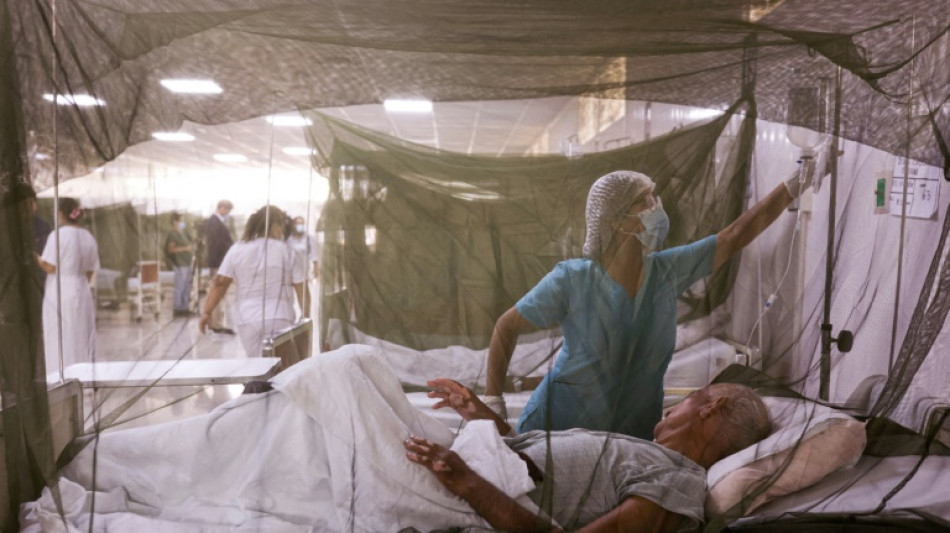
Pandemic talks extended as deadline passes / Photo: Juan Carlos CISNEROS - AFP

 South Korea score late to reach Asian Games football final

 Tom Kim defies jet-lag, Kho cards ace as Asian Games golf begins

 Thai teen rocker Nene aims to tour, write music... and return to school

 Ivory Coast clamps down on harmful illegal gold rush
 Nagoya mayor says sorry for Asian Games 'inconveniences'
 G20 trade officials meet under shadow of tariffs, overcapacity

 India's fat dog vote goes viral
 Asian Games crowds in spotlight as 998 see hosts in 50,000 stadium

 The eight stadiums for the 2027 Rugby World Cup

 Thieves swipe drugs under nose of Fiji police, swap with flour
 South Korea demands North apologise for DMZ mine blasts
 In Nepal's flood zone, teachers mourn students who never returned

 US Supreme Court lifts limits on third-country deportations

 Antonelli eager to 're-establish order' as F1 returns to Malaysia

 Paw-fect candidate: Australia finds new koala rescue dog
 One third of world population exposed to harmful air pollution: monitor

 North Korea denies South's claim it was apparently behind DMZ mine blasts

 West Bank's violent settlers part of a new generation fuelled by ideology
 US-led coalition ends mission in Iraq
 Pope-backed White Sox join Braves with MLB playoff wins

 Psychology Software Tools Builds on Early Bioz Success to Expand Access to Publication-Backed Product Evidence

 Alpha Growth Management Opens Rep Office in Japan

 NBA close to picking new $12-13bn Vegas team owners: report
 LA28 Olympics torch relay to visit all 50 states
 Spain brush aside Croatia in Nations League, England down Czechs
Countries trying to strike a landmark global agreement on handling future pandemics decided to keep negotiating for another fortnight after their deadline passed on Friday.
Scarred by the devastation caused by Covid-19 -- which killed millions, shredded economies and crippled health systems -- the World Health Organization's 194 member states have spent two years trying to hammer out binding commitments on pandemic prevention, preparedness and response.
The process was aimed at getting an agreement finalised by the WHO's annual assembly which opens on May 27.
A final talks session in March got nowhere near consensus, so an additional fortnight of talks was crammed in. However, despite progress on several fronts, the talks broke up on Friday without sealing a deal.
"They have worked very hard to get as far as they could on agreement and we are not there yet. So we will continue our work," co-chair Roland Driece told reporters at the WHO headquarters in Geneva.
"We worked very hard and there's just so many issues that we need to agree upon which are technical and political, and they take time."
- Keeping up the momentum -
The talks will keep going with intermittent meetings in person and online until the World Health Assembly (WHA).
Driece and his co-chair Precious Matsoso are to issue a schedule in coming days. They have to report to the May 27-June 1 annual assembly, regardless of how far the talks get.
In a statement, WHO chief Tedros Adhanom Ghebreyesus added: "During more than two years of intensive negotiations, WHO's member states have shown unwavering commitment to forging a generational agreement to protect the world from a repeat of the horrors caused by the Covid-19 pandemic.
"I welcome the determination that all countries have shown to continue their work and fulfil the mission on which they embarked."
Despite a showing desire for commitments aimed at preventing another Covid-style disaster, big differences have emerged between country blocs on how to acheive them.
The talks were held behind closed doors at the WHO headquarters in Geneva.
Fuelled by trolleys full of coffee, bananas, biscuits and sandwiches, negotiators have been pulling long hours since April 29 to try to reach agreement.
- Thorny issues -
The main disputes revolve around access and equity: access to pathogens detected within countries and to pandemic-fighting products such as vaccines produced from that knowledge; and equitable distribution of counter-pandemic tests, treatments and jabs, along with the means to produce them.
Each of the draft agreement's 37 articles has been individually thrashed out, with country negotiators breaking off into working groups to try to reach a consensus.
While general agreement has been found on some articles -- without formally signing them off -- the core aspects remain deadlocked.
"It's fair to say there's progress made. If you look at the outline of the agreement, all the important themes are there," Medicines Law and Policy director Ellen 't Hoen told reporters.
"But there remain a significant number of thorny issues that simply need more time."
James Love, the director of Knowledge Ecology International, added: "There is some room for negotiating right now. I don't think we're really there yet."
He said it was hardly "the worst outcome" to take more time.
Ch.Campbell--AT