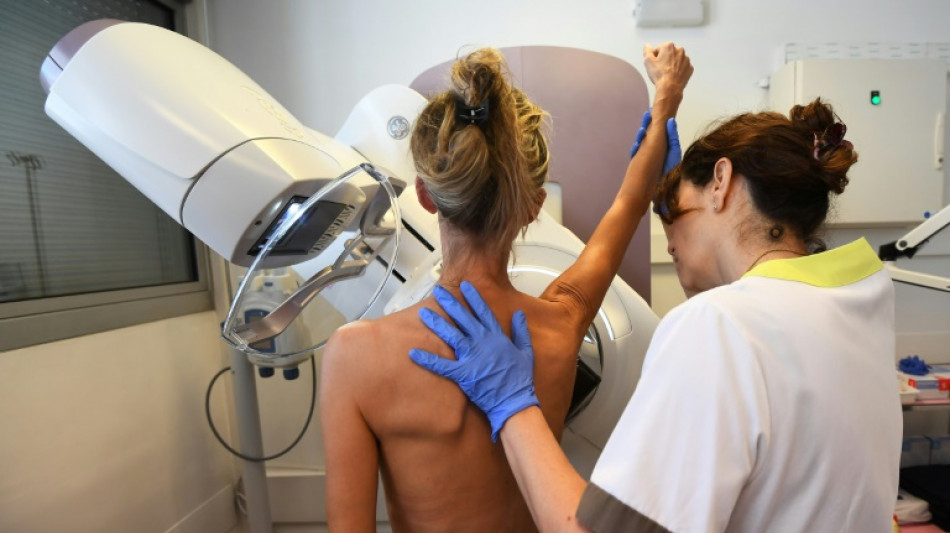
US panel recommends all women receive breast cancer screening from 40 / Photo: ANNE-CHRISTINE POUJOULAT - AFP/File

 South Korea score late to reach Asian Games football final

 Tom Kim defies jet-lag, Kho cards ace as Asian Games golf begins

 Thai teen rocker Nene aims to tour, write music... and return to school

 Ivory Coast clamps down on harmful illegal gold rush

 Nagoya mayor says sorry for Asian Games 'inconveniences'

 G20 trade officials meet under shadow of tariffs, overcapacity

 India's fat dog vote goes viral

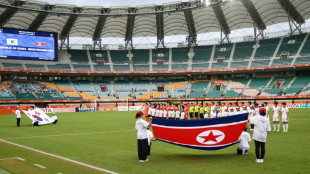 Asian Games crowds in spotlight as 998 see hosts in 50,000 stadium

 The eight stadiums for the 2027 Rugby World Cup

 Thieves swipe drugs under nose of Fiji police, swap with flour

 South Korea demands North apologise for DMZ mine blasts

 In Nepal's flood zone, teachers mourn students who never returned

 US Supreme Court lifts limits on third-country deportations

 Antonelli eager to 're-establish order' as F1 returns to Malaysia

 Paw-fect candidate: Australia finds new koala rescue dog

 One third of world population exposed to harmful air pollution: monitor

 North Korea denies South's claim it was apparently behind DMZ mine blasts

 West Bank's violent settlers part of a new generation fuelled by ideology

 US-led coalition ends mission in Iraq

 Pope-backed White Sox join Braves with MLB playoff wins

 Psychology Software Tools Builds on Early Bioz Success to Expand Access to Publication-Backed Product Evidence

 Alpha Growth Management Opens Rep Office in Japan

 NBA close to picking new $12-13bn Vegas team owners: report

 LA28 Olympics torch relay to visit all 50 states

 Spain brush aside Croatia in Nations League, England down Czechs

Women should get screened for breast cancer every other year starting from the age of 40 to reduce their risk of dying from the disease, an influential US body recommended on Tuesday.
The US Preventive Services Task Force, an independent panel of experts that receives federal funding, previously said that women in their 40s should make an individual decision about when to start mammograms based on their health history and reserved its mandatory recommendation for people turning 50.
Its new guidance was based on a review of evidence and a modeling study published in the Journal of the American Medical Association, and finalizes a draft recommendation proposed last year.
"More women in their 40s have been getting breast cancer, with rates increasing about 2 percent each year, so this recommendation will make a big difference for people across the country," Task Force chair Wanda Nicholson said in a statement.
"By starting to screen all women at age 40, we can save nearly 20 percent more lives from breast cancer overall."
Breast cancer is the second most common cancer and the second most common cause of cancer death for women in the United States, with more than 43,000 deaths last year.
Black women are 40 percent more likely to die of the disease than white women, and so ensuring they start screening at 40 "has even greater potential benefit for Black women," said Nicholson.
The new recommendation applies to nearly all women -- those who are at average risk of breast cancer, as well as those with a family history of breast cancer, and those with dense breasts.
Nearly half of all women have what's known as dense breast tissue, which they generally only find out during their first mammogram. Dense breast tissue increases their risk for breast cancer and means that mammograms may not work as well for them.
"Unfortunately, there is not yet enough evidence for the Task Force to recommend for or against additional screening with breast ultrasound or MRI," the experts said, urgently calling for more research.
The new recommendation doesn't apply however to those with a personal history of the disease, or those at very high rise due to certain genetic markers, or who have a lesion detected on previous biopsies -- they could benefit from more regular screening, in consultation with their doctor.
The new recommendation applies up until the age of 74, after which the balance of benefit-to-risk becomes uncertain, the task force said.
While screening is a powerful tool in the fight against cancer, there are also limits, the task force said, explaining why it is not recommending annual mammograms. Over-testing increases the number of harms, such as false positives, or receiving treatment that wasn't required.
H.Gonzales--AT