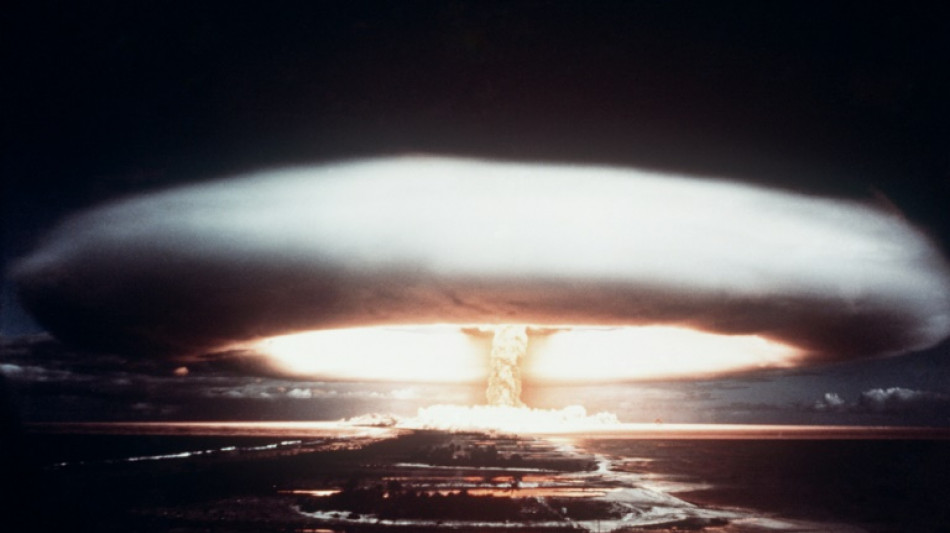
French lawmakers to probe Polynesia nuclear tests / Photo: © AFP/File

 South Korea score late to reach Asian Games football final

 Tom Kim defies jet-lag, Kho cards ace as Asian Games golf begins
 Thai teen rocker Nene aims to tour, write music... and return to school
 Ivory Coast clamps down on harmful illegal gold rush
 Nagoya mayor says sorry for Asian Games 'inconveniences'

 G20 trade officials meet under shadow of tariffs, overcapacity

 India's fat dog vote goes viral
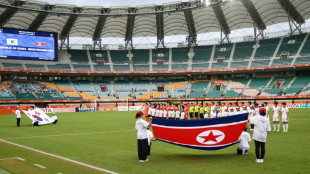 Asian Games crowds in spotlight as 998 see hosts in 50,000 stadium

 The eight stadiums for the 2027 Rugby World Cup

 Thieves swipe drugs under nose of Fiji police, swap with flour

 South Korea demands North apologise for DMZ mine blasts

 In Nepal's flood zone, teachers mourn students who never returned

 US Supreme Court lifts limits on third-country deportations

 Antonelli eager to 're-establish order' as F1 returns to Malaysia

 Paw-fect candidate: Australia finds new koala rescue dog

 One third of world population exposed to harmful air pollution: monitor

 North Korea denies South's claim it was apparently behind DMZ mine blasts

 West Bank's violent settlers part of a new generation fuelled by ideology

 US-led coalition ends mission in Iraq

 Pope-backed White Sox join Braves with MLB playoff wins

 Psychology Software Tools Builds on Early Bioz Success to Expand Access to Publication-Backed Product Evidence
 Alpha Growth Management Opens Rep Office in Japan

 NBA close to picking new $12-13bn Vegas team owners: report

 LA28 Olympics torch relay to visit all 50 states

 Spain brush aside Croatia in Nations League, England down Czechs

French lawmakers are expected to launch a probe into the impact of the country's nuclear weapons tests in French Polynesia over three decades.
France detonated almost 200 bombs from the 1960s to the 1990s in French Polynesia -- a scattered Pacific island territory thousands of kilometres east of Australia -- including 41 atmospheric tests between 1966 and 1974.
"We need to ask ourselves what the French government knew about the impact of the tests before they were carried out, as they occurred and up to today," the largely communist GDR group in the National Assembly said in a written request for an investigation.
The GDR used its right to request one parliamentary investigation per session to demand the probe, which must be formally approved by the defence committee.
The blasts "had numerous consequences: They relate to health, the economy, society and the environment," GDR said in the text written by Mereana Reid Arbelot, a French Polynesian member of parliament.
She called for a "full accounting" of the consequences and added that the group wanted to "shed light" on how testing sites were first chosen during the 1950s.
Reid Arbelot said those decisions inflicted "trauma on the civilian and military populations".
GDR said that Paris' claims about how much radiation people were exposed to at the time of the tests are contested among scientists and should be revised.
Paris first opened a path to compensation in 2010 when it acknowledged health and environmental impacts.
A study published by the French National Institute of Health and Medical Research (INSERM) last year found that the nuclear tests slightly increased the risk of thyroid cancer for local people.
But campaigners at the time said that it should have looked at a larger segment of the population and called for more reparations.
On a 2021 visit, President Emmanuel Macron said the nation owed French Polynesia "a debt" for the nuclear tests, the last as recently as 1996.
He called for archives on the testing to be opened, save only the most sensitive military information.
France's independent nuclear programme was launched in the wake of World War II and pushed by Fifth Republic founder Charles de Gaulle.
One of nine nuclear powers in the world, it maintains a stock of around 300 warheads -- a similar level to China or Britain, but far short of heavyweights Russia and the United States.
French nuclear doctrine calls for the bombs to be used only if the country's "vital interests" are under threat -- a relatively vague term leaving the president wide leeway to decide on their use.
H.Thompson--AT